Hello! In our last lesson, we explored constructivism, the idea that learning is an active process of building knowledge on the foundation of our experiences. We saw how this parallels the UX concept of mental models and is driven by the twin processes of assimilation and accommodation.
Today, we'll zoom in on that foundation: a learner's prior knowledge. This lesson addresses how existing knowledge and experiences shape what someone can learn next. You will see that everything new we encounter is interpreted through the lens of what we already know. For you, as a product designer building a career guidance app, this is a critical principle. Understanding it will allow you to design an experience that feels intuitive and truly helpful, rather than one that is confusing or irrelevant to your users.
The Brain's Filing System: Schema Theory
In the last lesson, we talked about "mental models." In cognitive science, the formal term for these structures of knowledge is schemas. A schema is a mental framework or a "bundle of knowledge" that organizes everything we know about a topic. Think of it as a cognitive shortcut, a template, or a pattern your brain uses to make sense of the world without having to process every single piece of information from scratch.
When you encounter a new situation, your brain doesn't see it with fresh eyes. Instead, it asks, "What do I already know that's like this?" It then activates the relevant schema.
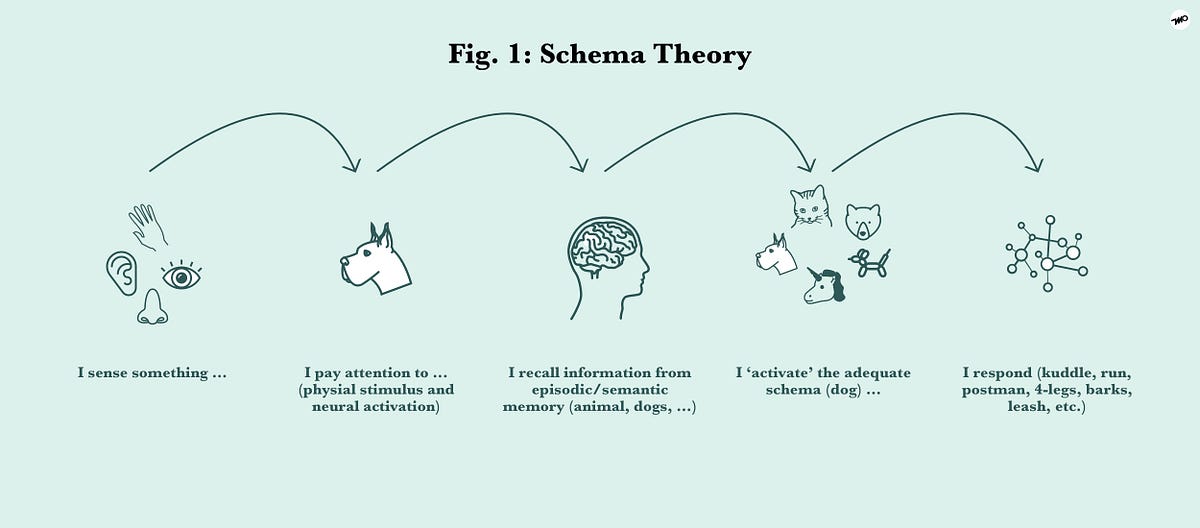
To get a more formal grasp of this concept, let's look at an overview of Schema Theory.
Schema Theory | Psychology | Research Starters
This article from EBSCO Research Starters provides a clear, academic introduction to Schema Theory, its origins, and its key concepts.
First, read the introductory section titled "Schema Theory" for a concise definition. Next, scroll down to the "Full Article" and read the section that begins with the definition from Tompkins and McGee. This part explains how schemas grow and change. Finally, review the definitions in the "Terms and Concepts" section at the end, particularly for Schema, Prior Knowledge, and Misconceptions.
As the article explains, learning happens when our schemas change. This is the same process of assimilation and accommodation we discussed previously.
- Assimilation: You fit new information into an existing schema.
- Accommodation: You must modify an existing schema, or create a new one, because the new information doesn't fit.
How Schemas Drive Learning
Schemas aren't just passive storage containers; they actively shape our learning experience. They dictate what we pay attention to, how quickly we learn, and how we interpret information.
The following video provides an excellent and engaging explanation of the powerful ways schemas influence the learning process.
Schema Theory Explains Why You Struggle to Learn New Things
This video from Dr. Erik Albinson clearly breaks down why learning can feel hard and how schemas are at the heart of it.
Please watch from the beginning to understand why learning feels hard without a schema. Then, pay close attention to the five powerful ways schemas shape learning: controlling attention, controlling learning speed, simplifying the world (reducing cognitive load), allowing fast thinking (pattern recognition), and shaping interpretation.
The distinction the video makes between a beginner and an expert is crucial. An expert doesn't necessarily have a "smarter" brain; they have richer, more complex schemas that allow them to see patterns and structure where a novice sees chaos. This is directly applicable to your work. A 16-year-old user of your app has a very different schema for "career" than a 40-year-old professional. Your design must account for that.
Prior Knowledge: The Double-Edged Sword
So, if learning is connecting new information to existing schemas, what happens when that prior knowledge is helpful, and what happens when it's not?
The Accelerator: When Prior Knowledge Helps
When a learner has relevant and accurate prior knowledge, it acts as an incredible accelerator for learning. This is because they have a well-developed schema with plenty of "hooks" to attach new information to.
A classic study by Bransford and Johnson powerfully illustrates this. A video from Columbia University explains this study and other examples of how prior knowledge enables comprehension.
MOOC EDSCI1x | Video 4: Connecting Prior Knowledge | Memory and Learning
This video demonstrates with clear examples how crucial prior knowledge is for making sense of new information.
First, watch the section that uses the word 'cardinal' and the "sour notes" sentence to show how context activates different schemas (Cardinal & bagpipes). Then, watch the explanation of the classic Bransford and Johnson study, where a seemingly nonsensical paragraph becomes clear once you're given the right schema (the sketch).
As the video shows, without the right schema activated, the information was just noise. It was impossible to comprehend or remember. For your app, this means that simply presenting career data (like salary or job duties) is not enough. You must first provide a context or framework—a schema—that helps the user make sense of that data.
The Blocker: When Prior Knowledge Hinders
The flip side is that prior knowledge can also be a barrier. This happens in two main ways:
- Absence of Knowledge: The learner has no relevant schema, like the participants in the Bransford and Johnson study before they saw the sketch.
- Inaccurate Knowledge (Misconceptions): The learner has an existing schema, but it's wrong or incomplete. This can be even more difficult to overcome because the brain actively resists information that contradicts its existing models.
This second point—the problem of misconceptions—has a direct parallel in your field of design: design fixation. This is the tendency for designers to get stuck on their first few ideas, which are heavily influenced by their prior assumptions and experiences.
A study on product design students explored exactly this phenomenon.
[PDF] Exploring Students' Product Design Concept Generation and ...
This research paper from the American Society for Engineering Education investigates how design students generate ideas. It provides a perfect real-world example of how prior knowledge can limit creativity, which is a form of learning.
First, read the introduction to understand the concept of design fixation. Next, go to the "Results" section and read the subsection "Pre-Learning Block...". Pay close attention to the example of Cathy, who assumed a snow transporter had to be motorized. This is a classic case of a schema limiting the solution space. Finally, read the first two paragraphs of the "Discussion" section, which summarizes how students' assumed requirements and focus on existing solutions were a barrier.
Cathy's assumption that "transportation on snow" requires a motor is her schema at work. It's a reasonable assumption based on her prior knowledge of snowmobiles. However, this schema prevented her from considering other solutions like skis, snowshoes, or sleds. In the same way, a user of your career app might have a schema for "good job" that includes "office, 9-to-5, salaried." This could prevent them from even considering freelance work, entrepreneurship, or skilled trades.
Implications for Your Design
Your role as a designer of a learning product is to be a "schema engineer." You need to:
- Ascertain Prior Knowledge: Through onboarding questions, quizzes, or initial choices, try to understand the user's existing mental model. What do they believe about careers, work, and education?
- Activate Relevant Schemas: Use familiar language, metaphors, and analogies. If you're introducing the concept of "career clusters," you might relate it to something they already understand, like genres of music or categories on Netflix.
- Build and Restructure Schemas: This is the core of learning. Your app should provide experiences that both add to existing schemas (assimilation) and challenge them in productive ways, forcing the user to update their understanding (accommodation).

Conclusion
Today we've gone deeper into the principle that all learning builds on prior knowledge. It's not just a vague idea; it's a fundamental cognitive process governed by schemas.
Here are the key takeaways for your design work:
- Knowledge is organized in schemas: These mental frameworks dictate how we interpret and store information.
- Schemas are active: They control attention, learning speed, and our interpretation of reality.
- Prior knowledge is a double-edged sword: It can be a powerful accelerator when it's accurate and relevant, or a significant barrier when it's missing or incorrect (a misconception).
- Design for the user's schemas: An effective learning product must be designed to assess, activate, and build upon what the user already knows.
This leads us to a crucial question: if a learner is struggling because their prior knowledge is insufficient for a task, how can we help them without just giving them the answer? We need to provide temporary support to bridge the gap. This support structure is called scaffolding, and it will be the topic of our next lesson.