Introduction
In our last lesson, we learned how to listen for the specific words and cues that signal a user is frustrated. Recognizing that a user has moved from a state of simple confusion to one of emotional distress is a critical first step. Now, we'll focus on the essential second step: how to respond.
This lesson is dedicated to the art of using empathetic statements to acknowledge and validate a user's frustration. This skill is more than just being polite; it's a powerful technique for de-escalating tension, building trust, and creating an environment where you and the user can work together to solve the technical problem. We will define what empathy means in a support context, build a vocabulary of effective phrases, and see how they are applied in realistic scenarios.
What is Empathy in Customer Service?
At its core, empathy is the ability to understand and share the feelings of another person. It's about putting yourself in their shoes and seeing the situation from their perspective. In a technical support role, this means recognizing that the user isn't just frustrated with a piece of software; they're frustrated because that software is preventing them from doing their job, connecting with family, or completing an important task.
When a user feels that you genuinely understand their frustration, they are more likely to calm down and trust you to guide them toward a solution. The article "35 Empathy Statements for Customer Service" explains this well.
35 Empathy Statements for Customer Service - AnswerConnect
This article from AnswerConnect provides a clear definition of empathy in customer service and highlights its importance.
Please read the section titled Understanding empathy. Note the statistic that only 35% of consumers feel understood by companies—your ability to show empathy will set you apart.
The Structure of an Effective Empathetic Response
An effective empathetic response isn't just a single phrase like "I understand." It's a structured statement that accomplishes several things at once. It validates the user's emotion, takes ownership of the situation, and pivots toward a solution.
The same article from AnswerConnect provides a simple and powerful four-step template for building these responses.
- Acknowledge the emotion: Start by naming the feeling. "I can imagine how frustrating this must be."
- Express apology or understanding: Show you're on their side. "I'm very sorry you've had to deal with this."
- Show support and offer a solution: Pivot from the problem to the solution. "Let's work together to fix this."
- Reaffirm your commitment: If a solution isn't immediate, reassure them. "We'll make sure this is taken care of."
Putting it all together, you get a comprehensive statement like: "I can imagine how upsetting this must be for you. I’m sorry you’ve had to deal with this issue. Let’s work together to find a solution." This structure turns a simple apology into a powerful tool for building trust.
Building Your Toolkit of Empathetic Phrases
Knowing the structure is great, but you also need a toolkit of specific, ready-to-use phrases. As you gain experience, these will become second nature, but it's helpful to start with a list.
The image below from HubSpot offers a great starting point with several common and effective empathy phrases.
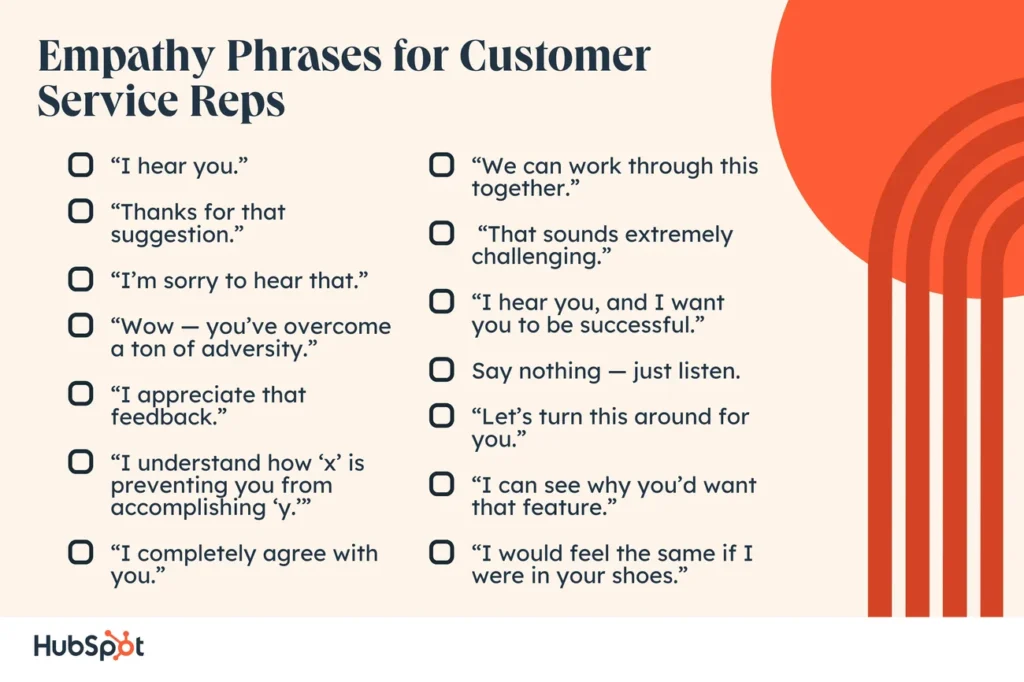
To expand this toolkit, we can look at some more detailed examples. The following video from Single Step English breaks down a few key phrases and shows how to use them.
Mastering Empathy in Customer Service: Top 5 Phrases and Examples
This short video provides clear examples for four foundational empathy statements.
Watch the segments for each of the first four phrases. Notice how each one is paired with a specific customer scenario. Phrase 1: "I understand how you feel." Phrase 2: "I'm sorry to hear that." Phrase 3: "That sounds frustrating." Phrase 4: "I can imagine how frustrating that must be."
These phrases, often called "acknowledgement statements," are designed to show the user you have heard them and are taking their problem seriously.
Putting Empathy into Practice: Mock Calls
Now let's see how these phrases are used in more complex, realistic conversations. The key is to match your level of empathy to the customer's situation and emotional state.
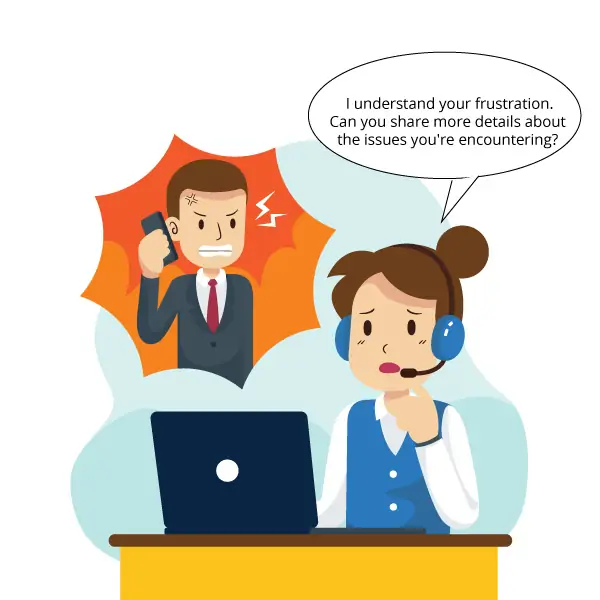
The following video from Kwestyon demonstrates how a skilled agent handles different scenarios. We'll focus on two common and important situations.
How to Empathize in Call Center Customer Service | Scripts, Mock Calls
This video uses mock calls to demonstrate how to apply empathy in different contexts, from a simple acknowledgement to handling a company error.
Please watch the following two scenarios: No resolution is possible. In this call, the agent must enforce a policy the customer doesn't like. Notice how she uses phrases like "I see your point" to validate the customer's feelings even though she cannot change the outcome. She acknowledges the emotion without validating an unreasonable demand. The company is at fault. Here, the company made a significant error. Listen to how the agent repeatedly apologizes, admits the mistake ("we failed on that"), and validates the customer's extreme frustration ("I truly understand how frustrating this is for you") before guiding the conversation toward the resolution.
These examples show that empathy isn't about always agreeing with the customer or giving them whatever they want. It's about acknowledging their feelings as valid and real, which is a crucial step before you can solve the problem or deliver bad news.
The Importance of Sincerity
Finally, remember that the how is just as important as the what. The most perfectly crafted empathy statement will fail if it doesn't sound sincere. Your tone of voice (or word choice in a chat) must convey genuine concern. Avoid sounding robotic or like you're reading from a script. Personalize your statements by using the customer's name and referencing specific details they've shared. Authenticity is what builds the bridge from frustration to trust.
Conclusion
In this lesson, we built upon our ability to spot frustration by learning how to respond to it effectively. You've learned that empathy is about understanding and validating a user's feelings to build trust. We broke down the four-step structure of an effective empathetic response: acknowledge, apologize/understand, support, and reaffirm. We also built a toolkit of phrases and saw them used in realistic mock calls, covering situations where the company is at fault and where you have to deliver bad news.
You now have the tools to both identify and acknowledge user frustration. In our next lesson, we will combine these skills and learn how to apply a structured communication technique to de-escalate a conversation and guide it toward a solution. This will give you a complete framework for turning difficult interactions into positive, productive outcomes.