Introduction
In our last lesson, we focused on the essentials of professional communication, covering how to structure your emails and chats to be clear, helpful, and efficient. We touched upon the importance of "addressing the underlying emotion," and today, we're going to dive deep into that single concept. Before you can address an emotion, you must first learn to recognize it accurately.
This lesson is dedicated to helping you identify the verbal cues and keywords that indicate a user is frustrated. Recognizing frustration early is a critical skill for any support analyst. It allows you to shift your approach, manage the conversation proactively, and prevent a minor issue from escalating into a major complaint. We will explore the common triggers of frustration and build a vocabulary of phrases to listen for in your interactions.
What Causes Frustration?
Frustration in a technical support context rarely appears out of nowhere. It's usually a reaction to a specific set of circumstances where the user's experience doesn't match their expectations. Understanding these common triggers can help you anticipate when a user might be feeling frustrated.
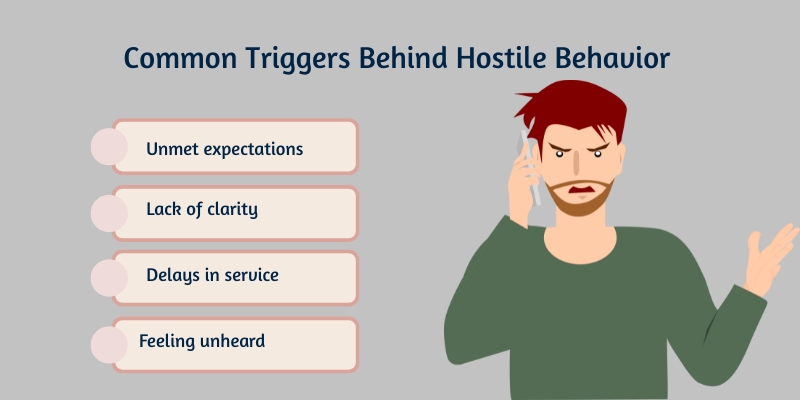
As the image shows, these triggers are often linked:
- Unmet expectations: The user thought the software would be easy to install, but it's not.
- Lack of clarity: The instructions they are following are confusing or incomplete.
- Delays in service: They have been trying to solve the problem for hours or have been waiting a long time for a response.
- Feeling unheard: They may have contacted support before, but feel their problem wasn't taken seriously.
When a user's experience involves one or more of these triggers, their patience wears thin, and their ability to think logically can diminish.
The Psychology of an Upset User
It's important to understand that a frustrated user isn't just being difficult; they are often operating from a place of high emotion. This emotional state can literally change how they process information. The following video explains this phenomenon by describing how anger activates the emotional part of the brain.
Watch this before you talk to your next angry customer (3 Keys to De-escalating)
This clip from communications trainer Myra Golden provides a clear, simple explanation of the mindset of an angry or frustrated person.
Please watch the section from "Anger blocks rational thinking" up to "an escalated situation". The key takeaway is that a person driven by strong emotion is not capable of being fully logical in that moment.
Understanding this "right brain" emotional response is crucial. It means that when you're dealing with a frustrated user, bombarding them with complex technical logic might not work. First, you need to spot the emotion, and then, as we'll learn in the next lesson, you need to acknowledge it.
Learning to Spot the Cues
Now, let's get into the practical skill of spotting frustration. This starts with listening for specific words and paying attention to shifts in tone and language.
The Early Warning Sign: "But"
Sometimes, a single word can signal a user's disappointment. One of the most powerful and common indicators is the word "but." It often acts as a pivot point in a sentence, shifting from a positive or neutral statement to a negative one.
Dealing with Difficult Customers: Recognising Customer Disappointment
This short video from Canity highlights the importance of the word "but" as an indicator of customer disappointment.
Watch the segment from the beginning of the main content. Notice how the word "but" completely changes the meaning of the user's statement.
When you hear a user say something like, "I successfully installed the program, but now I can't find it," the word "but" is your cue that their initial success has turned into frustration.
A Vocabulary of Frustration
Beyond single keywords, users express frustration through a wide range of phrases. These can be subtle hints of disappointment or direct statements of anger. The following article from Call Centre Helper provides an excellent categorized list of phrases to listen for.
The Top Words and Phrases Customers Use to Express their ...
This article breaks down phrases of dissatisfaction into different levels of intensity. Studying these will help you gauge how frustrated a user is.
Please read the following five sections under the heading "Customer Statements Expressing Dissatisfaction." Pay attention to the example phrases in each category. Straight Talking: These are direct and clear expressions of frustration. Soft Language: These are more subtle and often show disappointment or disbelief. Stronger Condemnation: These phrases signal a high level of anger and a loss of trust. Expressions of Exasperation: These remarks indicate a user's patience has run out. Repeat Callers: When a user mentions previous calls, it’s a clear sign of unresolved issues and growing frustration.
As you can see, frustration isn't a single emotion; it's a spectrum. Recognizing whether a user is using "soft language" versus "stronger condemnation" will help you tailor your response appropriately.
Putting It All Together
Let's look at how these cues appear in a real interaction. Even a simple technical problem can be communicated with underlying frustration.

While a technical support analyst on the phone or chat can't see body language, the user's tone of voice, or their written words, will carry the same message.
Consider these two ways a user might report the same problem:
- User A: "Hi, I'm having trouble logging into my account. Could you please help me?"
- User B: "I can't log in to my account. I've tried my password a dozen times and it's not working. This is ridiculous."
User A is asking for help. User B is also asking for help, but their message is packed with frustration cues:
- "I can't...": A direct, "straight talking" statement of failure.
- "...a dozen times...": An "expression of exasperation" showing repeated failed attempts.
- "...it's not working.": Another direct statement of frustration.
- "This is ridiculous.": A phrase of "stronger condemnation," showing their patience is gone.
Your job as an analyst is to hear the difference between User A and User B and recognize that User B needs more than just a password reset link; they first need their frustration to be acknowledged.
Conclusion
In this lesson, we have moved from the general principles of communication to the specific skill of emotional recognition. You've learned about the common triggers that lead to user frustration and the psychological state that a frustrated user is in. Most importantly, you now have a toolkit for identifying the verbal cues and keywords—from the simple word "but" to expressions of exasperation and condemnation—that signal a user is upset.
Being able to accurately identify these signs is the first, crucial step in handling difficult conversations. Now that you know what to look for, our next lesson will focus on what to do next. We will learn how to use empathetic statements to acknowledge and validate a user's frustration, turning a potentially negative interaction into a positive one.