Introduction
Over the past few lessons, we've built a strong foundation in communication. You've learned how to listen actively, spot the subtle cues of user frustration, and respond with empathy to validate a person's feelings. These are the essential ingredients for effective support. Now, it's time to put them all together into a recipe.
This lesson will teach you how to apply a structured communication technique to de-escalate a tense situation and guide a conversation back toward a productive, problem-solving path. We'll explore why a structured approach is so important when emotions are high, and we'll learn a specific, repeatable framework that you can use when faced with an angry or upset user. By the end of this lesson, you will have a complete toolkit for turning difficult interactions into positive outcomes.
The Psychology of De-Escalation
Before we learn a technique, it’s crucial to understand why de-escalation is necessary in the first place. When a person is frustrated or angry, their ability to think logically and cooperate is diminished. You can't effectively troubleshoot a technical issue with someone who isn't in a state of mind to solve problems. Your first job is not to fix the computer, but to help calm the user.
Dr. Jeremy Pollack, a specialist in conflict resolution, explains the simple psychology behind this.
De-escalation Skills Training for Employees | Dr. Jeremy Pollack
This video provides a concise explanation of why people become emotionally escalated and what they need to calm down.
Please watch the following segments: The "Why": Pay close attention to the explanation of how an emotionally escalated person is operating from a different part of the brain. Sources of Escalation: Note the three main sources, and especially the one most common in customer service: the feeling that the representative doesn't care. This directly connects to our last lesson on empathy. Recap: This provides a clear summary of the core principles.
As Dr. Pollack explains, the key to de-escalation is making the customer feel heard, respected, and cared for. A structured technique provides you with a reliable path to do just that, every single time.
A Structured Framework: The HEARD Method
When you're in a high-pressure situation, it can be hard to think clearly. That's why having a simple, memorable framework is so valuable. One of the most effective and widely used models in customer service is the HEARD method. It breaks down the de-escalation process into five logical steps.
We'll use the article "De-Escalating Angry Customers" from GigaBPO to explore this framework.
De-Escalating Angry Customers: Proven Techniques, Scripts, and Real Scenarios - GigaBPO
This article provides a comprehensive guide to de-escalation, and we'll focus on its explanation of the HEARD method.
First, read the section "Step-by-Step De-Escalation Techniques" to get a high-level overview of the process. Then, focus on the section titled "The HEARD Method". This will be our core framework. As you read, think about how each step connects to the skills we've already learned.
Let's break down the HEARD method:
- H - Hear: This is more than just staying silent; it's about active listening. Let the customer tell their story without interruption. As you listen, your goal is to understand the entire problem, including both the technical issue and their emotional frustration.
- E - Empathize: This is where you use the skills from our last lesson. Acknowledge their feelings with sincere statements like, "I can see why you're so frustrated," or "That sounds like a very difficult situation." You are validating their emotion, showing them that you care.
- A - Apologize: A sincere apology can be incredibly powerful. It's not necessarily about admitting personal fault, but about taking responsibility for the situation on behalf of the company. A simple, "I'm so sorry you've had to go through this," shows ownership and aligns you with the customer.
- R - Resolve: Once the customer feels heard and understood, they will be much more receptive to problem-solving. This is the pivot point where you transition from addressing the emotion to addressing the technical issue. You might say, "I'm committed to getting this fixed for you. Let's start by..."
- D - Diagnose: In many models, the process stops at "Resolve." The "Diagnose" step is what sets great support apart. After the immediate issue is fixed, you take a moment to think: Why did this happen? Was it a product flaw, a communication issue, a gap in our knowledge base? Diagnosing the root cause helps you and your team prevent the same problem from happening to someone else.
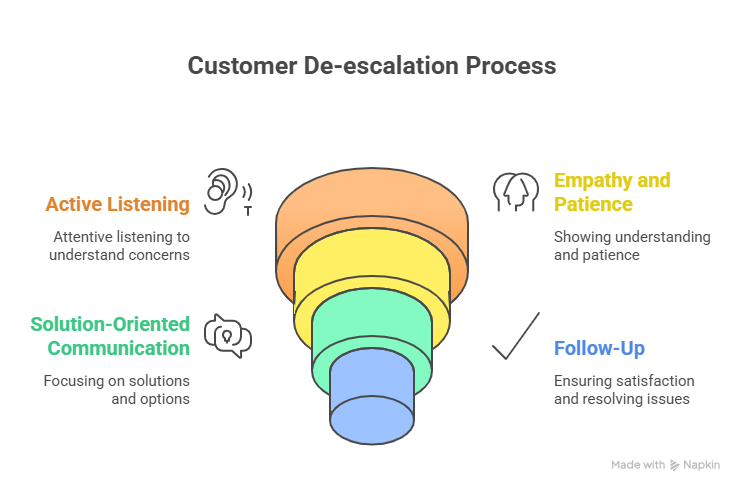
The four-step process shown in the "Customer De-escalation Process" image provides a great high-level summary of this flow.
De-Escalation in Action: The USA Method
The principles of Hear, Empathize, and Resolve are universal. Different companies sometimes use different acronyms to teach the same core idea. Let's look at another real-world example to see how these principles are applied, even with different labels.
In the following video, customer service expert Myra Golden shares the story of how she discovered a beautifully simple and effective three-step method her colleague was using, which she named the USA method.
How to De-escalate Calls with Angry or Agitated Customers
This video tells the story of a highly effective de-escalation technique used in a real call center. Listen to how the three steps align perfectly with the HEARD framework we just learned.
Please watch the key segments of the video that break down the method: The USA Method: The speaker introduces the three steps: Understanding, Situation, and Action. Step 1: Understanding: Notice how this is a combination of Hearing and Empathizing. Step 2: Situation: This is about positioning yourself as the person who can help, which builds the bridge to the Resolve step. Step 3: Action: This is the Resolve step, where you lay out the plan to fix the problem.
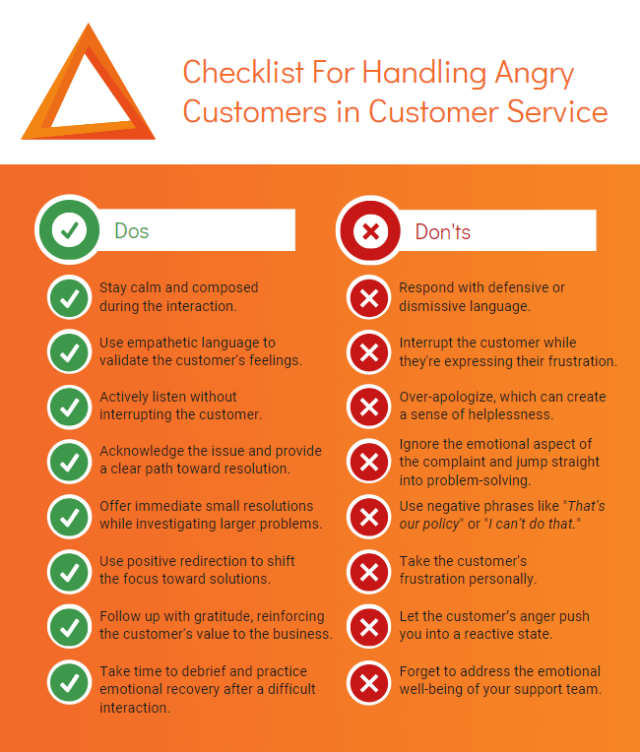
As you can see, whether it's called HEARD or USA, the core strategy is the same: Listen and validate emotions first, then pivot to taking action and solving the problem. The "Checklist For Handling Angry Customers" image provides a fantastic summary of the dos and don'ts that apply to any of these frameworks.
When De-Escalation Isn't Enough
Finally, it is essential to know your limits. Your role is to de-escalate frustration related to a technical problem, not to endure abuse. If a customer uses threatening or abusive language, or if they are demanding something far outside your authority, your responsibility is to escalate the situation to a supervisor or, in rare cases, end the interaction.
De-Escalating Angry Customers: Proven Techniques, Scripts, and Real Scenarios - GigaBPO
We will revisit the same article to learn about setting professional boundaries.
Please read the section titled "When De-Escalation Fails". This will give you clear signs to watch for and scripts for how to handle these difficult situations professionally.
Knowing you have a clear boundary and a procedure for handling these extreme cases should give you more confidence in managing everyday frustrations.
Conclusion
In this lesson, you've learned to combine the skills of active listening and empathy into a structured, repeatable process for de-escalation. We explored the psychology of why customers get upset and saw that making them feel cared for is the key to calming them down. We focused on the HEARD method (Hear, Empathize, Apologize, Resolve, Diagnose) as our primary framework for turning a negative interaction into a positive one.
This lesson completes the foundational module on customer communication. You now have the "soft skills" to handle everything from a simple query to a frustrated user.
In our next lesson, we will move into Module 2: Inside the Machine: Computer Hardware Essentials. You'll begin learning the technical knowledge that you will combine with these communication skills to become an effective technical support analyst.