Introduction
In our last lesson, we explored what a technical support analyst does, focusing on the blend of technical duties and people-centric skills required for the role. Today, we'll dive into one of the most fundamental of those people skills: active listening. Your success as a support analyst often begins not with what you know, but with how well you listen. A user's description of a problem is your starting point, and understanding it accurately is the key to solving it efficiently.
This lesson will equip you with practical active listening techniques. We'll define what active listening is in an IT context, explore specific methods you can apply in conversations, and learn how to understand not just the words a user says, but the meaning and emotion behind them.
Hearing vs. Listening: Why It's a Technical Skill
When a user reports that "the internet is down," they could mean anything from a disconnected Wi-Fi adapter on their laptop to a major network outage affecting their entire office. Your first job is to act as a detective, and your main source of clues is the user. Jumping to conclusions or interrupting with a solution before you have the full picture often leads to wasted time and increased frustration for everyone.
This is the difference between simply hearing words and actively listening for meaning. In IT, this isn't just about being polite; it's a critical part of the diagnostic process.
IT Listening Skills For Better IT Communication
This article from ITU Online frames listening as a core competency for IT professionals, distinguishing it from a simple "soft skill."
Please read the introduction to understand the difference between hearing, passive listening, and active listening. Focus on this key definition. Then, read the section "Why Listening Matters in IT Communication" to see how this applies directly to your future role. Pay attention to how good listening helps with these specific IT tasks.
As the article points out, strong listening skills allow a support analyst to accurately capture the real symptoms of a problem, not just a user's first guess. This prevents you from fixing the wrong issue and builds trust with the person you're helping.
The Five Core Techniques of Active Listening
Now that we understand why active listening is so important, let's focus on how to do it. We'll break it down into five core techniques that you can practice and apply in any conversation, whether it's over the phone, via chat, or in person.
The following resource provides a fantastic comparison of a conversation with and without active listening, followed by a clear breakdown of five key techniques.
Active Listening in Customer Service: Tips + Example - Quo
This article from Quo.com gives practical, customer-service-oriented advice that is directly applicable to a technical support role.
First, look at the table comparing an active vs. passive listening approach in a customer interaction. Notice how the active approach leads to a better outcome by addressing the customer's unspoken need (urgency). Next, read the section "5 core active listening techniques for customer service teams," which details these five methods. As you read, think about how each one could help you get better information from a user describing a technical issue.
Let's briefly summarize those five key techniques:
- Ask clarifying and open-ended questions: Instead of "Did you restart it?" (a yes/no question), try "What happened right after you restarted it?" This encourages the user to provide more detail.
- Paraphrase and mirror: Re-stating the user's problem in your own words ("So, if I understand correctly, you can receive emails but you can't send them?") is the single best way to confirm your understanding.
- Use verbal and non-verbal cues: On the phone, small acknowledgements like "I see," "Okay," or "Uh-huh" show you're still engaged.
- Avoid interrupting: Let the user finish their thought. The most important clue might come at the very end of their sentence.
- Respond with empathy: Acknowledging the user's frustration ("I can see why that would be frustrating") shows you're on their side. We will dedicate an entire future lesson to this powerful technique.
The two infographics below provide a great visual summary of these core skills. Notice the overlap in techniques like paraphrasing, asking questions, and summarizing.
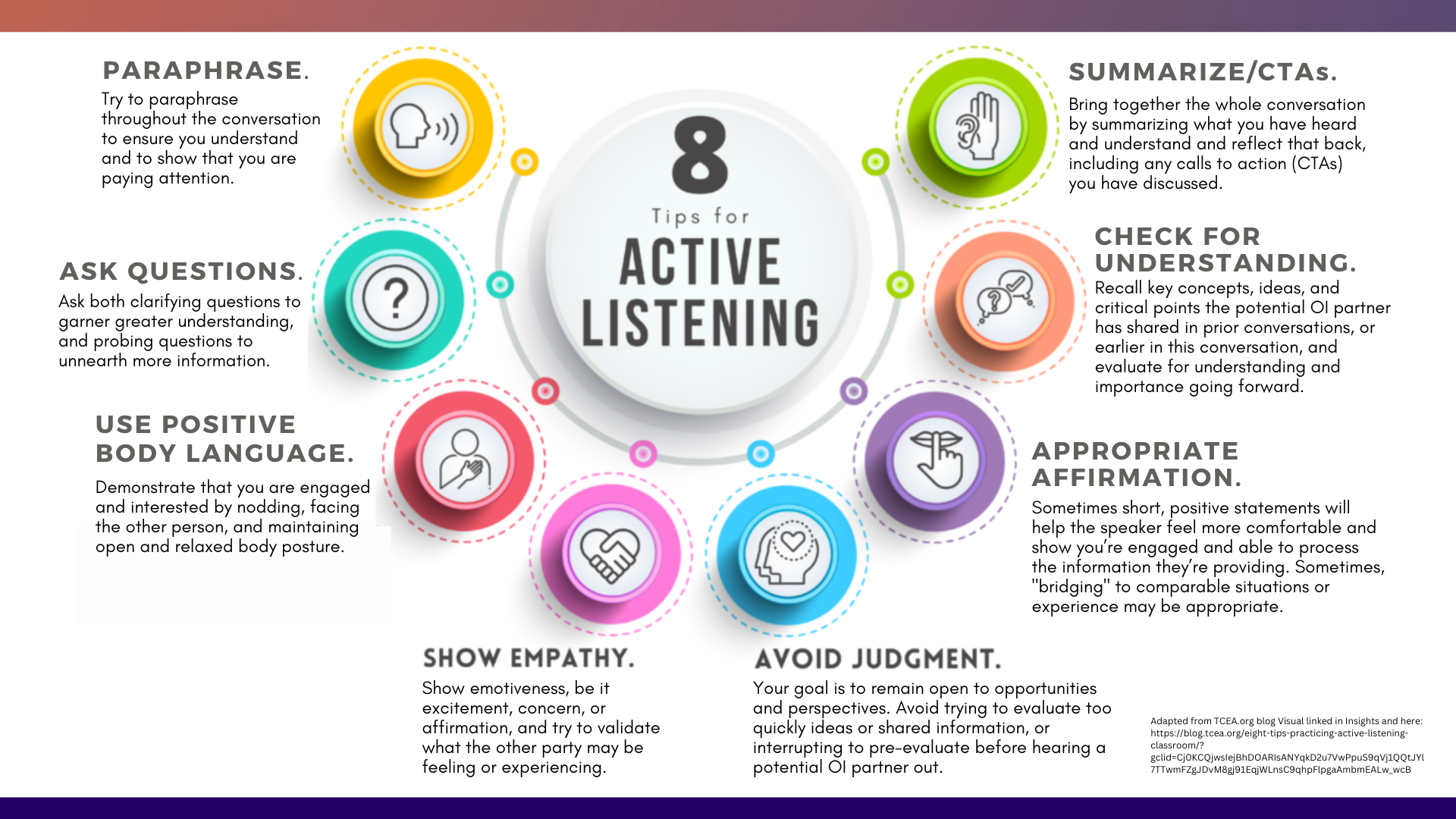

Listening Beyond Words: Understanding Paralanguage
A significant portion of your work as a support analyst will happen over the phone, where you can't see the user's body language. This is where "paralanguage" becomes incredibly important. Paralanguage refers to the non-verbal elements of speech—tone of voice, pace, pitch, and volume—that reveal the emotion behind the words. A user might say "That's fine," but how they say it tells you if they are genuinely satisfied or sarcastically frustrated.
This video provides excellent examples of how to listen for these crucial cues.
How to Improve Active Listening for Call Center Agents
The Kwestyon channel breaks down active listening specifically for call center agents, focusing on the audible cues you'll rely on during phone support.
Watch these key segments: First, learn the definition of paralanguage and why it's so important in phone conversations. Next, see an example of how a simple sigh can signal that a customer is becoming impatient, which is your cue to be more direct and efficient. Finally, learn about non-lexical sounds—the "uh-huhs" and "I sees" that show you are listening without interrupting the user's flow.
By paying attention to paralanguage, you can gauge a user's emotional state. Are they confused, angry, or just in a hurry? Recognizing these cues helps you adapt your communication style and address their underlying feelings, not just their technical problem.
The 3 R's: A Simple Framework for Active Listening
We've covered a lot of techniques, so let's simplify them into a memorable, three-step framework: Repeat, Reflect, Respond.
- Repeat (or Paraphrase): State the key facts of the problem back to the user to show you were listening and to confirm your understanding is correct.
- “So, just to be clear, the error message 'Access Denied' appears only when you try to open files in the 'Shared' folder, but not from your own 'Documents' folder. Is that right?”
- Reflect: Acknowledge the emotional content or the implied meaning of what the user said. This shows you understand the impact of the problem.
- “I can see how that would be stressful, especially with your project deadline coming up.”
- Respond: After confirming the facts and acknowledging the feeling, you can then propose your next action.
- “Okay, thank you for clarifying. The first thing I'd like to check is the permission settings on that 'Shared' folder. Would you be able to...”
Using this simple "Repeat, Reflect, Respond" loop will guide you through conversations, ensuring you capture information accurately and build rapport with the user.
Conclusion
In this lesson, you've learned that active listening is one of the most powerful tools in a support analyst's toolkit. It’s a technical skill that allows you to accurately diagnose problems by understanding not just what a user says, but also what they mean and how they feel. We've broken this skill down into practical techniques like paraphrasing, asking open-ended questions, and paying attention to paralanguage. By practicing the "Repeat, Reflect, Respond" framework, you can make your conversations more efficient and build trust with the users you support.
In our next lesson, we will build directly on this foundation. Once you have actively listened to and understood a user's problem, you need to communicate back to them clearly and professionally. We will focus on how to write effective responses to support requests, a skill you will use every single day.