Introduction
In our last lesson, we established that electron-electron repulsion in multi-electron atoms is not a simple phenomenon. We introduced the concept of shielding to model this, defining an effective nuclear charge () as the net pull an electron actually feels. We concluded that core electrons are excellent at shielding valence electrons.
This left us with a crucial, unanswered question. Consider a lithium atom with its electron configuration 1s²2s¹. If we excite the outermost electron into the 2p orbital, its new configuration becomes 1s²2p¹. In a hydrogen atom, the 2s and 2p orbitals are degenerate—they have the exact same energy. Does this hold true for lithium? Is the energy of the 1s²2s¹ state the same as the 1s²2p¹ state?
Experimentally, the answer is a firm no. The 2s orbital is lower in energy than the 2p orbital. The shield provided by the 1s² core is not experienced equally by the 2s and 2p electrons.
Today's lesson will explain this energy splitting. We will introduce the concept of orbital penetration, exploring how the shape of an orbital dictates how effectively it can "pierce" the core electron shield. Your goal is to explain, from first principles, why an s-orbital in a given shell is always lower in energy than a p-orbital in that same shell. This is the final piece of the puzzle we need before we can construct the electronic structure of any atom.
1. The Intuitive Picture: Piercing the Shield
The terms "core electrons" and "valence electrons" can conjure a misleading image of neat, separate layers, like an onion. In reality, orbitals are probability clouds, and they overlap. A "valence" electron has a non-zero probability of being found very close to the nucleus, inside the region primarily occupied by "core" electrons.
This ability to get close to the nucleus is called penetration.
When an electron penetrates the core shield, it is momentarily exposed to a much larger fraction of the nucleus's true charge. It is less shielded, experiences a higher , and is therefore more strongly attracted and more stable (lower in energy). The degree of penetration, then, directly affects the energy of an orbital.
Let's watch a video that builds this intuition by considering where lithium's third electron will go.
I learnt chemistry using physics! (It blew my mind)
The video 'I learnt chemistry using physics!' by FloatHeadPhysics provides an excellent and intuitive explanation for why 2s is lower in energy than 2p. It moves away from static models and thinks about the probabilistic nature of the electron.
Watch the segment from 15:56 to 19:43. Focus on the core argument: Why is the simple model of perfect shielding by the 1s² core inaccurate? How do the shapes of the 2s and 2p orbitals lead to different probabilities of being found 'inside the shield'? How does this difference in probability translate to a difference in the average nuclear pull (or Zeff) and, consequently, a difference in energy?
As the video compellingly argues, the difference in energy between 2s and 2p is a direct consequence of their different shapes.
- The 2p orbital has a node at the nucleus, meaning the probability of finding a 2p electron at the very center is zero. It is primarily located outside the 1s core.
- The 2s orbital, despite its main probability being further out, has a small inner lobe of probability density very close to the nucleus.
This small but significant inner lobe means a 2s electron spends more time "penetrating" the 1s shield than a 2p electron does. This greater penetration leads to a higher average and a lower, more stable energy state.
2. Visualizing Penetration with Radial Probability
We can make this concept more precise by using the radial probability distribution functions we saw in a previous module. These plots show the probability of finding an electron at a certain distance r from the nucleus.
Let's look at the plots for the 1s, 2s, and 2p orbitals.
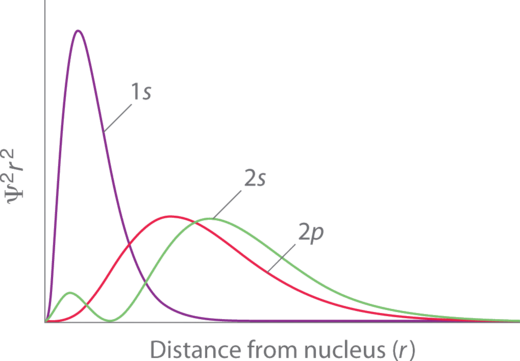
The graph confirms our intuition. That small, green hump for the 2s orbital close to the nucleus is the "penetrating" inner lobe. The 2p orbital has no such feature. Even though the most probable distance for a 2s electron is slightly greater than for a 2p electron, the ability of the 2s electron to get closer to the nucleus is the decisive factor for its energy.
This leads to a general rule:
For a given principal quantum number , the penetrating power of orbitals is:
And because greater penetration leads to less shielding, higher , and lower energy, the energy ordering within a shell is:
To see this applied to higher orbitals, let's watch a segment from an MIT lecture.
In this clip from 'Multielectron Atoms', Professor Sylvia Ceyer uses radial probability distribution graphs to formalize the link between penetration, shielding, and orbital energy.
Watch the segment from 15:11 to 18:13. Pay attention to how she uses the graphs to explain the energy ordering for both the n=2 and n=3 shells. Note how the argument for 2s vs 2p is extended to compare 3s, 3p, and 3d.
3. A Deeper Look: Attraction vs. Repulsion
We now have the standard "textbook" explanation: 2s is lower in energy than 2p because it penetrates more, experiences a greater , and is thus more attracted to the nucleus.
This explanation is correct, but it's not the complete picture. As a thinker interested in first principles, you might spot a subtle issue. If the 2s electron spends more time in the same region as the 1s core electrons, wouldn't it also experience greater electron-electron repulsion? The standard argument emphasizes increased attraction but is silent on this corresponding increase in repulsion.
A more profound physical explanation reframes the narrative. It turns out that the dominant effect is not the increased attraction but the change in repulsion.
Why is the 2s orbital more stable than 2p in poly-electronic atoms?
The paper 'Some thoughts on shielding, penetration and effective nuclear charge' by Prof. John McGrady offers a critical and more physically accurate perspective on this topic. It challenges the oversimplified textbook explanation.
Please read the section titled 'What really lies behind the relative stability of the 2s and 2p orbitals in the first row?'. You can find this starting on page 6 of the PDF. Read down to the end of that section on page 10. Don't worry about the Hartree-Fock appendix for now. Focus on the core argument: Why is focusing only on the small inner lobe of the 2s orbital misleading? What is the role of the outer radial maximum of the 2s orbital? How does the author shift the explanation from 'maximizing attraction' to 'minimizing repulsion'?
The McGrady paper delivers a beautiful insight. The stability of the 2s orbital is a masterful compromise.
- The presence of a radial node in the 2s orbital has two consequences, not one. Yes, it creates the small, penetrating inner lobe. But it also pushes the outer, larger lobe further away from the nucleus than the single lobe of the 2p orbital.
- The majority of the 2s electron's probability density is in this outer lobe. By being further away from the 1s² core, it experiences less electron-electron repulsion.
- The paper argues that this reduction in repulsion is the decisive factor.
So, the refined explanation is this: The 2s orbital is more stable than the 2p orbital not primarily because its inner lobe gains more attraction, but because its outer lobe avoids repulsion more effectively. Zeff, in this view, is really just a proxy for electron-electron repulsion: a higher Zeff signifies less repulsion.
Guided Discovery Problem
Let's consolidate these ideas. Answer the following questions to test your understanding.
Problem:
- Standard Explanation: Using the radial distribution plot from the lesson, explain to a fellow student why a 2s orbital is lower in energy than a 2p orbital. Frame your answer using the standard textbook concepts of penetration and effective nuclear charge.
- The Deeper Why: Now, critique your own explanation from question 1. What physical interaction does the standard explanation conveniently ignore? Based on the McGrady reading, provide the more complete physical reason for the 2s orbital's stability, emphasizing the role of both lobes and electron-electron repulsion.
- Extrapolation: In the FloatHeadPhysics video, it was mentioned that the 3d orbital is so high in energy that it's actually above the 4s orbital. A 3d orbital has zero radial nodes. How does this fact, combined with the concepts of penetration and repulsion, explain why the 3d orbital is so much less stable (higher in energy) than the 3s and 3p orbitals?
- Insight from the Problem: Your answers should demonstrate a shift in thinking. The first answer represents a good, functional understanding. The second represents a deeper, more physically sound understanding that appreciates the balance of forces. The third question forces you to generalize this principle: orbitals with fewer radial nodes (like 2p, 3d, 4f) confine their electrons to a narrower shell, leading to greater electron-electron repulsion and thus lower stability compared to their s-orbital counterparts in the same or even higher shells.
Conclusion
In this lesson, we have resolved the degeneracy of orbitals within a shell for multi-electron atoms.
Key Takeaways:
- In a multi-electron atom, subshells within a given shell () are not degenerate in energy.
- This energy splitting is caused by orbital penetration: the ability of an electron in an outer orbital to be found close to the nucleus, inside the shield of core electrons.
- The penetrating power within a shell follows the trend .
- Greater penetration leads to a higher effective nuclear charge () and thus a lower (more stable) energy. The resulting energy order is .
- The deeper physical reason for this stability is that orbitals with more radial nodes (like s-orbitals) achieve a better compromise, minimizing electron-electron repulsion by having their main probability density further from the core.
We now have the three fundamental architectural principles for building atoms:
- Pauli Exclusion Principle: Governs how many electrons can occupy any given state.
- Shielding: Establishes the general energy difference between shells.
- Penetration: Establishes the energy ordering of subshells within a shell.
With these tools in hand, we are finally ready to derive the rules for predicting the ground-state electron configuration of any element. In our next lesson, we will synthesize these concepts to justify the Aufbau Principle and understand the famous 1s, 2s, 2p, 3s, 3p, 4s, 3d... filling order.