Introduction
In our last lesson, we derived the Pauli Exclusion Principle from the fundamental indistinguishability of electrons. We established that this principle acts as the master architect of the atom, forbidding electrons from collapsing into a single state and forcing them to occupy a hierarchy of distinct orbitals. This gives the atom its structure.
However, the Pauli principle only tells us the rules of occupancy—that no two electrons can share the same four quantum numbers. It doesn't explain the specific energetic ordering of the orbitals in a multi-electron atom. Why, for instance, are the 2s and 2p orbitals, which are degenerate (equal in energy) in a hydrogen atom, split into different energy levels in a lithium atom? The simple hydrogenic model, with its potential energy depending only on the distance from a single proton, is no longer sufficient.
Today, we will address this by introducing the crucial concept of electron shielding. We'll explore how electron-electron repulsion modifies the clean picture we had for hydrogen. Your goal for this lesson is to explain how this shielding effect leads to the idea of an effective nuclear charge (Zeff), which is the actual charge an electron "feels" from the nucleus and is always less than the full nuclear charge. This concept is the first step toward understanding the true energy landscape inside an atom.
1. Beyond Hydrogen: The Problem of Repulsion
The beauty of the hydrogen atom (and any one-electron ion like He⁺ or Li²⁺) is its simplicity. There is a single electron interacting with a single nucleus. The potential energy is a pure Coulombic attraction:
The Schrödinger equation with this potential can be solved exactly, yielding the orbital energies that depend only on the principal quantum number, .
Now, consider Helium (He), with two protons () and two electrons. The total potential energy of the system is no longer simple. For a given electron (say, electron 1), it is attracted to the nucleus but also repelled by the other electron (electron 2). This adds an electron-electron repulsion term to the Hamiltonian, making the Schrödinger equation for Helium analytically unsolvable.
This isn't just a mathematical inconvenience; it is the central problem of multi-electron atoms. To move forward, we must approximate. Instead of trying to track every complex interaction perfectly, we can ask: what is the net effect of the other electrons on a single electron of interest? This is the conceptual origin of shielding.
To begin, let's watch a short video that introduces this idea by contrasting the simple case of hydrogen with the more complex case of helium.
Effective Nuclear Charge and the Shielding Effect
The video 'Effective Nuclear Charge and the Shielding Effect' by Andrey K provides a clear, foundational explanation. It starts with the basics of Coulomb's law and then shows why the presence of a second electron in Helium complicates the picture, introducing the idea of shielding.
Watch from the beginning to 04:56. Focus on these key points: The basic electrostatic forces holding an atom together. How the presence of an 'inner' electron in Helium 'shields' an 'outer' electron from the full pull of the nucleus. The definition of effective nuclear charge (Zeff) as the net charge felt by the electron and the simple formula Zeff = Z - S (though here S is described qualitatively).
2. The Shielding Effect and Effective Nuclear Charge (Zeff)
As the video explained, shielding (or screening) is the reduction of the attractive force between a specific electron and the nucleus due to the repulsive forces exerted by the other electrons in the atom.
We can model this effect by defining an effective nuclear charge, . This is the net positive charge that an electron "experiences" or "feels." It's a conceptual tool that allows us to pretend we are dealing with a one-electron system, but with a reduced nuclear charge.
The relationship is simple:
where:
- is the actual nuclear charge (the atomic number, i.e., the number of protons).
- is the shielding constant, which represents the degree to which the other electrons block the nuclear charge. is always positive.
Therefore, is always less than .
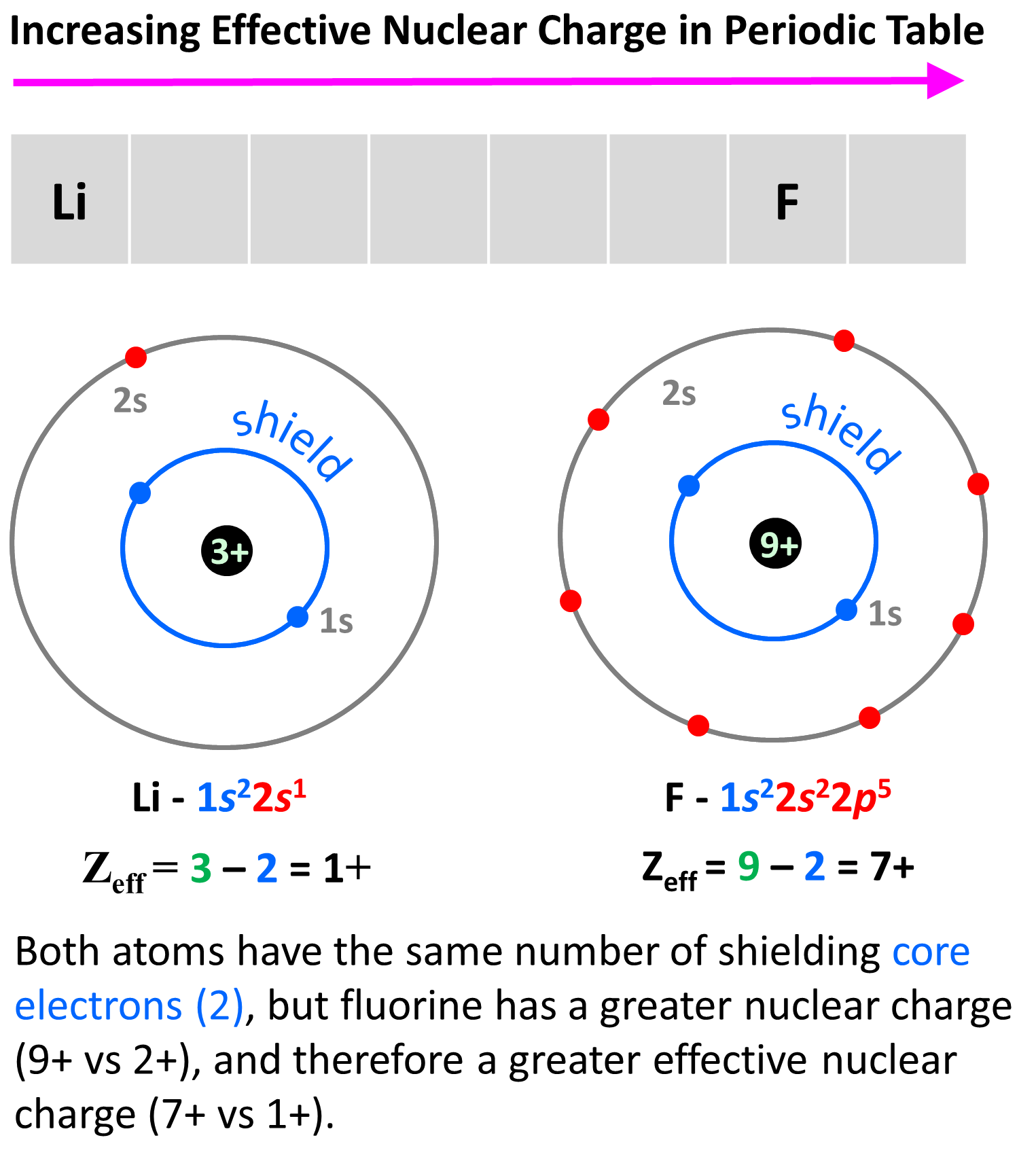
The diagram illustrates a crucial point: electrons in inner shells (core electrons) are much more effective at shielding electrons in outer shells (valence electrons) than electrons in the same shell are at shielding each other.
- Core electrons spend most of their time between the nucleus and the valence electrons, effectively canceling a portion of the nuclear charge.
- Valence electrons are, on average, at a similar distance from the nucleus. They can't effectively get "in between" each other and the nucleus, so their shielding of one another is weak.
3. A Deeper Look: The Reality of Shielding in Helium
To truly grasp the concept, let's dissect the simplest multi-electron atom, Helium, using limiting cases. This approach will give you a feel for the physics before we attempt any calculation.
Experimentally, the energy required to remove the first electron from a Helium atom (the first ionization energy) is 24.6 eV. This means the binding energy of that electron is -24.6 eV. Let's see how this compares to what we'd predict in extreme scenarios.
The quantum-mechanical model of the atom
The article from LibreTexts Chemistry, 'The quantum-mechanical model of the atom', provides the hard numbers that make the case for shielding. It compares the theoretical energy of a Helium electron without shielding to the experimentally measured value.
Read the section titled 'Multi-electron Atoms', down to the sentence '...after one of the two electrons has been removed.' Focus on the contrast between the predicted energy of -54.4 eV and the measured energy of -24.6 eV. This discrepancy is the entire motivation for the concept of shielding.
As the text shows, there is a large gap between the naive prediction (-54.4 eV) and reality (-24.6 eV). The naive prediction assumes the electron feels the full nuclear charge. The experimental value shows it feels significantly less.
Let's explore the two logical extremes that bound this reality, as explained in a lecture from MIT OpenCourseWare.
Professor Sylvia Ceyer's lecture on 'Multielectron Atoms' brilliantly uses the idea of limiting cases to build intuition for Zeff. She examines two 'superhero' scenarios for an electron in Helium: maximum possible shielding and zero shielding.
Watch the segment from 05:06 to 13:09. Follow her logic for these two extreme cases: Maximum Shielding: What is Zeff if one electron perfectly shields the other? What would the binding energy be? Zero Shielding: What is Zeff if one electron provides no shielding at all? What would the binding energy be? How does the experimentally determined Zeff fit between these two extremes?
Let's summarize the argument:
- Extreme 1: No shielding. An electron feels the full nuclear charge, . This is the case for He⁺. The binding energy would be . Here .
- Extreme 2: Perfect shielding. One electron perfectly cancels one proton's charge. The other electron feels a net charge equivalent to a hydrogen nucleus, . The binding energy would be . Here .
The actual, measured binding energy is -24.6 eV. This value lies between our two extremes. This confirms that the shielding is partial. Each electron in the 1s orbital of helium does shield the other, but incompletely. Using the formula , we can work backward to find that the experienced by an electron in Helium is approximately 1.34. The shielding constant is therefore .
Guided Discovery Problem
Now, let's connect these ideas. The following questions are designed to help you articulate the concepts in your own words and see their direct consequences.
Problem 1: Conceptual Foundations
- The Unsolvable Equation: In your own words, explain from first principles why the Schrödinger equation can be solved exactly for the He⁺ ion but not for the neutral He atom. What is the fundamental physical interaction that introduces this mathematical complexity?
- Feynman-style Explanation: Imagine you are explaining shielding to someone who knows about protons and electrons but has never heard of this concept. Create a simple analogy (not the light bulb one used earlier) to explain why a valence electron does not feel the full charge of the nucleus.
- Limiting Cases: Consider a neutral Lithium atom (1s²2s¹). Its first ionization energy is 5.39 eV.
- What would you predict for its first ionization energy if the two 1s electrons provided perfect shielding (i.e., S=2)?
- What would you predict if shielding did not exist at all (i.e., S=0)?
- How does the actual value of 5.39 eV tell you about the effectiveness of shielding by core electrons? (You can use the hydrogen energy levels as a reference: E₁ = -13.6 eV, E₂ = -3.4 eV).
Insight from the Problem
The unsolvability of the helium atom is a profound point. It tells us that as soon as a system involves more than two interacting bodies (here: nucleus, electron 1, electron 2), the clean, perfect solutions of classical and early quantum physics break down. We are forced into the world of approximations, where concepts like "shielding" are our powerful, albeit imperfect, tools for understanding a complex reality. Your analysis of the Lithium atom should reveal that shielding from core electrons is very effective, but not perfect. The 2s electron feels a much closer to 1 than to 3, which is why lithium's chemistry resembles hydrogen's in some ways (one valence electron).
Conclusion
We began with a problem: the simple hydrogenic model of the atom fails for everything beyond hydrogen because it ignores electron-electron repulsion. We've now developed the conceptual framework to address this.
Key Takeaways:
- Electron-electron repulsion makes solving the Schrödinger equation for multi-electron atoms impossible without approximations.
- The shielding effect is our primary approximation. It models the repulsion from other electrons as a reduction, or screening, of the positive nuclear charge.
- This reduced charge is the effective nuclear charge (Zeff), defined as , where is the shielding constant.
- Shielding is not all-or-nothing. Core electrons shield valence electrons very effectively, while electrons in the same shell shield each other poorly.
We have established that Zeff is a more realistic measure of the nuclear pull on an electron than Z. But we've been treating all electrons in a given shell (like 2s and 2p) as roughly equivalent. Is that accurate? Does a 2s electron experience the exact same shielding as a 2p electron? The answer is no, and the reason lies in the different shapes of their orbitals.
In the next lesson, we will introduce the concept of orbital penetration. We will see how the shape of an orbital determines how much time it spends close to the nucleus, "penetrating" the shield of the core electrons. This will be the final piece we need to explain the energy ordering of orbitals within a shell (e.g., why E₂s < E₂p) and, ultimately, to justify the Aufbau principle.