Introduction
In our last lesson, we uncovered a crucial architectural principle: orbital penetration. We established that within a given energy shell, the subshells are not degenerate. An electron in a 2s orbital is lower in energy than one in a 2p orbital because its ability to penetrate the core shield results in it experiencing a lower net electron-electron repulsion.
With this, our toolkit is complete. We have the three foundational principles that dictate the electronic structure of atoms:
- Pauli Exclusion Principle: No two electrons can share the same quantum state. This sets the capacity of each orbital.
- Shielding: Core electrons create a shield that raises the energy of outer electrons.
- Penetration: The shapes of orbitals determine how well they pierce the shield, splitting the energy levels of subshells (
s < p < d < f).
Today, we will synthesize these principles to justify the Aufbau principle, which is German for the "building-up" principle. This principle describes the sequence in which we fill orbitals to determine the ground-state electron configuration of any element. Your goal is to move beyond memorizing the filling order (1s, 2s, 2p, 3s, 3p, 4s, 3d...) and to justify it as a direct consequence of the atom's relentless drive to find its lowest possible energy state. We will focus on the most famous "anomaly" in this sequence: why the 4s orbital is filled before the 3d orbital.
The Aufbau Principle as an Energy-Minimization Strategy
The Aufbau principle isn't a physical law in itself, but rather a procedure that follows from the laws of quantum mechanics. It states that as we add electrons one by one to build up an atom, they will occupy the lowest-energy orbitals available. Nature seeks stability, and for an atom, the lowest total energy corresponds to the most stable arrangement.
This process is nicely illustrated in the following video.
This clip from an MIT lecture on 'Multielectron Atoms' introduces the process of building electron configurations using the Aufbau principle, connecting it to the energy level diagram we've been developing.
Please watch from 02:01 to 04:04, then skip to 15:11 and watch until 21:05. The first part will remind you how multi-electron energy levels differ from hydrogen. The second part explains how penetration dictates the energy order within a shell (a quick review) and then demonstrates the 'building-up' process with oxygen.
As the video demonstrates, for the first 18 elements (up to Argon), the filling order is straightforward and follows the principal quantum numbers sequentially: 1s, 2s, 2p, 3s, 3p. The atom simply fills the lowest energy orbitals available, respecting the Pauli principle.
The first real intellectual puzzle appears when we arrive at element 19, Potassium (K). The electron configuration of Argon is 1s²2s²2p⁶3s²3p⁶. Where does the 19th electron go? The n=3 shell is not yet full; the 3d orbitals are empty. Yet, experimentally, Potassium's 19th electron occupies the 4s orbital. Why?
The Central Case Study: The 4s vs. 3d Battleground
The simple answer must be that for Potassium, the 4s orbital is lower in energy than the 3d orbitals. The question is why. This is a classic case where two competing factors are at play:
- Principal Quantum Number (
n): The3dorbital has a lower principal quantum number (n=3) than the4sorbital (n=4). In a one-electron system, this would make3dunambiguously lower in energy. - Penetration (
l): The4sorbital (l=0) is an s-orbital, while the3dorbital (l=2) is a d-orbital. We know that s-orbitals are far more penetrating than d-orbitals.
In the complex environment of a multi-electron atom, these two factors are in direct competition. To see which one wins, we must perform a more careful analysis of the physical forces involved.
The paper we consulted in the last lesson provides a brilliant and rigorous analysis of this exact problem. It moves beyond superficial explanations and dissects the contributions of attraction and repulsion.
The 4s/3d ordering controversy in the fourth period
To truly understand why the 4s orbital fills before the 3d, we must analyze the physical forces at play. The McGrady paper provides an excellent, in-depth analysis of this very issue.
Please read the section titled 'The 4s/3d ordering controversy in the fourth period' starting on page 11 of the PDF. Read until the subheading 'An analysis of the 4s/3d problem using Hartree-Fock theory' on page 17. As you read, focus on answering these questions: What is the 'critical ratio' of Zeff(4s)/Zeff(3d) that determines which orbital is lower in energy? Using Slater's rules for Potassium (K), how does the paper show that the 4s orbital is favored? What happens to this ratio for an ion like Ti³⁺, and what does this imply about the orbital ordering? What is the paper's ultimate physical explanation? Does it attribute the stability of 4s to greater attraction or lower repulsion? Why?
The McGrady paper articulates the core of the issue perfectly. The choice between 4s and 3d is a strategic compromise to minimize the atom's total energy.
- Placing the electron in the 3d orbital offers strong attraction to the nucleus (due to the lower
n=3), but it comes at the cost of high electron-electron repulsion because the3dorbital is spatially located in the same region as the dense3sand3pcore electrons. - Placing the electron in the 4s orbital means sacrificing some nuclear attraction (due to the higher
n=4), but it dramatically reduces electron-electron repulsion because the diffuse4sorbital's main lobe is much further away from then=3core.
For a neutral atom like Potassium, minimizing repulsion is the winning strategy. The energy saved by avoiding the dense 3s²3p⁶ core is greater than the energy lost by being, on average, further from the nucleus. Therefore, E(4s) < E(3d), and the 19th electron enters the 4s orbital.
The Plot Twist: Shifting Energies and Ionization
This explanation leads to an apparent paradox. We fill 4s before 3d (e.g., K is [Ar] 4s¹, Ca is [Ar] 4s², Sc is [Ar] 4s² 3d¹). However, when we ionize a transition metal like Scandium to form Sc²⁺, we remove the two 4s electrons first, leaving a configuration of [Ar] 3d¹.
If the 4s orbital is lower in energy, why are its electrons the first to be removed? This implies they are the highest energy electrons.
The resolution is that orbital energies are not fixed. They are dynamic and depend on the nuclear charge (Z) and the electron configuration itself.
This leads to a common point of confusion: if 4s is filled first because it's lower in energy, why are 4s electrons removed first when forming a transition metal ion? The MIT lecture provides a clear explanation for this apparent paradox.
Watch the clip from 32:00 to 34:49. The professor explains that once d-orbitals begin to fill, their energy drops below that of the 4s orbital. Focus on why this energy re-ordering happens and how it explains why valence electrons are removed from the 4s orbital first during ionization.
As Z increases across the periodic table, all orbitals are pulled closer to the nucleus. However, this stabilization effect is much more pronounced for the compact 3d orbitals than for the diffuse 4s orbital. Once we start adding electrons to the 3d orbitals (beginning with Scandium), their energy plummets, dropping below the energy of the 4s orbital.
So, for transition metals from Scandium onwards, the 4s electrons are, in fact, the highest-energy electrons. They function as the valence electrons and are removed first during ionization. The apparent paradox is resolved when we abandon the idea of a static energy ladder and embrace a dynamic energy landscape.
Guided Discovery Problem
Let's put all these ideas together. The following problem, based on the provided image, will guide you through a complete analysis of orbital energies.
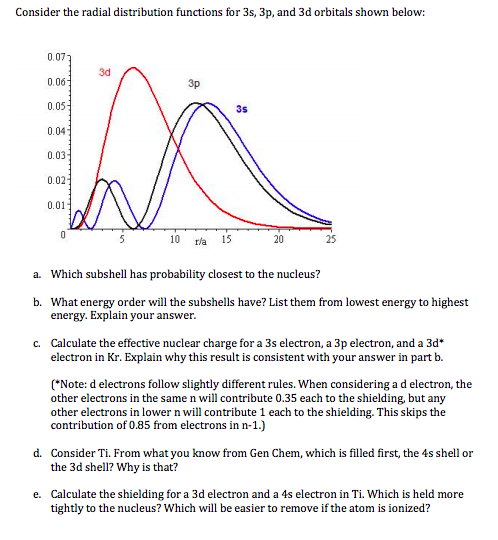
Problem:
Please answer the questions presented in the image. For clarity, they are transcribed below:
(a) Examine the radial distribution functions for the 3s, 3p, and 3d orbitals shown in the graph. Which of these subshells has the highest probability of being closest to the nucleus (i.e., which is most penetrating)?
(b) Based on your answer to (a) and your knowledge of shielding and penetration, predict the order of the subshells from lowest energy to highest energy.
(c) Slater's rules can be used to estimate the effective nuclear charge, , for an electron. For an electron in an s or p orbital, electrons in the same shell shield by 0.35, electrons in the n-1 shell shield by 0.85, and electrons in deeper shells (n-2 or more) shield by 1.00. Using these rules, calculate for a 4s electron in a Potassium atom (K, Z=19). The configuration of the core is 1s²2s²2p⁶3s²3p⁶.
(d) Now, let's consider the 3d orbital. A key difference in Slater's rules for a d electron is that all electrons in shells with a smaller principal quantum number shield it completely (shielding constant = 1.00). Calculate for a hypothetical 3d electron in a Potassium atom. Based on your values from (c) and (d), which orbital, 4s or 3d, would be lower in energy? Does this explain the observed electron configuration of Potassium ([Ar] 4s¹)?
(e) When a transition metal atom such as Titanium ([Ar] 4s² 3d²) is ionized to form Ti²⁺, the two electrons are removed from the 4s subshell, not the 3d subshell. Explain this observation, which seems to contradict the filling order.
- Insight from the Problem: Your answers should walk through the complete logic. You'll start with the visual evidence of penetration from the graphs, connect it to energy ordering, perform a quantitative estimation using Slater's rules to solidify the
4svs.3dargument, and finally resolve the apparent paradox of ionization. This exercise encapsulates the entire justification for the Aufbau principle's nuances.
Conclusion
In this lesson, we have deconstructed the Aufbau principle, revealing it not as a list of arbitrary rules but as a consequence of a dynamic energy landscape within the atom.
Key Takeaways:
- The Aufbau ("building-up") principle is a procedure for determining an atom's ground-state electron configuration by filling the lowest energy orbitals first.
- The filling order is governed by the relative energies of orbitals, which are determined by a competition between the principal quantum number (
n) and the orbital's penetrating power (l). - The famous
4sbefore3dfilling order occurs because the superior penetration of the4sorbital allows it to avoid electron-electron repulsion from the core more effectively than the3dorbital, making it the lower-energy option in neutral atoms like Potassium and Calcium. - Orbital energies are not static. As the nuclear charge increases and
3dorbitals begin to fill, their energy drops below that of the4sorbital. Consequently, for transition metals, the4selectrons become the highest-energy valence electrons and are removed first upon ionization.
We are now fully equipped to construct the electron configuration for any element. In the next lesson, we will introduce our final rule, Hund's Rule, which governs how electrons fill degenerate orbitals. With that, we will be able to write the ground-state configuration for any atom and begin to explain the structure and predictive power of the Periodic Table.