Introduction
In our journey so far, we have constructed a detailed picture of the isolated atom. We've explored its quantum structure, understood why it has a specific size, and quantified its willingness to lose or gain electrons through ionization energy and electron affinity. We saw that processes like gaining an electron can be energetically favorable, releasing energy and leading to a more stable state.
This raises a fundamental question: If individual atoms can achieve greater stability by interacting with a lone electron, what happens when they interact with each other? Why is the universe not just a soup of 118 different types of isolated atoms?
This lesson marks our transition from the properties of single atoms to the principles of their collective behavior. We will address the most fundamental question in chemistry: Why do atoms form chemical bonds? Your learning outcome for today is to explain chemical bonding as a process driven by the minimization of a system's total potential energy.
You will discover that atoms don't bond because of a "desire" to have eight valence electrons. The octet rule is a useful guideline, but it's a consequence of a much deeper, universal principle rooted in physics: the tendency of all systems to settle into their lowest possible energy state.
The Universal Drive Towards Lower Energy
In physics, a recurring theme is that systems spontaneously evolve toward states of lower potential energy. A boulder rolls downhill, not uphill. A stretched spring, when released, returns to its equilibrium length. In both cases, the system releases stored potential energy to reach a more stable configuration.
Atoms and molecules are no different. They are governed by the same laws of energy. The formation of a chemical bond is the atomic equivalent of a boulder rolling into a valley.
To build your intuition for this core idea, please watch the first part of the following video.
Why do atoms form molecules? The quantum physics of chemical bonds explained
The video 'Why do atoms form molecules?' by Arvin Ash introduces the concept of energy minimization using a simple classical analogy before applying it to atoms.
Watch from 00:55 to 02:23. Focus on the central principle: like a marble rolling downhill, natural systems tend to adopt a state of lowest energy.
This principle is the "why" behind all chemical bonding. An isolated atom is like a marble partway up a hill—it has a certain amount of potential energy. A bonded system, like a molecule, is like that same marble at the bottom of the hill. The bonded state is inherently more stable because the system as a whole has a lower total energy.
An Energetic Landscape: The Potential Energy Curve
To understand bond formation rigorously, we must analyze the energy of the system as two atoms approach each other. Let's consider the simplest possible case: two hydrogen atoms. We can plot the total potential energy of the two-atom system as a function of the distance between their nuclei. This creates a graph known as a potential energy curve.
This curve is the result of a delicate balance between attractive and repulsive forces:
- Attractive Forces: The nucleus of each atom attracts the electron of the other atom. These forces pull the atoms together and lower the system's potential energy.
- Repulsive Forces: The two positively charged nuclei repel each other, and the two negatively charged electrons repel each other. These forces push the atoms apart and raise the system's potential energy.
The following video provides an excellent step-by-step construction of this curve, explaining what happens at each stage of the interaction.
Bond length and bond energy | AP Chemistry | Khan Academy
In 'Bond length and bond energy', Khan Academy methodically builds the potential energy curve for diatomic hydrogen, explaining the interplay of forces at different distances.
Watch from 01:45 to 06:42. As you watch, focus on answering these questions: Why is the potential energy defined as zero when the atoms are infinitely far apart? What happens to the potential energy as the atoms are brought closer together from a large distance? What happens to the potential energy when the atoms are forced too close together? How are 'bond length' and 'bond energy' identified on this graph?
Let's formalize the key features of this energetic landscape, using the potential energy curve for H₂ as our reference.
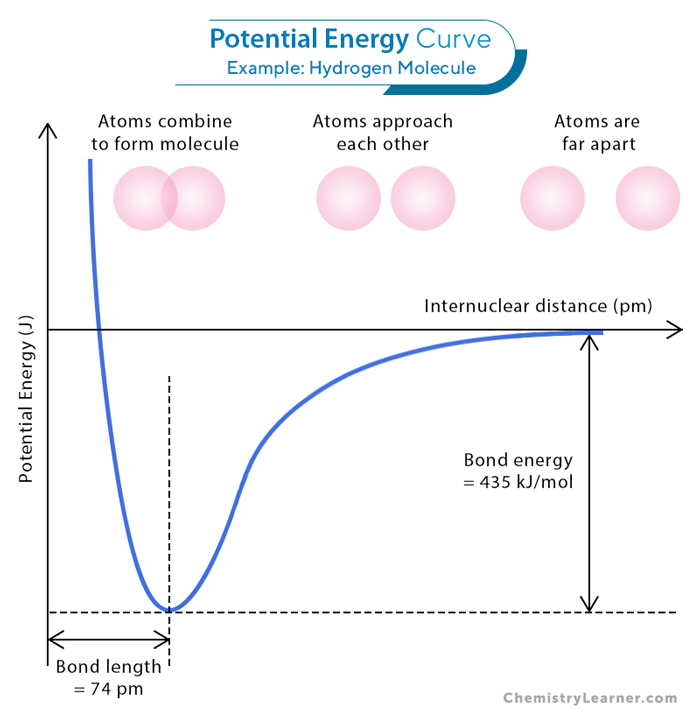
- Infinite Separation (Right side of the graph): When the atoms are very far apart, they don't interact. By convention, we define their potential energy as zero.
- Attraction Dominates (Decreasing part of the curve): As the atoms approach, the nucleus-electron attractions begin to dominate over the nucleus-nucleus and electron-electron repulsions. The system becomes more stable, and its potential energy decreases (becomes more negative).
- Minimum Energy - The "Sweet Spot" (The bottom of the well): At a specific distance, the attractive and repulsive forces reach an optimal balance. The system is at its lowest possible potential energy. This is the most stable configuration, and it represents the formation of a stable chemical bond.
- Bond Length: The internuclear distance at this energy minimum is the bond length (74 pm for H₂).
- Bond Energy: The energy difference between the separated atoms (zero energy) and the minimum of the curve is the bond energy (436 kJ/mol for H₂). It is the amount of energy released when the bond is formed, and conversely, the amount of energy that must be supplied to break the bond.
- Repulsion Dominates (Steeply rising part of the curve): If the atoms are pushed closer than the bond length, the powerful repulsion between the two nuclei skyrockets, making the system extremely unstable and sharply increasing its potential energy.
The formation of a bond is, therefore, not a conscious choice by the atoms but an inevitable slide down an energy hill to the most stable point in their shared energetic landscape.
A Deeper Quantum Perspective: Kinetic vs. Potential Energy
You have a keen interest in the philosophical underpinnings of physics, so it is worth noting that the simple electrostatic picture, while useful, is not the complete story. There has been a long-standing debate about the true physical origin of the bond's stability.
A common and intuitive explanation, advanced by scientists like Slater and early on by Feynman, is that the buildup of electron density between the nuclei acts as an electrostatic "glue." The attraction of the nuclei to this intermediate charge lowers the system's potential energy, driving bond formation.
However, a deeper analysis pioneered by Hellmann and Ruedenberg, and later adopted by Feynman himself, argues that the primary driver is actually a quantum mechanical effect related to kinetic energy. Recall the Heisenberg Uncertainty Principle from Module 4. When an electron is confined to a single atom, its position is relatively localized (small ). When two atoms bond, the electron is delocalized over both nuclei. Its "box" becomes larger (larger ). A larger uncertainty in position allows for a smaller uncertainty in momentum (), which translates to a lower average kinetic energy ().
According to this view, the initial stabilization as atoms approach is driven by a decrease in the electrons' kinetic energy due to delocalization. The subsequent changes in potential energy and the satisfaction of the Virial Theorem at the equilibrium bond length are secondary effects that arise from the orbitals contracting.
As Nordholm and Bacskay state in their paper, "The Basics of Covalent Bonding in Terms of Energy and Dynamics" (a fascinating but advanced read), Feynman eventually came to this view, explaining bonding as a "flip-flop motion of electrons between bonded atoms, causing a corresponding drop in the electron’s kinetic energy." This perspective reveals the bond not as static glue, but as a dynamic, quantum phenomenon. The key takeaway is that the simple picture of potential energy minimization is a powerful model, but the quantum reality underneath is even more subtle and elegant, involving the wave-like nature and dynamics of the electron.
Guided Discovery Problem
Let's use the potential energy curve model to test your understanding.
Problem:
(a) Sketch and Label:
Draw a generic potential energy curve for a stable diatomic molecule (like N₂ or O₂). On your sketch, clearly label:
- The x-axis and y-axis.
- The region where attractive forces dominate.
- The region where repulsive forces dominate.
- The equilibrium bond length ().
- The bond energy ().
(b) The Forces of Creation:
In your own words, explain the origin of the forces that cause the potential energy to (i) decrease as two atoms approach from infinity and (ii) increase sharply as they become very close.
(c) A Universe of Collapse:
Imagine a hypothetical universe where the potential energy between two atoms did not have a minimum but simply continued to decrease as the atoms got closer. What would be the catastrophic consequence for the structure of matter in such a universe? What fundamental concepts of bonding would cease to exist?
(d) To Bond or Not to Bond:
The H₂ molecule is stable, but the He₂ molecule is not. Helium atoms have a full valence shell (1s²). Using this knowledge, sketch the potential energy curve you would expect for two approaching helium atoms. How does it differ from the curve for H₂, and how does this difference explain why He₂ does not form a stable bond under normal conditions?

- Insight from the Problem: This set of questions moves from simple recall to deep conceptual reasoning. Part (a) is a Feynman-style check of your basic model. Part (b) forces you to articulate the underlying physics. Part (c) is a classic "what would break if..." question, forcing you to see the role of nuclear repulsion in creating stable, structured matter. Finally, part (d) requires you to apply the principle of energy minimization to a real-world counterexample (He₂), connecting the shape of the curve directly to molecular stability.
Conclusion
Today, we have established the foundational principle of chemical bonding: it is an energy-driven process. Atoms don't form bonds to satisfy an abstract rule; they form bonds because the resulting molecule represents a lower-energy, more stable state for the system of atoms and electrons.
Key Takeaways:
- Chemical bonding is fundamentally driven by the universal tendency of systems to minimize their total potential energy.
- The potential energy curve is a powerful model that visualizes the energetic landscape of bond formation, plotting potential energy against internuclear distance.
- The minimum point on this curve defines the molecule's equilibrium bond length (the distance) and its bond energy (the stability).
- The shape of the curve is a result of the balance between long-range attractive forces (nucleus-electron) and short-range repulsive forces (nucleus-nucleus and electron-electron).
- A deeper quantum view suggests that the initial stabilization is due to a decrease in kinetic energy from electron delocalization, a beautiful consequence of the wave nature of matter.
Now that we understand why atoms bond, our next step is to explore how they bond. In the next lesson, we will introduce the concept of electronegativity, which will allow us to predict the character of a bond and understand the spectrum that runs from the complete transfer of electrons (ionic bonding) to the equal sharing of electrons (covalent bonding).