Introduction
In our last lesson, we explored the fascinating anomalies in ionization energy. We discovered they weren't random "glitches" but logical consequences of an atom's underlying quantum architecture, specifically the stability of filled and half-filled subshells. You learned that removing an electron from a stable configuration, like Beryllium's 2s² or Nitrogen's 2p³, costs more energy than expected, while removing an electron that relieves repulsion, like in Oxygen's 2p⁴, costs less.
Today, we examine the other side of this energetic coin: Electron Affinity. Instead of taking an electron away, what happens when we give one to a neutral atom? Does the atom "want" it? The energy change associated with this process is electron affinity, and it provides one of the deepest insights into an element's chemical character.
Your learning outcome is to predict and justify the periodic trend in electron affinity, considering factors like effective nuclear charge (), shielding, and subshell stability. We will see how the same principles that explained ionization energy anomalies manifest here, but in a new context. This completes our trilogy of fundamental atomic properties (radius, IE, EA) and sets the stage for understanding chemical bonding.
Defining Electron Affinity: A Question of Stability
First, let's establish a precise definition. Ionization is always an endothermic process; you must input energy to pull an electron away from an attractive nucleus. Electron affinity is more nuanced.
Electron Affinity (EA) is defined as the energy change that occurs when a neutral atom in the gaseous state gains an electron to form a gaseous anion.
The sign of this energy change is critical to its physical meaning:
- If EA is negative, energy is released. The process is exothermic. This implies that the resulting anion (X⁻) is more stable than the neutral atom and the free electron. The atom has a natural "affinity" for the electron. A more negative value means a stronger affinity.
- If EA is positive, energy must be absorbed to add the electron. The process is endothermic. This implies the resulting anion is unstable and will not form spontaneously. The atom resists gaining an electron.
Think of it as an energetic landscape. A negative EA means the electron rolls "downhill" into a stable position in the atom, releasing its potential energy. A positive EA means you must push the electron "uphill" to force it onto an unwilling atom.
For a clear explanation of this concept, often termed "electron gain enthalpy," and its sign convention, please watch the beginning of the following video.
Electron gain enthalpy| Periodic properties | Grade 11 | Chemistry | Khan Academy
This video from Khan Academy India provides a formal definition for electron gain enthalpy (which we are calling electron affinity) and clearly explains the crucial sign convention.
Watch from the beginning to 01:41. Focus on understanding why a negative value corresponds to energy being released and a positive value corresponds to energy being absorbed.
The General Trends: A Familiar Battle
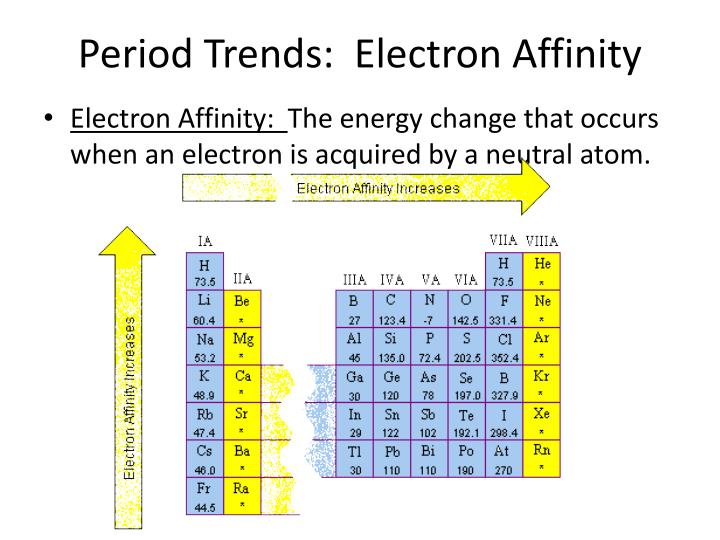
Just like with atomic radius and ionization energy, the trends in electron affinity are primarily governed by the interplay between effective nuclear charge () and the principal quantum number ().
-
Across a Period (Left to Right): Electron affinity generally becomes more negative.
- Justification: As we move across a period, increases steadily. The nucleus exerts a stronger pull on the incoming electron, meaning it can be bound more tightly. This results in a larger release of energy upon its capture.
-
Down a Group (Top to Bottom): Electron affinity generally becomes less negative.
- Justification: Moving down a group, the principal quantum number of the valence shell increases. The incoming electron enters an orbital that is, on average, farther from the nucleus. This greater distance weakens the electrostatic attraction, and the increased shielding from core electrons further diminishes the nucleus's pull. Consequently, less energy is released.
These general trends, however, are punctuated by significant and illuminating anomalies. It is in these "exceptions" that the underlying quantum structure of the atom truly reveals itself.
Anomalies: Where Subshell Stability Dictates the Trend
The smooth trends described above are disrupted when an incoming electron alters a particularly stable or unstable electron configuration. These are the same stability rules we saw with ionization energy, now applied to the process of gaining an electron.
For a comprehensive overview of these trends and their exceptions, the following reading is highly recommended.
2.5 Periodic Variations in Element Properties
This webpage from OpenIntro Chemistry provides a detailed written explanation of the trends in electron affinity and, most importantly, the physical reasons for the key exceptions.
Read the subsection titled 'Variation in Electron Affinities'. Pay close attention to the explanations for the exceptions in Group 2, Group 15, and Group 18. We will discuss the F vs. Cl anomaly separately.
Let's break down the three most important anomalies:
-
Group 2 (Alkaline Earth Metals) & Group 18 (Noble Gases): Positive EA
- Group 2 (e.g., Be: 1s²2s²): These atoms have a filled
ssubshell. The incoming electron cannot join the stablesorbital; it must be placed in the next available, higher-energypsubshell. Forcing an electron into this less stable, more shielded orbital requires an input of energy. - Group 18 (e.g., Ne: 1s²2s²2p⁶): These atoms have a completely filled valence shell, the most stable configuration possible. The incoming electron must enter a new principal shell (e.g.,
n=3for Neon), which is very far from the nucleus and perfectly shielded. This is highly energetically unfavorable, resulting in a positive EA.
- Group 2 (e.g., Be: 1s²2s²): These atoms have a filled
-
Group 15 (e.g., Nitrogen: 1s²2s²2p³): Less Negative EA than Expected
- These atoms have a half-filled
psubshell (p³), a configuration of enhanced stability due to maximized exchange energy. The incoming electron must pair up with an electron already in aporbital, introducing electron-electron repulsion. This repulsion costs energy, partially offsetting the energy released from the nuclear attraction. Therefore, the net energy released is smaller (less negative) than for the adjacent elements.
- These atoms have a half-filled
The Great Anomaly: Fluorine vs. Chlorine
Based on the general trend, we would expect fluorine, at the top of Group 17, to have the most negative electron affinity. The data, however, reveals a surprise:
- EA(F) = -328 kJ/mol
- EA(Cl) = -349 kJ/mol
Chlorine has a more negative electron affinity than fluorine! This is a classic and crucial anomaly, especially relevant for competitive exams like JEE. It highlights that our general rules are sometimes overridden by competing effects.
The cause is electron density. The valence shell of fluorine () is exceptionally small and compact. While fluorine's nucleus is very attractive, the seven valence electrons are already crowded into this tiny volume. The incoming electron experiences significant electron-electron repulsion from the electrons already present. In chlorine, the valence shell is the larger shell. This extra space reduces the electron-electron repulsion, allowing the nuclear attraction to dominate more effectively. The incoming electron is accepted more readily into the more spacious chlorine atom than into the crowded fluorine atom.
The following video explains this vital point very clearly.
Electron gain enthalpy| Periodic properties | Grade 11 | Chemistry | Khan Academy
This segment explains the trend down a group and focuses specifically on the critical F vs. Cl and O vs. S anomalies, attributing them to electron-electron repulsions in the small n=2 shell.
Watch from 09:49 to 12:08. The core of the explanation is understanding why the small size of fluorine and oxygen leads to strong electron-electron repulsion that makes their electron affinities less negative than their larger group-mates, chlorine and sulfur.
Guided Discovery Problem
Now, let's connect these ideas. Justify your answers from first principles, focusing on electron configurations, orbital energies, and the balance of attractive and repulsive forces.
Problem:
(a) Foundational Check:
In your own words, explain why a negative electron affinity signifies a stable anion, while a positive electron affinity signifies an unstable one.
(b) The s-to-p Barrier:
Rank the first electron affinities of Lithium (Li), Beryllium (Be), and Boron (B) from most positive (least affinity) to most negative (greatest affinity). Justify your entire ranking by referring to their specific electron configurations and the subshells the new electron would enter.
(c) The Half-filled Disruption:
Rank the first electron affinities of Carbon (C), Nitrogen (N), and Oxygen (O) from most positive/least negative to most negative. Use orbital box diagrams to explain why Nitrogen disrupts the trend. Specifically address the roles of subshell stability and electron-electron repulsion.
(d) The Size Anomaly:
Explain, in detail, why chlorine (Cl) has a more negative electron affinity than fluorine (F). Why doesn't fluorine's higher effective nuclear charge and smaller size lead to a more negative EA as the general trend would predict?
(e) Beyond the First Electron:
The first electron affinity of Oxygen (O → O⁻) is negative (-141 kJ/mol), but the second electron affinity (O⁻ → O²⁻) is strongly positive (+744 kJ/mol). Why is the second electron affinity of any element always a positive value?
- Insight from the Problem: This problem guides you from the basics to advanced application. Parts (b) and (c) force you to apply the same logic of subshell stability you learned for ionization energy to this new context. Part (d) tests your understanding of the most important anomaly in this trend, requiring you to weigh competing factors (Zeff vs. electron repulsion). Part (e) pushes you to think about the fundamental electrostatics of adding an electron to an already negative ion, a key idea for understanding ionic compounds.
Conclusion
Today we have completed our survey of the fundamental properties of atoms. We've seen that electron affinity, like ionization energy, is not a simple, smooth trend. It is shaped by the same quantum mechanical principles: the powerful pull of the nucleus (), the distance and shielding effects of electron shells (), and the special stability of filled and half-filled subshells.
Key Takeaways:
- Electron Affinity (EA) is the energy change when an atom gains an electron. A negative value indicates energy is released and a stable anion is formed.
- The general trend is for EA to become more negative across a period and less negative down a group.
- Anomalies provide deep insight:
- Groups 2 & 18 have positive EAs because the new electron must occupy a new, high-energy subshell or shell.
- Group 15 has a less negative EA due to the stability of the half-filled
psubshell and the repulsion cost of pairing electrons. - Chlorine's EA is more negative than Fluorine's because the intense electron-electron repulsion in fluorine's compact shell outweighs its higher nuclear charge.
With a firm grasp of atomic radius, ionization energy, and electron affinity, you are now fully equipped to understand not just what atoms are, but what they do. In our next lesson, we will begin Module 8 and use these principles to explain the fundamental driving force behind all of chemistry: the formation of the chemical bond.