Introduction
In our last lesson, we established the fundamental reason atoms form bonds: to reach a state of lower total energy. We visualized this as atoms "rolling" down an energetic hill to find a stable valley. We saw that this stability arises from a complex interplay of attractive and repulsive forces, with a deeper quantum origin related to the kinetic energy of delocalized electrons.
However, this raises a crucial question. When two different atoms bond—say, hydrogen and chlorine—they don't contribute equally to this new, stable arrangement. One atom often pulls the shared electrons more strongly than the other. This "tug-of-war" over electrons is central to chemistry.
Today, we will quantify this electron-attracting power by defining a property called electronegativity. Your learning outcome is to define electronegativity and use its difference (ΔEN) to predict the character of a bond along the ionic-covalent spectrum. We will explore how this single concept allows us to understand why some bonds involve gentle sharing (covalent) while others involve a complete transfer (ionic), and everything in between.
What is Electronegativity?
Imagine two atoms in a chemical bond. The electrons that form the bond are being pulled by both nuclei. Electronegativity is our measure of how strongly an atom pulls these bonding electrons toward itself. It's a quantification of "electron greed."
To build a formal understanding, let's turn to a precise definition.
8.4: Bond Polarity and Electronegativity - Chemistry LibreTexts
The Chemistry LibreTexts page on Bond Polarity and Electronegativity provides a clear and rigorous definition of the concept and connects it to properties you already know.
Read the first section, titled 'Electronegativity'. Pay close attention to two key points: The formal definition: electronegativity is the relative ability of an atom to attract electrons in a chemical compound. Its relationship to ionization energy (IE) and electron affinity (EA).
As you read, you should notice two crucial aspects:
- It's a Relative, In-Situ Property: Unlike ionization energy or electron affinity, which are measured for isolated gas-phase atoms, electronegativity is a property an atom exhibits within a molecule. It depends on its chemical environment.
- It Connects to Fundamental Properties: An atom will be highly electronegative if it has a high ionization energy (it holds its own electrons tightly) and a highly negative electron affinity (it strongly desires to gain an electron). This is the "why" behind the trends. Fluorine, with its high IE and high EA, is the most electronegative element. Cesium, with its low IE and low EA, is one of the least.
The most famous scale for electronegativity was developed by Linus Pauling, who arbitrarily set fluorine's value to 3.98, creating a scale from ~0.7 to 4.0. However, as the image below shows, other scientists have developed different scales based on different calculations.

The Spectrum of Bonding
Now, what happens when two atoms with different electronegativity values form a bond? The difference in their "electron greed" determines the nature of the bond. It's not a simple choice between "sharing" or "transferring"; it's a continuous spectrum.
Let's watch a video that illustrates this continuum with clear examples.
Electronegativity: bond character/bond type: electronegativity difference and predicting bond type
This video from Crash Chemistry Academy provides a concise overview of how the difference in electronegativity (ΔEN or Δχ) determines a bond's character.
Watch from the beginning to 04:53. Focus on the three key examples: Chlorine & Chlorine (Cl₂) Hydrogen & Chlorine (HCl) Sodium & Chlorine (NaCl) Notice how the electron distribution changes as the electronegativity difference increases.
This leads us to a powerful classification system, visually summarized by the diagram below.
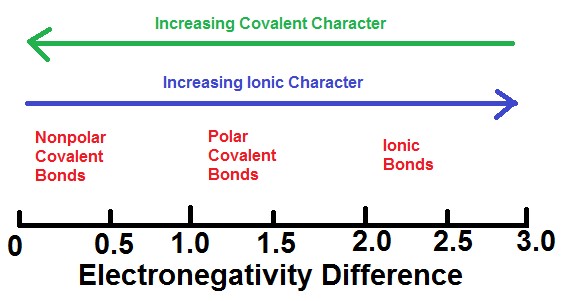
Let's formalize the regions of this spectrum based on the electronegativity difference, Δχ = |χ₂ - χ₁|:
- Nonpolar Covalent Bond (Δχ ≈ 0 to 0.4): The atoms have very similar electronegativities. They share the bonding electrons almost equally. Example: Cl₂ (Δχ = 3.16 - 3.16 = 0).
- Polar Covalent Bond (Δχ ≈ 0.4 to 1.7): There is a significant difference in electronegativity. The more electronegative atom pulls the electron density towards itself, gaining a partial negative charge (δ⁻). The less electronegative atom is left with a partial positive charge (δ⁺). Example: H–Cl (Δχ = 3.16 - 2.20 = 0.96).
- Ionic Bond (Δχ > 1.7): The electronegativity difference is so large that we model the interaction as a complete transfer of one or more electrons from the less electronegative atom to the more electronegative one. This creates fully charged ions (e.g., Na⁺ and Cl⁻) that are held together by electrostatic attraction. Example: Na–Cl (Δχ = 3.16 - 0.93 = 2.23).
It is vital to understand that the numerical cutoffs (0.4, 1.7) are just convenient guidelines. Nature does not have sharp boundaries. The cutoff of ~1.7, for instance, is simply the point where the bond is considered to have about 50% "ionic character."
A Deeper Look: The Reality of the Continuum
A common misconception is that an ionic bond involves a 100% complete transfer of an electron. This is an idealization.
Even in a highly ionic compound like NaCl, the Na⁺ cation still exerts an electrostatic pull on the electron cloud of the Cl⁻ anion, drawing a tiny amount of electron density back. This means there is always a minuscule degree of "sharing" or covalency. A purely 100% ionic bond does not exist.
We can quantify this "ionic character" experimentally. A polar bond creates a dipole moment (μ), which is a measure of charge separation. By measuring a molecule's dipole moment and bond length, we can calculate the effective partial charges on its atoms. For example, such a calculation for the H–Cl bond reveals it has about 18% ionic character.
The relationship between electronegativity difference and percent ionic character for several compounds is plotted in the graph shown in the LibreTexts resource, under the section "Dipole Moments." It beautifully visualizes the smooth continuum we've been discussing.
A Philosophical Aside: The Nature of Electronegativity
Given your interest in the philosophy of science, let's question the very nature of this concept. Is electronegativity just a useful calculational tool, or does it represent something deeper about an element?
Concerning Electronegativity as a Basic Elemental Property
You've expressed a deep interest in the 'why' behind scientific principles. This article by Mark Leach explores the very nature of electronegativity, asking whether it's a fundamental property of matter. It's a more advanced text, but it directly addresses these kinds of questions.
I want you to read three key parts of this paper: The introduction (first page, up to 'Key Words'): This gives a historical overview and defines electronegativity from multiple perspectives, showing it's a deeply integrated property. A portion of the 'Electronegativity' section (page 2, from 'In 1932 Pauling introduced...' to '...depending upon the electronegativity difference.'): This shows how the concept is applied to predict bond polarity and reactivity. The section 'Electronegativity: The Missing Transcendental Property?' (page 4): This is the most philosophical part. It argues that electronegativity is a property of the basic element, like atomic number. Focus on the core argument here.
The author, Mark Leach, proposes that we should think of electronegativity as a "transcendental property" of the basic element, alongside atomic number. What does this mean? When sodium metal (a simple substance) reacts with chlorine gas, the metallic properties of sodium vanish. But the essence of sodium, the "basic element," survives in the resulting compound, NaCl. Leach argues that electronegativity is a property of this surviving essence. It's the property that determines whether the simple substance will be a metal or non-metal, whether it will form ionic or covalent bonds. This view elevates electronegativity from a mere calculation to a fundamental principle that dictates an element's chemical destiny.
Guided Discovery Problem
Let's apply these ideas to solidify your understanding.
Problem:
(a) Ranking the Greed:
Without looking at a table, arrange the following atoms in order of increasing electronegativity and briefly justify your reasoning based on periodic trends: Na, P, F, Rb.
(b) Placing Bonds on the Spectrum:
You are given the following Pauling electronegativity values: H = 2.20, C = 2.55, N = 3.04, O = 3.44, F = 3.98, Na = 0.93, Cl = 3.16.
For each bond below, calculate the electronegativity difference (Δχ), classify the bond as nonpolar covalent, polar covalent, or ionic. For the polar covalent bonds, draw the bond showing partial charges (e.g., Aδ+—Bδ-).
- N–H
- C–H
- O–H
- Na–Cl
- F–F
(c) The Reactivity of Polarity:
Consider the water molecule (H₂O) and the methane molecule (CH₄). Based on your calculations for O-H and C-H bonds in part (b), which molecule would you expect to interact more strongly with ions like Na⁺ or Cl⁻? Explain your reasoning in terms of bond polarity. This provides a clue as to why water is an excellent solvent for many ionic compounds.
(d) The Nonpolar Puzzle:
The C–H bond is ubiquitous in organic chemistry. Your calculation showed a Δχ of 0.35. This value sits right on the borderline between nonpolar and polar.
- What does this borderline nature tell you about the "rules" and "cutoffs" you learned for classifying bonds?
- If you were forced to assign a partial charge, which atom would be δ⁻ and which would be δ⁺?
- Oils and waxes are large molecules made almost entirely of C–H and C–C bonds. Why do you think oil and water don't mix? (Hint: Consider your answer to part c).
- Insight from the Problem: This problem guides you from basic application to deeper reasoning. Part (a) checks your grasp of periodic trends. Part (b) is a direct application of the learning outcome. Part (c) pushes you to connect an abstract property (bond polarity) to a concrete physical phenomenon (solubility). Finally, part (d) forces you to confront the ambiguity of scientific models and use the concept of polarity to explain a common, real-world observation.
Conclusion
Today we introduced electronegativity as the measure of an atom's ability to attract electrons within a chemical bond. This single concept provides a powerful framework for understanding how atoms achieve the energy minimization we discussed in the last lesson.
Key Takeaways:
- Electronegativity (χ) is a relative measure of an atom's "electron greed" in a bond. It increases up and to the right on the periodic table.
- The difference in electronegativity (Δχ) between two atoms determines the bond's character along a continuous spectrum.
- This ionic-covalent spectrum ranges from nonpolar covalent (equal sharing, Δχ ≈ 0), to polar covalent (unequal sharing, intermediate Δχ), to ionic (electron transfer, large Δχ).
- The cutoffs between bond types are useful guidelines, not rigid laws. The reality is a continuum of percent ionic character.
- Philosophically, electronegativity can be viewed not just as a calculation, but as a fundamental property of an element that dictates its chemical behavior.
Now that we have a framework for classifying bonds, we can explore the consequences of these different bonding types. In the next lesson, we will focus on ionic bonding, examining how the electrostatic attraction between ions leads to the formation of highly stable, ordered crystal lattices.