Introduction
In our last lesson, we established that a large difference in electronegativity (ΔEN) between two atoms pulls the bonding electrons so strongly toward one atom that we model the outcome as an ionic bond. This bond results from the "transfer" of an electron, creating a positively charged cation and a negatively charged anion.
This simple model, however, presents a paradox. Creating these ions in isolation actually costs energy. So, if forming the ions is energetically unfavorable, why do ionic compounds like sodium chloride (NaCl) exist and form so readily?
Today, we will resolve this paradox. Your learning outcome is to describe ionic bonding as the result of electron transfer between atoms with large ΔEN, stabilized by the electrostatic attraction quantified by lattice energy. We will discover that the true source of stability in ionic compounds is not the electron transfer itself, but the immense energy released when the newly formed gaseous ions arrange themselves into a highly ordered, three-dimensional crystal lattice.
The Energetic Paradox of Ion Formation
Let's begin by examining the energy cost of forming a pair of sodium and chloride ions from their gaseous atoms.
- Step 1: Ionizing Sodium. We must supply energy to remove an electron from a sodium atom. This is the first ionization energy (IE₁) of sodium.
- Step 2: Chlorine Gains an Electron. A chlorine atom gains an electron, releasing energy. This is the electron affinity (EA) of chlorine.
If we add these two steps together, the net energy change for forming one mole of gaseous ion pairs is:
This is an endothermic process. It requires a net input of energy. This is the central puzzle: if it costs energy to make the ions, why is NaCl a stable solid? The answer lies in what happens next.
The Crystal Lattice: A Collective Stabilization
The isolated gaseous ions, Na⁺(g) and Cl⁻(g), are not the final product. In reality, these oppositely charged ions are powerfully attracted to each other by the electrostatic force, described by Coulomb's Law. They don't just form a single pair; they arrange themselves into a vast, repeating three-dimensional structure called a crystal lattice.
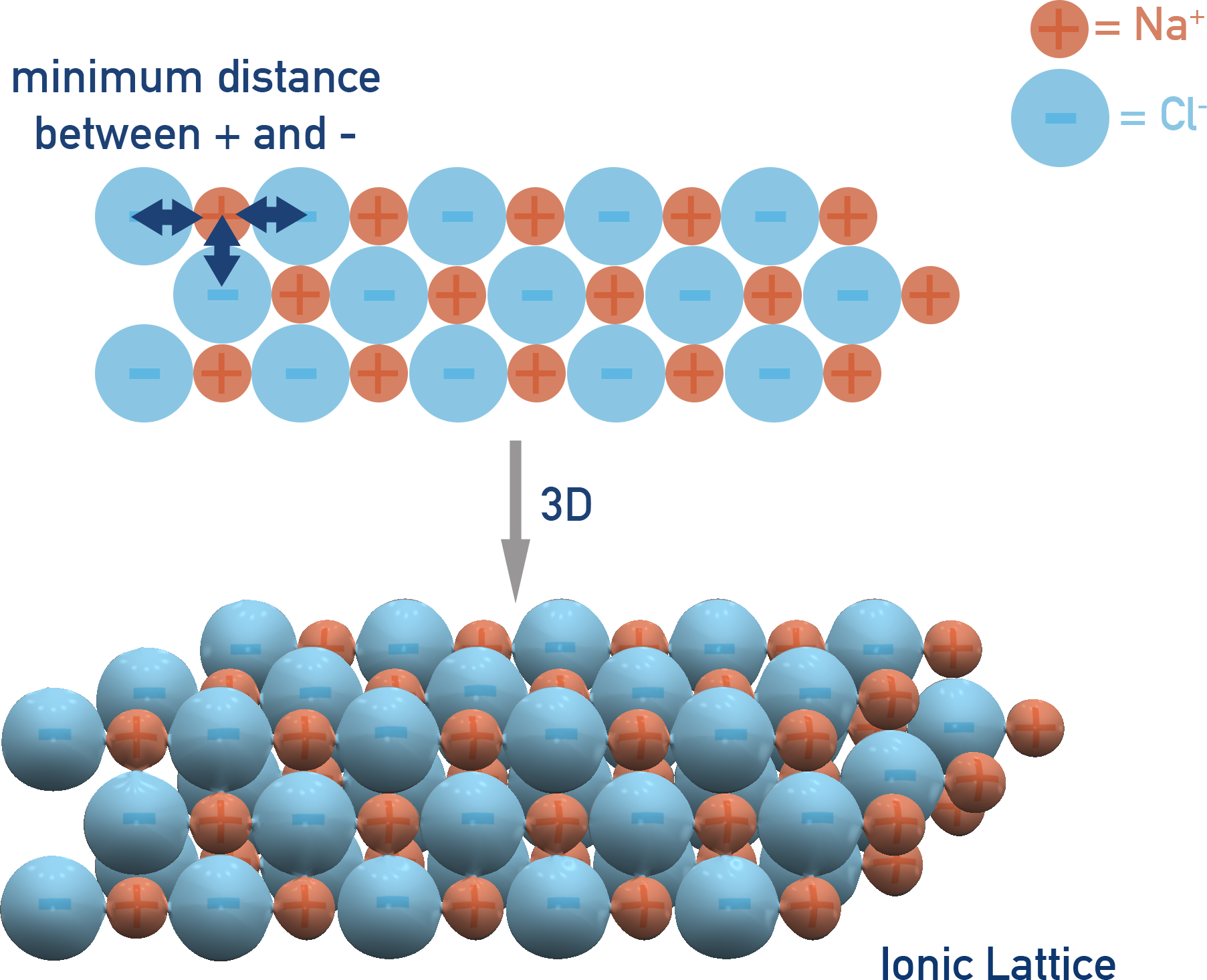
The formation of this ordered lattice from scattered gaseous ions releases a tremendous amount of energy. This energy is called the lattice energy.
Quantifying Stability: Lattice Energy
Lattice energy is the key to understanding the stability of ionic compounds. However, its definition can be a source of confusion. Let's clarify this first.
Lattice Enthalpies and Born Haber Cycles
The Chemistry LibreTexts page on Lattice Enthalpies provides a precise discussion on the two common, and opposing, definitions of lattice energy. Reading this short section will ensure we have a clear and unambiguous foundation for the rest of the lesson.
Read the section titled 'Defining Lattice Enthalpy'. Focus on the distinction between 'lattice dissociation enthalpy' (breaking the lattice) and 'lattice formation enthalpy' (forming the lattice).
As you've just read, we can define it in two ways:
- Lattice Dissociation Enthalpy: The energy required to break 1 mole of an ionic solid into its constituent gaseous ions. This is always a positive (endothermic) value.
- Lattice Formation Enthalpy: The energy released when 1 mole of an ionic solid is formed from its constituent gaseous ions. This is always a negative (exothermic) value.
Both definitions describe the same physical quantity—the strength of the ionic bonds in the lattice—just from opposite directions. For consistency, we will use lattice dissociation enthalpy (a positive value), but be aware that you will encounter both conventions. The crucial takeaway is that the magnitude of the lattice energy is a measure of the ionic compound's stability.
Now, our energy calculation makes sense. The cost of forming the ions (+147 kJ/mol) is more than paid for by the massive energy released when the lattice forms (-787 kJ/mol). The overall process is highly exothermic, which is why sodium and chlorine react so vigorously to form stable salt crystals.
Factors Affecting Lattice Energy
What determines the magnitude of the lattice energy? Since the force is electrostatic, we can use Coulomb's Law as our guide:
Here, and are the charges of the ions, and is the distance between their centers. This gives us two main factors:
- Ionic Charge (q): As the magnitude of the charges on the ions increases, the electrostatic attraction increases dramatically, leading to a much higher lattice energy. This is the most dominant factor.
- Ionic Radius (r): As the size of the ions increases, the distance between their centers increases. This weakens the electrostatic attraction, leading to a lower lattice energy.
Let's watch a video that explains these factors with clear, comparative examples.
Ionic Bonding | Lattice Energy Trends and Bond Strength (8.1) | General Chemistry
This video from Chad's Prep clearly defines lattice energy and then systematically walks through how ionic charge and size affect its magnitude.
Watch from 09:12 to 15:34. Pay close attention to: The formal definition of lattice energy presented (it corresponds to the dissociation enthalpy we've discussed). The logic used to compare the lattice energies of different compounds, first by looking at charges, and then by looking at ionic radii if the charges are the same.
To summarize the logic from the video:
- When comparing lattice energies, always look at the charges first. A compound with +2/-2 ions (like MgO) will have a vastly larger lattice energy than one with +1/-1 ions (like NaCl), even if the sizes are similar.
- If the charges are the same, then compare the ionic radii. The compound with the smaller ions will have a higher lattice energy because the ions can get closer together.
The Born-Haber Cycle: A Complete Picture
We have accounted for the energy changes intuitively. There is a formal way to map these steps called the Born-Haber cycle. It is a practical application of Hess's Law that connects all the individual energy changes (atomization, ionization, electron affinity, and lattice energy) to the overall enthalpy of formation of the ionic compound.
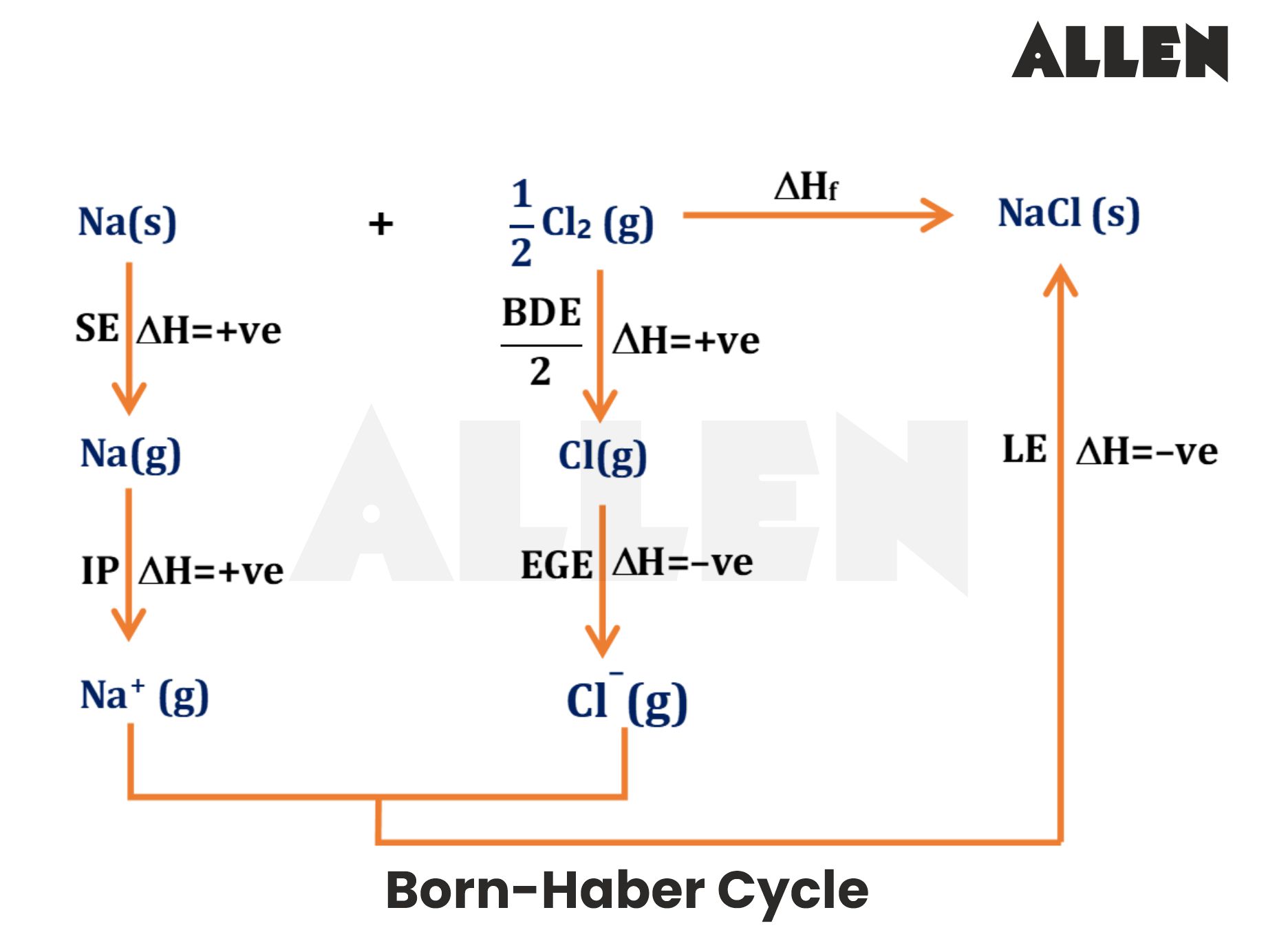
The power of this cycle is that it provides a complete energetic justification for why certain compounds form with a specific stoichiometry. It answers questions like, "Why is magnesium chloride MgCl₂, and not MgCl or MgCl₃?"
Lattice Enthalpies and Born Haber Cycles
To explore this deeper 'why', let's return to the Chemistry LibreTexts resource. The section on the Born-Haber cycle for MgCl₂ is a perfect example of the explanatory power of this tool.
Read the section titled 'Example: Born-Haber Cycle for MgCl₂'. You don't need to memorize the exact numbers. Instead, focus on the argument. Understand why MgCl is less stable than MgCl₂ and why MgCl₃ is extremely unstable. Pay attention to the trade-off between ionization energy and lattice energy.
As you saw, the formation of MgCl₂ is the most energetically favorable path. Although forming a Mg²⁺ ion requires a large energy input (the second ionization energy), this cost is more than compensated by the much larger lattice energy resulting from the +2 charge. Conversely, the astronomical energy required for the third ionization of magnesium is too great for even the lattice energy of a hypothetical MgCl₃ to overcome, making it highly unstable.
Guided Discovery Problem
Let's use these principles to analyze and predict the stability of ionic compounds.
Problem:
(a) Ranking Stability:
Arrange the following ionic compounds in order of increasing lattice energy (from least stable to most stable lattice). Justify your ranking based on the principles of ionic charge and radius.
LiF, RbI, CaO, SrS
(b) The Paradox of Oxides:
The formation of a gaseous oxide ion (O²⁻) from a gaseous oxygen atom is highly endothermic overall:
- O(g) + e⁻ → O⁻(g) ΔH = -141 kJ/mol (exothermic)
- O⁻(g) + e⁻ → O²⁻(g) ΔH = +798 kJ/mol (highly endothermic!)
- Net: O(g) + 2e⁻ → O²⁻(g) ΔH = +657 kJ/mol
Despite the huge energy cost to create the O²⁻ ion, stable ionic oxides like magnesium oxide (MgO) are very common and have very high melting points, indicating a very stable lattice. Explain this apparent paradox. How can MgO be so stable?
(c) A Hypothetical Compound:
Consider the hypothetical formation of Neon Fluoride (NeF). Neon's first ionization energy is 2081 kJ/mol. Fluorine's electron affinity is -328 kJ/mol. The lattice energy of NeF is theoretically estimated to be similar to that of NaF, around +780 kJ/mol (dissociation).
- Calculate the approximate enthalpy of formation (ΔH_f) for one mole of gaseous Ne⁺ and F⁻ ions from their gaseous atoms.
- Using the lattice energy, estimate the overall enthalpy of formation for solid NeF.
- Based on your calculation, would you expect NeF to be a stable compound that forms from neon and fluorine? Why is this consistent with the known chemistry of noble gases?
- Insight from the Problem: This problem set is designed to move you from direct application to deeper synthesis. Part (a) is a direct test of the ranking rules. Part (b) presents a classic conceptual puzzle that forces you to identify the dominant energetic factor (lattice energy) in a real-world scenario. Part (c) uses a counterfactual (a compound that doesn't exist) to demonstrate how these energy calculations explain fundamental patterns in chemistry, like the inertness of noble gases. It shows that the "rules" we learn are consequences of these underlying energetic trade-offs.
Conclusion
Today, we resolved the paradox of ionic bonding. The transfer of an electron is not the end of the story; it is the beginning.
Key Takeaways:
- Ionic bonding occurs between atoms with a large ΔEN, leading to the formation of cations and anions.
- The formation of isolated gaseous ions is typically an energy-intensive (endothermic) process.
- The true stability of an ionic compound comes from the lattice energy: the massive amount of energy released when gaseous ions assemble into a rigid, ordered crystal lattice.
- Lattice energy is governed by Coulomb's Law: its magnitude increases dramatically with higher ionic charges and decreases as ionic size increases.
- The Born-Haber cycle is a thermodynamic tool that maps all the energy contributions, providing a complete explanation for the stability and stoichiometry of ionic compounds.
We have now explored the idealized extremes of bonding: pure covalent sharing and complete ionic transfer. In our final lesson on bonding, we will unify these concepts by examining the potential energy curve for a diatomic molecule, which provides a universal framework for understanding bond length, bond energy, and the continuous nature of the chemical bond.