Hello again! Welcome back to our course on creating impactful videos for non-profits.
In our first lesson, we explored the what—the key emotional pathways like empathy, compassion, and hope that motivate audiences to act. We talked about how your role as a filmmaker is akin to a neurochemist, using story to create an "angels' cocktail" of hormones in the viewer.
Today, we're diving deeper into the how. Our goal is to explain the neuroscience of how stories can bypass rational resistance to influence decision-making. You've seen this happen in your own work—an audience is moved to act not by a list of facts, but by a story that seems to speak directly to their heart. We'll unpack the science behind this phenomenon, giving you a research-backed understanding of why your craft is so powerful.

We'll investigate three core ideas:
- How the brain is fundamentally wired to think in stories.
- The specific chemical chain reaction that turns feeling into action.
- How your choices as a director can literally synchronize the brain activity of an entire audience.
Let's begin.
1. The Brain's "Story Net": Hardwired for Narrative
The most fundamental reason stories bypass rational thought is that our brains are not neutral processors of information. They are, by evolutionary design, story processors. Information presented as a list of facts requires conscious, effortful translation. Information presented as a story plugs directly into the brain's native operating system.
Researcher and storyteller Kendall Haven calls this the "neural story net." It's a network in the brain that automatically tries to make sense of incoming information by fitting it into a story structure—and this happens before the information even reaches our conscious, rational mind.
To understand this foundational concept, let's hear from Kendall Haven himself.
In this clip from his talk "Your Brain on Story," Kendall Haven explains the groundbreaking finding that our brains are hardwired to turn information into story form before we are even consciously aware of it. This is the very definition of bypassing rational resistance.
Please watch from 7:29 to 10:43. Pay close attention to his explanation of the 'neural story net' and the 'make sense mandate.' Notice what he says about how the brain distorts incoming information to fit a story structure.
As Haven explains, your brain is not passively receiving information. It is actively and automatically working to fit everything into a narrative. This has a staggering implication for your work:
If the information you provide doesn't fit a story structure, the viewer's brain will ignore, augment, reinterpret, or even invent details until it does.
This means that simply presenting the facts about a non-profit's mission is not enough. Your job is to provide the story that the brain is desperately looking for. When you do, you're not fighting for rational buy-in; you're aligning with a deep, pre-conscious cognitive process. The story becomes the vehicle that carries your message past the viewer's analytical guards.
2. The Neurochemical Engine: How Feeling Drives Action
So, our brains are built for story. But what is the fuel that makes the story-engine run and ultimately drive behavior? In our last lesson, we introduced oxytocin. Now, let's look at the direct, measurable evidence that links a story to a chemical release and then to a concrete, altruistic action.
Neuroeconomist Paul Zak has conducted landmark research demonstrating this process. He showed participants a short, emotional video about a little boy with brain cancer named Ben and his father.
Empathy, Neurochemistry, and the Dramatic Arc: Paul Zak at the Future of StoryTelling 2012
Let's watch Dr. Paul Zak describe his famous experiment. He details how a simple, poignant story triggers a specific neurochemical response that directly predicts whether someone will donate money.
Watch the first 2 minutes and 57 seconds of this talk. Note the two specific chemicals he identifies and the distinct role each one plays. Listen for the 'punchline' where he connects the release of these chemicals to prosocial behavior.
Zak's experiment reveals a powerful two-part mechanism:
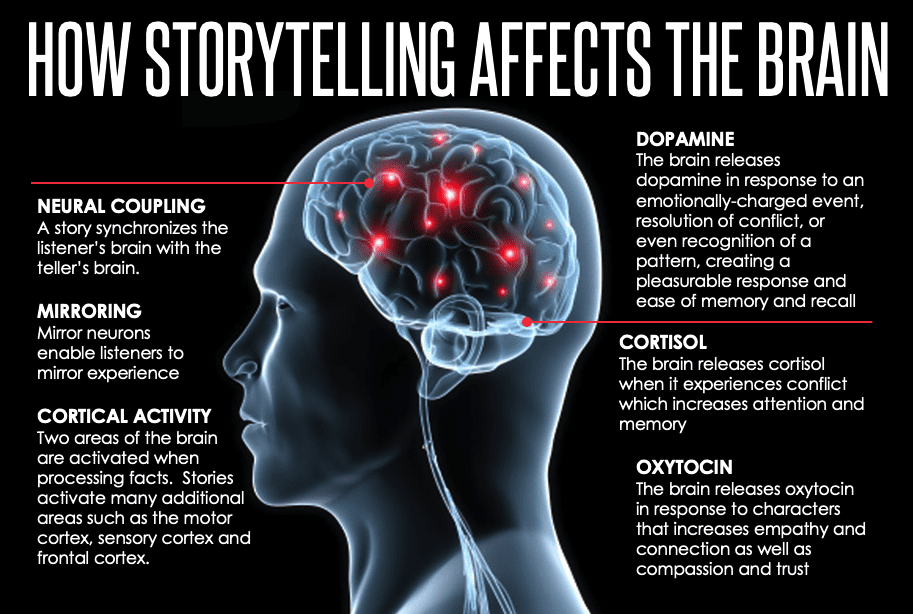
- Cortisol Release (The Attention Signal): The story's tension and distress cause the brain to release cortisol. While often known as a stress hormone, in this context, its function is to signal "Pay attention! This is important." It grabs the viewer's focus and holds it on the narrative.
- Oxytocin Release (The Empathy Signal): As the viewer connects with the father and son, the brain releases oxytocin. As we discussed, this is the neurochemical of empathy, connection, and trust.
Here is the critical finding: The people who released both cortisol and oxytocin were the most likely to donate money to a stranger or a charity after the video. Attention alone wasn't enough. Empathy alone wasn't enough. It was the combination of focused attention and emotional connection that drove action.
This is the neuroscientific blueprint for the "deeper impact" you seek. A successful non-profit film must first capture and sustain attention through narrative tension, and then use that attention to build an empathic connection that triggers the release of oxytocin.
Test your understanding!
Consider a documentary film or a scene you find particularly moving and persuasive.
- Where does the film create tension to command your attention (the 'cortisol' moment)?
- Where does it build character connection to foster empathy (the 'oxytocin' moment)?
- How does the film combine these two to make its point more powerfully than a simple statement of fact would?
Show answer
Let's take the example of the documentary Blackfish.
-
Cortisol (Attention): The film creates immense tension and commands attention through scenes depicting whale attacks on trainers, especially the graphic descriptions and chilling 911 calls related to Dawn Brancheau's death. This shocking, high-stakes conflict makes it impossible to look away.
-
Oxytocin (Empathy): The film builds a deep empathic connection to the orca, Tilikum. It tells his life story, showing footage of his traumatic capture as a calf and his subsequent confinement in a small concrete pool. By framing him as a victim and a character with a tragic backstory, the film fosters a powerful sense of empathy for him.
-
Combination: The film doesn't just state "keeping orcas in captivity is dangerous and cruel." It first uses the cortisol-inducing attack scenes to grab our undivided attention and establish the stakes. Then, it uses that focused attention to deliver the oxytocin-inducing story of Tilikum's suffering. The combination is devastatingly effective. The audience is primed by the danger, then emotionally connected to the cause of that danger, leading to the conclusion that the system itself is the problem. This bypasses a rational debate about marine park economics and creates a visceral, emotional conviction.
3. Neurocinematics: The Filmmaker as Brain Synchronizer
We've established that the brain is wired for story and that stories trigger chemical reactions. The final piece of the puzzle, especially for you as a filmmaker, is understanding how your specific craft—editing, framing, and sound design—can direct this neurological process.
An emerging field called Neurocinematics uses fMRI scans to see what happens in people's brains while they watch movies. One of the most fascinating discoveries is a phenomenon called Inter-Subject Correlation (ISC).
In simple terms, ISC measures how similar the brain activity is across different people as they watch the same film.
- Low ISC means everyone's brain is doing something different. People are noticing different things, thinking different thoughts, and their minds are wandering.
- High ISC means the audience's brain activity is synchronized. They are paying attention to the same things at the same time, and their emotional and cognitive responses are aligned. The filmmaker is, quite literally, getting everyone on the same wavelength.
This has profound implications. If a filmmaker can control an audience's brain states, they can guide their thoughts and emotions.
Neurocinematics: The Neuroscience of Film
This foundational paper, "Neurocinematics: The Neuroscience of Film," explains how movies can 'control' viewers' mental states. It's a bit academic, but the core ideas are revolutionary for filmmakers.
Please read two key parts of this paper: Find the paragraph that begins "There are two important implications..." (on page 2). Focus on the connection the authors make between controlling brain states and controlling mental states. Next, read the section titled "Specificity and Selectivity of Inter-Subject Correlation" (starting on page 6). Pay attention to the experiment comparing a tightly edited Sergio Leone film to an unedited, single-shot video of a park. This is the crucial evidence.
The key takeaways from this research are powerful validation for the art of filmmaking:
- Direction Over Reality: The study showed that a tightly edited film by a director like Sergio Leone produced high ISC. An unedited, single-shot video of a real-life event in a park produced very low ISC. This is scientific proof that your directorial choices—framing, cutting, guiding the eye—are what create a shared experience and control attention. A mere recording of reality is not enough.
- Filmmaking is Mind-Guiding: As the authors state, if we accept that mental states are tied to brain states, then "controlling viewers’ brain states... is the same as controlling their mental states including their percepts, emotions,thoughts, attitudes, etc."
This is the ultimate explanation for how stories bypass rational resistance. By using the tools of your craft, you are not just presenting a story; you are actively orchestrating a synchronized neurological experience for your audience, guiding them through a specific emotional and cognitive journey that makes your intended message feel like their own personal discovery.
Conclusion
Today we've moved from the what to the how, exploring the neuroscience that makes storytelling such a potent tool for influence.
Key Takeaways:
- Stories are the Brain's Native Language: Your brain is not a neutral observer. It has a "neural story net" that automatically and pre-consciously processes the world through a narrative lens, making story the most direct path for a message.
- The Attention-Empathy Engine: Effective stories trigger a one-two neurochemical punch. First, cortisol focuses attention through tension. Then, oxytocin builds an empathic connection. This combination is what powerfully motivates prosocial behavior.
- Directing is Brain-Synchronizing: Through intentional filmmaking choices like editing and composition, you can create high Inter-Subject Correlation (ISC), aligning the brain activity of your audience and guiding them through a shared mental and emotional journey.
Preview of the Next Lesson:
We've seen how powerfully stories can engage the brain's emotional, non-rational systems. But is an emotional appeal always the best strategy? What if your audience is highly analytical, or the topic is complex?
In our next lesson, we will address this by learning to apply the Elaboration Likelihood Model to choose between emotional and rational appeals for different audiences and goals. This will give you a strategic framework to decide when to bypass rational resistance and when to engage it directly.