Hello! Welcome back.
In our last lesson, we explored the fascinating neuroscience of how a well-crafted story can bypass an audience's rational defenses and trigger an emotional, action-oriented response. We saw how you, as a filmmaker, can act as a "neurochemist," using narrative to synchronize brain activity and release a cocktail of chemicals like cortisol and oxytocin.
This raises a critical strategic question: if emotional stories are so powerful, should you always lead with them? What about situations where your audience is more analytical, or the call-to-action requires careful consideration, like a multi-year funding commitment?
Today's lesson addresses this directly. Our goal is to apply the Elaboration Likelihood Model to choose between emotional and rational appeals for different audiences and goals. This model is a cornerstone of persuasion psychology and will provide you with a powerful framework for deciding when to tug at the heartstrings, when to appeal to the logical mind, and how to effectively do both.
The Elaboration Likelihood Model (ELM): Two Paths to Persuasion
At its core, the Elaboration Likelihood Model (ELM) proposes that we process persuasive messages through one of two mental "routes." The route we take depends on how much we are willing and able to think—or "elaborate"—on the message.
To get a clear overview of this model, please watch the following video.
This short animated video provides an excellent introduction to the Elaboration Likelihood Model. It clearly defines the two processing routes and the factors that determine which one we use.
Please watch from the beginning to 04:54. Focus on understanding: The difference between the Central Route and the Peripheral Route. The three factors that determine the route: Motivation, Ability, and Opportunity. The type of attitude change that results from each route (long-lasting vs. temporary).
As the video explained, these two routes represent the two fundamental ways our brains engage with a persuasive message. Let's solidify these concepts.
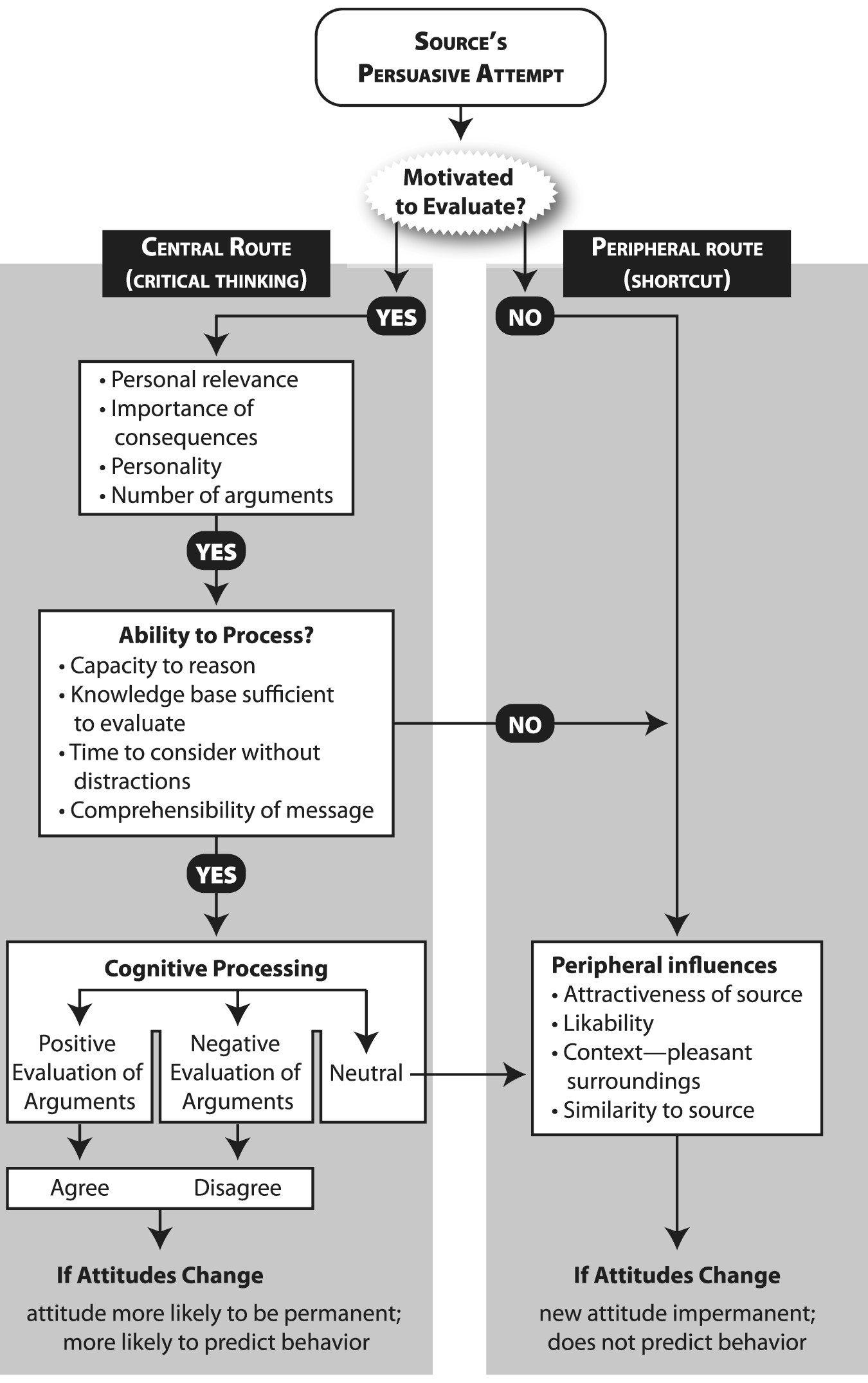
The Two Routes to Persuasion
-
The Central Route: This is the path of high effort and conscious thought. When an audience takes this route, they are actively analyzing the arguments, scrutinizing the evidence, and weighing the pros and cons. They are, in a word, elaborating.
- Triggered by: High motivation, ability, and opportunity.
- Best appeals: Logical arguments, data, credible evidence, expert testimony.
- Result: Strong, long-lasting attitude change that is resistant to counter-persuasion and predictive of future behavior.
-
The Peripheral Route: This is the path of low effort and mental shortcuts. When an audience is not motivated or able to think deeply, they rely on simple cues to make a decision.
- Triggered by: Low motivation, ability, or opportunity.
- Best appeals: Emotional stories, attractive or likable sources (characters), powerful music, striking visuals—all the things we discussed in the last lesson!
- Result: Weaker, temporary attitude change that is more susceptible to change.
Your expertise in creating emotional connections is perfectly suited for the peripheral route. The neuroscience we explored previously explains why these peripheral cues are so effective. The ELM gives us a framework for knowing when to deploy them.
Applying ELM to Your Non-Profit Video Strategy
The power of this model comes from using it to analyze your audience and your goals before you even start scripting. Let's translate the three key factors—Motivation, Ability, and Opportunity—into the context of non-profit filmmaking.
- Motivation: How much does your target viewer already care? A long-term donor has high motivation. A person randomly encountering your video on social media has low motivation.
- Ability: Does your audience have the background knowledge to understand complex arguments about your work? Is their viewing environment conducive to concentration? A program officer at a foundation has high ability. Someone watching on a noisy subway has low ability.
- Opportunity: How much time and attention can you realistically expect? A captive audience at a gala gives you a high opportunity. A pre-roll ad on YouTube gives you a very low opportunity.
By assessing your audience on these three factors, you can predict which route they will likely take and design your video accordingly.
The following article provides a perfect, real-world application of this thinking for non-profits.
Episode 65: The Science of Emotional Fundraising
This article, "The Science of Emotional Fundraising," directly applies the ELM to a non-profit context. It brilliantly illustrates how to tailor your strategy based on the audience's processing route.
Please read the section under the heading "The Two-Route Brain." Pay close attention to the contrast between how you should approach 'major donors reading your newsletter' versus 'social media followers casually scrolling'.
As the article makes clear, the same cause requires completely different strategies for different audiences.
- High Elaboration Audience (likely Central Route): This includes major donors, foundation boards, and corporate partners. They are motivated and able. For them, a purely emotional appeal can feel superficial or even manipulative. They need their logical minds engaged. Your video must provide substance—the "why" behind the "what."
- Low Elaboration Audience (likely Peripheral Route): This includes the general public on social media or viewers of a TV spot. They are likely distracted and have low initial motivation. For them, facts and figures are just noise. You need to use powerful, simple emotional cues to grab their attention and prompt an immediate, almost automatic, response.
Research confirms this. A study on fundraising messages on social media found that rational characteristics like informativeness had no significant effect on giving intention. However, messages with a strong emotional charge were highly effective. In the low-elaboration context of a social media feed, the brain defaults to the peripheral, emotional route.
Structuring Your Appeal: A Strategic Framework
Let's put this into a practical table you can use in your pre-production planning.
| Audience & Context | Likely Elaboration | Dominant Route | Recommended Video Strategy |
|---|---|---|---|
| Social Media Campaign (e.g., TikTok, Instagram) | Low | Peripheral | Emotional Focus: A 15-45 second, visually arresting video. Use powerful music, and focus on a single, compelling character. The message is the emotion. The call-to-action is simple and immediate (e.g., "swipe up to sign"). |
| Gala/Fundraising Event | High | Central | Blended Focus: A 5-10 minute film. Start with an emotional story to create connection (peripheral entry-point), then pivot to rational proof (central satisfaction) with impact data, program logic, or expert voices. End by returning to the emotional story. |
| Meeting with a Foundation/Major Donor | High | Central | Rational Focus: A polished, 2-4 minute video that presents a clear, logical case for support. Use infographics, testimonials from experts, and data visualizations to prove efficacy and ROI. The story element should serve to illustrate the data, not replace it. |
| General Awareness on Your Website's Homepage | Mixed | Both | Blended Focus: Offer both routes. Feature an emotional "brand anthem" video prominently, but also provide links to more detailed, data-driven videos or reports for those who want to "learn more" and engage their central route. |
Test your understanding!
A non-profit that builds clean water wells in remote villages needs two videos:
- A short video for a YouTube pre-roll ad campaign targeting a general audience.
- A primary video for a grant application package being sent to the "Global Health & Infrastructure Foundation."
Using the ELM, briefly outline the core persuasive strategy (emotional, rational, or blended) for each video and justify your choice based on the likely audience and processing route.
Show answer
-
YouTube Pre-Roll Ad:
- Audience: General, low motivation (they want to skip the ad), low opportunity (they have 5 seconds before they can skip).
- Likely Route: Peripheral.
- Strategy: Purely Emotional. The video must make an impact in seconds. It should use powerful peripheral cues: a striking visual of a child drinking dirty water contrasted with a child joyfully splashing in clean water. The music should be poignant. There is no time for stats. The goal is a quick emotional jolt that might lead to a click or, at minimum, a fleeting positive association with the brand.
-
Grant Application Video:
- Audience: Foundation program officers. High motivation (it's their job to review this), high ability (they understand development work), and high opportunity (they will watch the full video).
- Likely Route: Central.
- Strategy: Primarily Rational, Supported by Emotion. The video must satisfy their need for logical proof. It should lead with data on the health and economic impact of the wells, feature interviews with engineers about the sustainability of the technology, and include testimonials from community leaders about the long-term benefits. A personal story can be woven in to illustrate these rational points and maintain engagement, but the core of the message must be a logical, evidence-based argument for why this project is a sound investment.
Conclusion: The Sophisticated Storyteller
Being an impactful filmmaker in the non-profit space isn't just about telling emotional stories; it's about telling the right kind of story to the right audience at the right time. The Elaboration Likelihood Model elevates you from a storyteller to a communication strategist.
Key Takeaways:
- The ELM offers two paths to persuasion: The Central Route for logical, deep thinking, and the Peripheral Route for emotional, shortcut-based decisions.
- Your audience determines the path: Their Motivation, Ability, and Opportunity dictate whether they will engage with a rational argument or be swayed by an emotional cue.
- Tailor your appeal: For low-elaboration contexts like social media, lean into the powerful emotional and neurochemical triggers we've discussed. For high-elaboration contexts like a foundation meeting, you must blend that emotion with the credible, logical evidence needed to satisfy the central route.
By diagnosing your audience's likely processing route, you can be more intentional and effective, ensuring your message not only connects but also convinces.
Preview of the Next Lesson:
Sometimes, even a perfectly chosen appeal can fall flat. Why is it that audiences can become desensitized or even resistant to stories of need? In our next lesson, we will explore this challenge as we learn to recognize common psychological barriers (e.g., compassion fatigue, psychic numbing) that prevent audiences from acting. This will equip you to craft stories that can overcome these deep-seated defense mechanisms.