Hello! Welcome to the fourth lesson in our course.
In our last session, we explored the Elaboration Likelihood Model and how to strategically choose between rational and emotional appeals based on your audience and context. We saw that a powerful emotional story is often the key to persuasion, especially in low-attention environments like social media.
But what happens when even a compelling emotional story fails to connect? As a filmmaker, you've likely experienced this: you pour your heart into a piece that you believe is profoundly moving, yet the audience response is muted. They see the suffering but don't act. Why does this happen?
This lesson confronts that challenge head-on. Our learning outcome is to recognize common psychological barriers (e.g., compassion fatigue, psychic numbing) that prevent audiences from acting. Understanding these deep-seated defense mechanisms is the key to crafting narratives that can skillfully navigate them, ensuring your call for deeper impact is heard and felt.
1. Psychic Numbing: The Arithmetic of Compassion
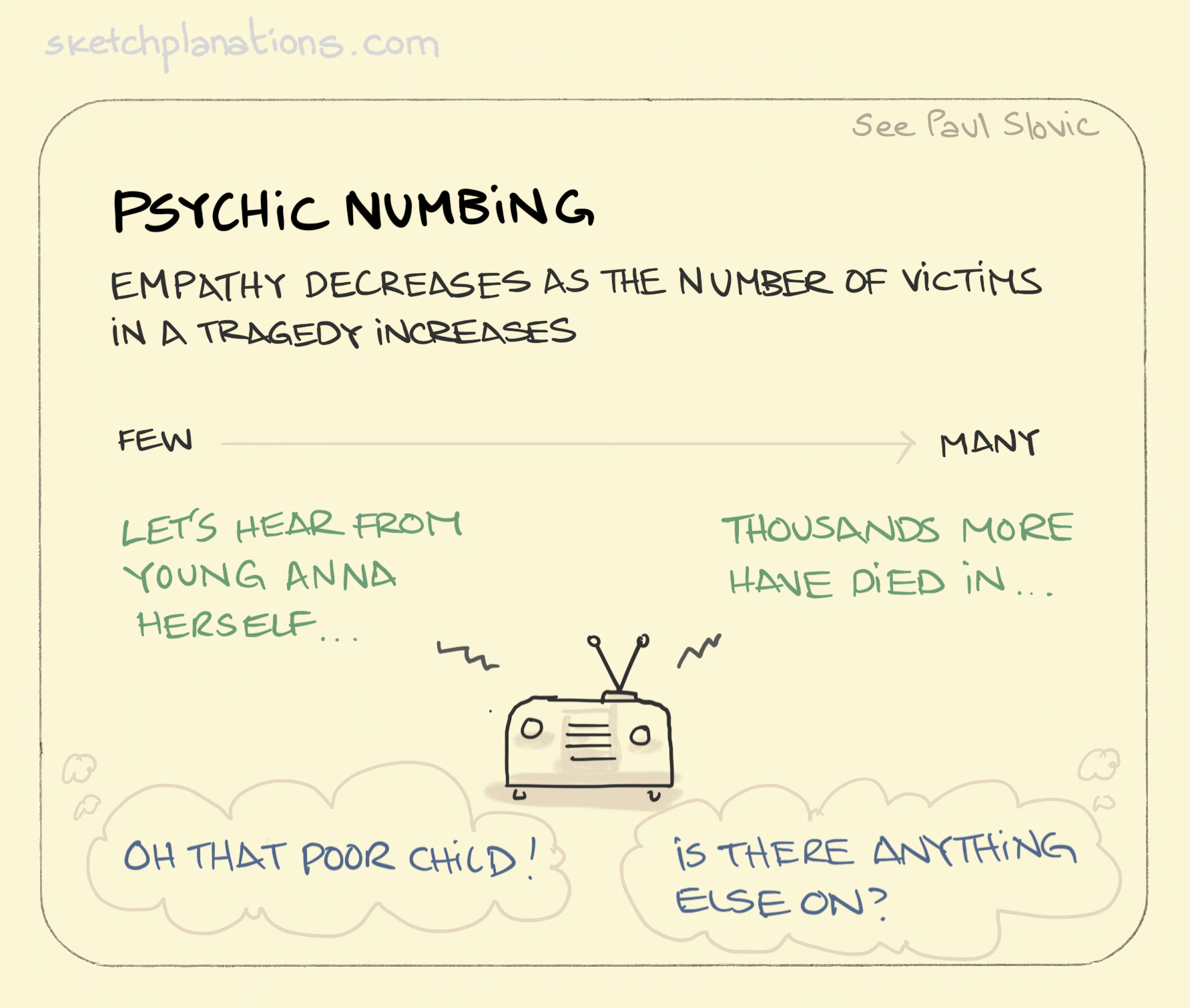
One of the most powerful and counterintuitive barriers you'll face is a phenomenon known as "psychic numbing." In short, our capacity to feel for others doesn't scale in a logical way. As the number of people suffering increases, our empathy often decreases.
To understand this concept from its source, please watch the following TEDx talk by Dr. Paul Slovic, the leading researcher in this field.
HUMAN TRAGEDIES: THE MORE WHO DIE, THE LESS WE CARE | Paul Slovic | TEDxKakumaCamp
In this foundational talk, 'HUMAN TRAGEDIES: THE MORE WHO DIE, THE LESS WE CARE,' Dr. Paul Slovic explains the core psychological mechanisms behind our seeming indifference to mass suffering.
Please watch from the beginning until 08:00. Focus on: Dr. Slovic's core summary: 'The more who die, the less we care.' The distinction between 'fast' (intuitive, feeling) and 'slow' (logical, calculating) thinking. Why our 'fast' thinking system, which drives emotion, fails to comprehend large numbers.
As Dr. Slovic explains, this isn't a moral failing; it's a cognitive feature. Our emotional system evolved to respond to immediate, individual threats, not abstract statistics. Statistics, as one saying goes, are "human beings with the tears dried off."
The following graphs visually represent the two phenomena Dr. Slovic describes.

This leads to a stark conclusion for storytellers: a story about thousands of people in need may be less effective than a story about one.
So, how do you, as a filmmaker, fight psychic numbing? By giving the "fast thinking" emotional system what it understands: an individual.
How to Tell Stories About Complex Issues
The article 'How to Tell Stories About Complex Issues' from the Stanford Social Innovation Review offers a practical antidote to psychic numbing for communicators.
Please read section 1 of the article, titled 'Tell stories about individuals.' Note how it connects Dr. Slovic's research directly to a narrative strategy, using the story of Aylan Kurdi as a prime example.
By anchoring a large, complex issue in the tangible experience of one person, you bypass the brain's numerical shutdown and create a direct emotional pathway for the viewer. Your past work on character-driven documentaries has already given you the skills to do this masterfully; this psychological framework now explains why it is so critically important.
2. Pseudo-Inefficacy: The "Drop in the Bucket" Problem
Psychic numbing is only part of the story. Even if an audience connects emotionally with an individual, another barrier can arise: the feeling that their contribution is meaningless in the face of an overwhelming problem. Dr. Slovic calls this a "false sense of powerlessness" or pseudo-inefficacy.
Let's return to Dr. Slovic's talk to see how this works.
HUMAN TRAGEDIES: THE MORE WHO DIE, THE LESS WE CARE | Paul Slovic | TEDxKakumaCamp
This segment of Dr. Slovic's talk explores why learning about those we can't help can demotivate us from helping the one person we can.
Please watch from 11:09 to 14:41. Pay close attention to the experiment involving the single starving child versus the same child presented alongside statistics of millions. The result is profoundly counterintuitive.
The key takeaway is that the "warm glow" of helping is diminished by the negative feeling of not being able to solve the whole problem. The audience thinks, "My $20 donation is just a drop in the bucket," and this feeling of inadequacy can lead to inaction.
This means your narrative has two jobs:
- Make the audience care about an individual (overcome psychic numbing).
- Frame the call-to-action in a way that feels significant and effective (overcome pseudo-inefficacy).
A story that says "Help us save Rokia" is more powerful than one that says "Rokia is one of millions you can't help, but you can help her." Your call-to-action must convey that even a partial solution saves a whole life.
This concept is neatly summarized in an interview with Dr. Slovic.
A psychologist explains the limits of human compassion - Vox
This Vox article, 'A psychologist explains the limits of human compassion,' provides a concise summary of the key barriers to action.
Please read the two sections titled 'Three factors keep people and politicians from intervening...' and '"Even partial solutions save whole lives"'. This will reinforce the concept of pseudo-inefficacy and provide concrete advice for communicators like you.
3. Compassion Fatigue: When Empathy Becomes a Burden
Finally, we turn to a barrier that builds over time: compassion fatigue. This is different from psychic numbing. It's not about the number of victims in a single story, but about the cumulative emotional toll of being exposed to many traumatic stories over time.
This is especially relevant for your most dedicated supporters—the ones who follow your non-profit's work closely. If every communication is a story of tragedy, they can become emotionally exhausted and begin to disengage as a form of self-protection.
Drowning in Empathy: The Cost of Vicarious Trauma | Amy Cunningham | TEDxSanAntonio
In 'Drowning in Empathy,' therapist Amy Cunningham explains the nature of compassion fatigue. While her talk is aimed at helping professionals, the mechanism is highly relevant for understanding audience burnout.
Please watch from 00:58 to 02:19 and again from 03:43 to 05:03. Focus on: The definition of compassion fatigue as a set of vicarious trauma symptoms. The key distinction from burnout: compassion fatigue changes your worldview and can make you fearful or overly vigilant.
For an audience, compassion fatigue might manifest as:
- Actively avoiding your content because it's "too depressing."
- Becoming cynical about the possibility of change.
- Feeling emotionally numb or detached from stories that once moved them.
Recognizing the risk of compassion fatigue doesn't mean you should stop telling difficult stories. It means you must be a responsible steward of your audience's emotional energy. This often involves strategically balancing stories of need with stories of hope, impact, and resilience—a topic we will explore in-depth in a later module on narrative structure.
Test your understanding!
Imagine a long-time donor to a wildlife conservation group sees two different videos:
- A video stating that 100,000 elephants were lost to poaching in the last decade. The donor feels overwhelmed and unsure what to do.
- A video detailing the brutal, day-by-day reality of anti-poaching rangers, which they find so distressing that they decide to stop watching the group's updates for a while.
Which psychological barrier is most prominent in each scenario?
Show answer
-
Psychic Numbing & Pseudo-Inefficacy: The large, impersonal number (100,000) triggers psychic numbing. The scale of the problem also induces a sense of pseudo-inefficacy—the feeling that their individual donation can't possibly make a meaningful difference against such a massive loss.
-
Compassion Fatigue: This scenario describes an emotional overload from repeated exposure to traumatic content. The donor isn't shutting down because of a number, but because the emotional cost of engaging with the story has become too high. This is a classic example of an audience disengaging to protect their own emotional well-being.
Conclusion
Your goal is to move people to act, but the human mind has developed sophisticated defenses against being overwhelmed by the world's suffering. As a filmmaker, you can't simply batter these walls with emotion; you must learn to unlock the gates.
Key Takeaways:
- Psychic Numbing is a cognitive barrier where our empathy fails to scale with large numbers of victims. The most effective counter is to tell the story of a single, identifiable individual.
- Pseudo-Inefficacy is the feeling that one's actions are too small to matter. Your narrative must frame the call-to-action in a way that feels concrete, meaningful, and effective.
- Compassion Fatigue is an emotional exhaustion from repeated exposure to trauma. It requires you to be a mindful storyteller, balancing difficult truths with messages of hope and impact to sustain audience engagement over the long term.
By recognizing these barriers, you are no longer just reacting to audience indifference; you are proactively designing stories that anticipate and navigate it.
Preview of the Next Lesson:
Theory is powerful, but seeing it in action is transformative. In our next lesson, we will bring together everything we've learned in this module. We will analyze a successful non-profit video, deconstructing its use of psychological triggers, emotional arcs, and its strategies for overcoming the very barriers we discussed today.