Introduction
In our last lesson, we examined the 26th and 27th Amendments, a profound and controversial episode of constitutional engineering that illustrated how Pakistan's foundational legal framework can be subjected to immense political pressure. Such events, where the core balance of power is radically altered, naturally lead to a more fundamental question: How has the 1973 Constitution itself managed to endure? Despite being suspended by military dictators, distorted by amendments, and frequently violated in spirit, it has remained Pakistan's "permanent constitution" for over half a century, a feat its predecessors could not achieve.
This lesson aims to answer that very question. We will assess the key factors contributing to the 1973 Constitution's remarkable resilience. Our analysis will go beyond a simple description of its features to explore the unique historical consensus that birthed it, the protective mechanisms embedded within its text, and the powerful idea of "resurgent constitutionalism"—where the document gains strength by serving as a rallying point for democratic struggle. This inquiry is central to your CSS preparation, as it requires a deep, analytical understanding of Pakistan's political and legal identity.
The Bedrock of Legitimacy: A Constitution Born of Consensus
To understand the endurance of the 1973 Constitution, we must first return to the moment of its creation. Pakistan in December 1971 was a nation shattered. The trauma of military defeat, the secession of its eastern wing, and the humiliation of having over 90,000 prisoners of war created an existential crisis. It was from the ashes of this dismemberment that the urgent need for a new, unifying social contract arose.
Zulfikar Ali Bhutto, upon assuming power, understood that a constitution imposed by a single party, even one with a majority, would lack the moral authority to hold the fragmented nation together. The mistakes of the past—where constitutional arrangements failed to secure broad-based agreement—had led directly to the 1971 tragedy. Therefore, a path of deliberate and painstaking consensus-building was chosen.
Why the original Constitution of 1973 still matters?
This article from The Express Tribune eloquently captures the historical context and the spirit of consensus that defined the making of the 1973 Constitution. It provides the "why" behind its foundational strength.
Please read the article, focusing on two key aspects: The description of the historical backdrop of 1971, which created the necessity for a truly consensual document. The explanation of Bhutto's decision to opt for consensus and the inclusive process involving diverse political leaders. Also, note the conclusion that the Constitution was conceived as a social contract.
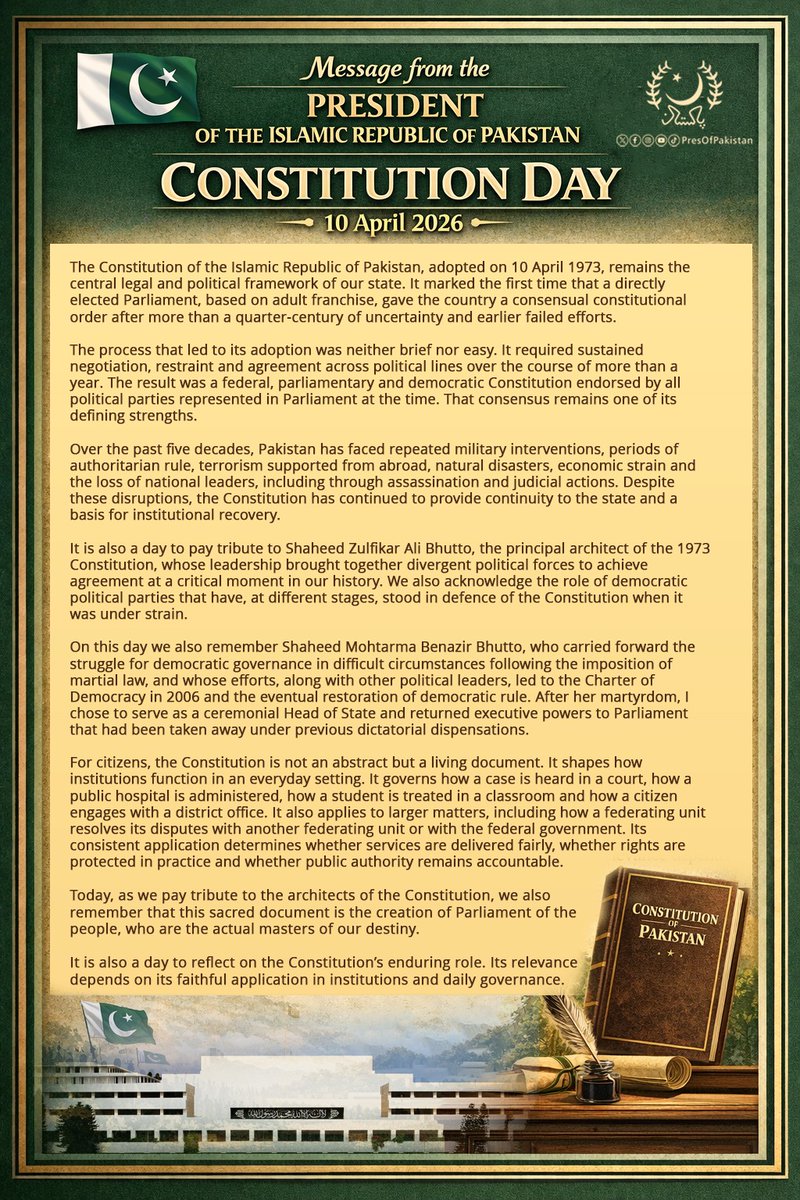
As the article highlights, the unanimity achieved on April 10, 1973, was not merely a legislative formality. It was a political and moral compact. Leaders from across the political spectrum, including staunch opponents of the government like Khan Abdul Wali Khan and Mufti Mehmood, set aside deep ideological differences to endorse a single document. This consensus imbued the 1973 Constitution with a unique and powerful legitimacy that its predecessors never had. It became more than just a law; it became a symbol of national reconciliation and a shared resolve to avoid repeating the errors that led to dismemberment.

Structural Safeguards: The Constitution's Armor
The framers of the constitution were not naive. They were acutely aware of Pakistan's history of constitutional abrogation and military coups. To protect their hard-won consensus, they embedded specific structural safeguards into the document to make it difficult to overturn.
A short video, designed for CSS preparation, explains these critical features concisely.
Constitution of 1973| Constitution of Pakistan
This video highlights the key textual features that have contributed to the Constitution's longevity, distinguishing it from the 1956 and 1962 versions.
Please watch the following key segments: First, understand the crucial distinction that the 1973 Constitution was suspended but not abrogated (annulled). This is a vital difference from previous constitutions. Next, focus on the explanation of its rigid nature, which requires a two-thirds majority in both the National Assembly and the Senate for any amendment. Finally, pay close attention to the discussion of the high treason clause, which makes any attempt to subvert the Constitution a capital crime.
These two features form the Constitution's primary defense mechanism:
-
Rigidity: Unlike a simple law, the Constitution cannot be amended by a fleeting majority. The requirement of a two-thirds supermajority in both houses of Parliament ensures that any change must have broad political support, preventing a single party or a weak coalition from easily altering the foundational text. This forces negotiation and compromise, reinforcing the original spirit of consensus.
-
The High Treason Clause (Article 6): This is perhaps the most powerful safeguard. It explicitly states that any person who abrogates or subverts the Constitution by use of force is guilty of high treason, an offense punishable by death. While its enforcement has been inconsistent, its very existence acts as a significant legal and psychological deterrent against overt military takeovers. It ensures that abrogating the Constitution is not a political act, but a capital crime. This is a key reason why military dictators since 1973 have opted to "suspend" or "hold in abeyance" the Constitution, rather than annulling it outright, as they implicitly acknowledge its supreme legal status.
Resurgent Constitutionalism: A Living Document Forged in Struggle
While consensus and safeguards are crucial, the most profound reason for the 1973 Constitution's endurance lies in its lived experience. It has survived not by being a perfect, untouchable text, but by becoming the central arena for political struggle in Pakistan. This idea is best captured by the academic concept of "resurgent constitutionalism."
The scholar Maryam S. Khan argues that the Constitution's legitimacy has been built and reinforced over time through a recurring cycle: it is suspended or distorted by authoritarian forces, only to be reclaimed and revived by pro-democracy movements that use it as their central rallying cry.
[PDF] Founding Moments and Pakistan ' s ' Permanent Constitution ' of 1973
This academic paper provides the core theoretical framework for our lesson. It argues that the 1973 Constitution's strength comes from its instrumental role in political struggles.
This is a dense but highly rewarding text. Please focus on the central arguments: First, read the section that introduces the core thesis. You will find it starting with the paragraph "Hence, it is with some trepidation...". Focus on understanding the argument that the Constitution should be appraised on its instrumental value in enabling opposition. Grasp the definition of a founding moment as "resurgent" and "negotiated." Next, read the section that provides the historical evidence, beginning with the paragraph "The resurgent model of founding moments...". Pay close attention to the examples used to illustrate the ex post (after enactment) struggles that strengthened the Constitution, such as the MRD, the Lawyers' Movement, and the 18th Amendment.
As you've read, the endurance of the Constitution can be broken down into two elements:
-
Ex Ante Legitimacy (The Founding Moment): This refers to the conditions of its birth. As we discussed, the unprecedented democratic consensus forged in the aftermath of the 1971 crisis gave the Constitution its initial, powerful legitimacy.
-
Ex Post Resurgence (The Lived Struggle): This is the crucial, dynamic element. The Constitution's status has been cemented by the political and social movements that have fought to restore it.
- The Movement for the Restoration of Democracy (MRD) in the 1980s did not call for a new constitution; its central demand was the restoration of the 1973 Constitution against General Zia's military rule.
- The Lawyers' Movement (2007-2009) that led to General Musharraf's downfall was fought under the banner of the "rule of law" and the supremacy of the Constitution. The movement's goal was to restore the judiciary and constitutional order that the dictator had subverted.
- The 18th Amendment (2010) represents the pinnacle of this resurgence. After years of presidential and military distortions, a consensus-driven Parliament worked to systematically strip away the autocratic amendments and restore the Constitution to its original federal, parliamentary character.
Each of these episodes, born from a crisis, ended up reinforcing the Constitution's role as the sole legitimate framework for governance in Pakistan. It has endured precisely because it has proven to be the most potent symbol and tool for challenging authoritarianism.
Enduring Despite Its Flaws
The final piece of the puzzle is to acknowledge that the Constitution endures despite, not because of, its perfect implementation. As you know from your own studies and as is often debated in Pakistan, there is a persistent and painful gap between its promises and the political reality.
The Constitution of Pakistan, 1973: Constitutional Principles and Why Do They Matter
This public lecture explores the principles of the 1973 Constitution and critically evaluates how they have been implemented—or violated—in practice.
Please watch the main analytical section of the talk, titled "Evaluation of the Constitutional Principles in Pakistan." You can find it from this timestamp. The speaker discusses the gap between the constitutional ideal and the reality regarding institutional balance, representative government, rule of law, and fundamental rights.
The speaker in the video systematically outlines how every major institution—the executive, the legislature, the judiciary, and the military establishment—has, at various times, overstepped its constitutional boundaries, weakening the overall system. This reality does not negate the Constitution's importance; it reinforces it. The constant public and political debate over judicial activism, military interference, and the erosion of fundamental rights is itself a testament to the Constitution's role as the accepted benchmark against which the state's actions are judged. It endures because it remains the reference point for all arguments about what is right and what is wrong in the governance of Pakistan.
Conclusion
The 1973 Constitution's survival is not accidental. It is a product of a unique combination of historical foresight, structural design, and an ongoing political struggle for its soul. It has endured where others failed for four primary reasons:
- Consensual Origin: It was born not from the will of one man or party, but from a national consensus forged in the wake of a catastrophic failure of the state, giving it unparalleled moral legitimacy.
- Structural Defenses: Its rigid amendment process and the high treason clause (Article 6) provide a formidable legal armor against easy alteration or abrogation.
- Resurgent Power: It has repeatedly served as the central rallying point for major pro-democracy movements, with its legitimacy being reinforced each time it is restored after periods of authoritarian rule.
- Normative Benchmark: Despite frequent violations, it remains the undisputed standard against which the legitimacy of state actions is measured, making it the permanent battleground for Pakistan's political future.
Ultimately, the 1973 Constitution endures because it is more than a legal text; it is the embodiment of Pakistan's tumultuous quest for a stable, democratic, and federal identity.
Preview of the Next Lesson:
This lesson concludes our module on Pakistan's constitutional and political history. Having established the legal foundations of the state, we will now turn our attention to its physical and material realities. In the next module, we will begin by examining Pakistan's geography, analyzing how its strategic location has shaped its history, security, and its role in the region.