Introduction
Welcome back! In our last lesson, we established the fundamental role of metadata, explaining that it is the "data about data" that makes datasets discoverable, usable, and interpretable. We set the stage for this module's framework, SAD, which stands for the three main types of metadata: Structural, Administrative, and Descriptive.
Today, we will take a deep dive into the first category, Structural Metadata. The goal of this lesson is to learn how to identify structural metadata in a dataset. We'll move from abstract definitions to concrete examples, looking at how data is organized in both a bra design spreadsheet and a database designed for social research on relationships. By the end, you'll be able to recognize the "blueprint" or "skeleton" that gives a dataset its shape.
1. Defining Structural Metadata
Before we can identify structural metadata, we need a clear definition. At a high level, structural metadata describes how a dataset is organized. It's the blueprint that defines the data's internal architecture, the relationships between its different parts, and the rules that govern it.
To get a more formal understanding, let's start with a short reading that defines structural metadata and its key features.
Importance of Understanding Structural Metadata in Data Systems
This article from Actian, a data management company, provides a clear definition of structural metadata and distinguishes it from other types. It will give us a solid foundation for the rest of the lesson.
Please read the sections titled 'What is Structural Metadata?' and 'Key Features of Structural Metadata.' Focus on how it acts as a 'blueprint' for data organization and note the key features mentioned, such as data relationships, formats, and constraints.
As the article explains, structural metadata isn't the data itself, but rather the framework that holds the data. The key features it mentioned—Data Relationships, Data Formats and Types, Hierarchical Organization, and Data Integrity and Constraints—are the elements we will be looking for.
Let's see what this looks like in practice.
2. Structural Metadata in Bra Design
Your experience in lingerie design involves highly structured information. Technical packs, specification sheets, and bills of materials are all rich with structural metadata. Let's look at two concrete examples.
Example 1: The Components Spreadsheet
Imagine you are creating a "tech pack" for a new bra design. A crucial part of this is the list of all materials and components.
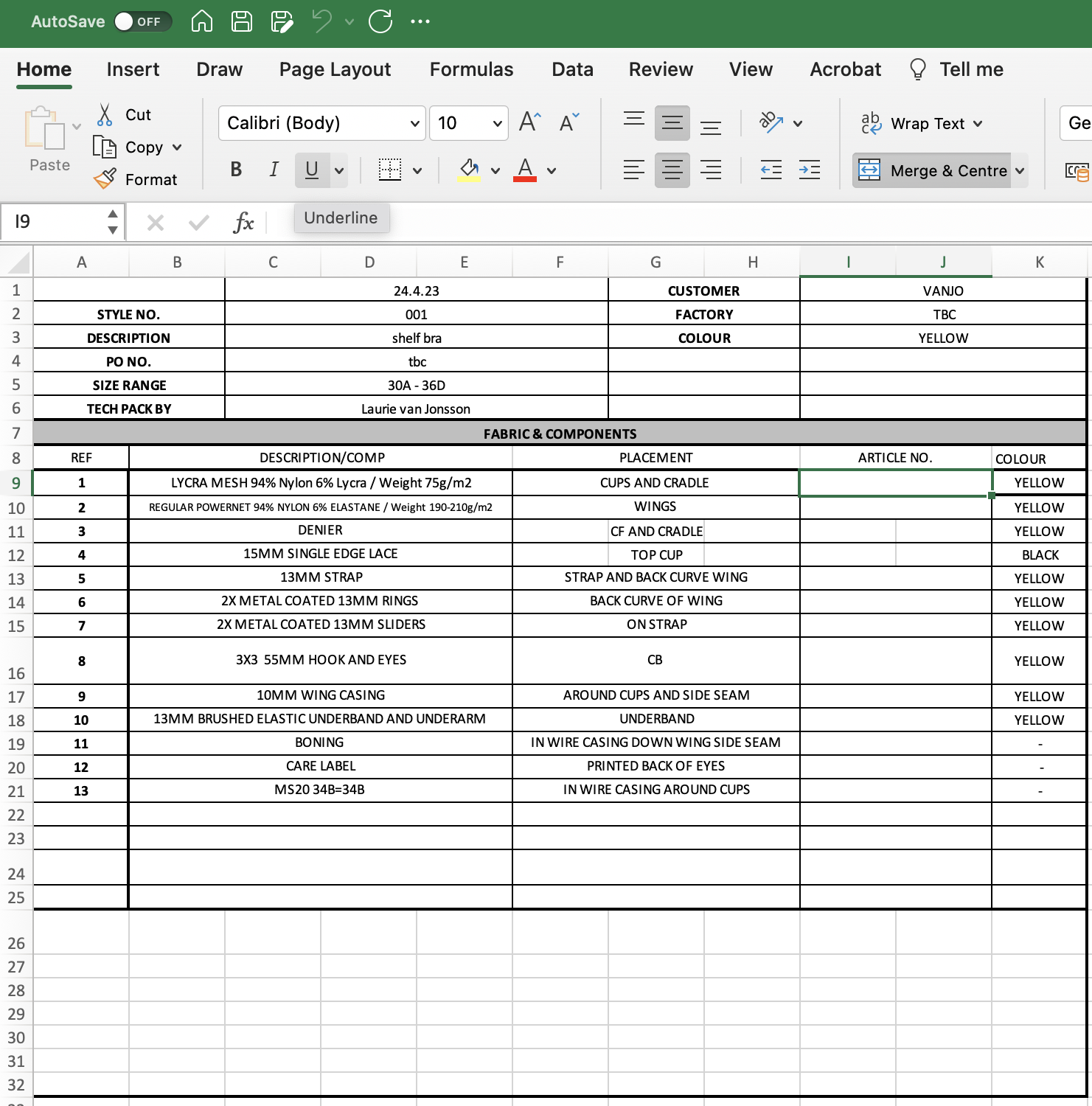
In this spreadsheet, the structural metadata is primarily the column headers:
STYLE NO.DESCRIPTIONSIZE RANGEFABRIC & COMPONENTSDESCRIPTION/COMPPLACEMENTCOLOUR
These headers define the schema for the data. They tell anyone looking at this sheet that for each component listed (e.g., 'LYCRA MESH'), there is corresponding information about its description, placement, and color. The tabular layout of rows and columns is itself a fundamental piece of structural metadata. It dictates that the data is organized as a list of records (rows), where each record has a consistent set of attributes (columns).
Example 2: The Measurement Specification Sheet
Now, let's consider the physical measurements of the garment. This requires another highly structured document.

Here, the structural metadata is even more detailed:
- The list of "Points of Measure (POM)": Items like
Body Length HPS,Chest Width 1" below armhole, andSleeve Length from Shoulderare the defined variables. This is the core structure for the measurement data. - The column headers for each POM: The columns
Tol (+/-),Target Proto Sample MSM,Actual Proto Sample MSM, andDiff. (+/-)define the specific data points to be collected for each measurement variable. This structure allows for systematic quality control by comparing design targets to actual samples.
In both examples, the structural metadata is what makes the data usable and interpretable. Without it, you would just have a list of numbers and words with no context.
3. Structural Metadata in Relationship Studies
Now let's switch to your work as a social researcher. Structuring data about human relationships, especially complex ones like polyamorous dynamics, presents a fascinating challenge that directly highlights the importance of structural metadata.
Imagine you are designing a longitudinal study to track the evolution of single-female-multiple-male polyamorous relationship structures (often called a "V" or "Vee"). You need to record who is involved, their roles, and how the relationships change over time. A simple spreadsheet would quickly become unmanageable. This is where database design, a formal process of defining structural metadata, becomes essential.
The following resource is a blog post and comment thread where database engineers discuss the challenge of modeling marriage. The comments contain excellent, specific proposals for how to structure such data.
Gay marriage: the database engineering perspective - Qntm
In this article, 'Gay marriage: the database engineering perspective,' and especially in its comments, people brainstorm different ways to structure data about relationships. This is a real-world example of defining structural metadata.
Please read the three specific comments from the article's comments section authored by 'Art', 'JoAnne', and 'Ryland'. You may need to scroll to find them. Focus on the table structures they propose—the names of the tables, the columns within them (like 'marriage_id', 'spouse_id'), and how they link together. These are concrete proposals for structural metadata.
The proposals in those comments offer different blueprints for structuring relationship data. Let's analyze a couple of them in the context of our study on "V" relationships.
The Relational Model Approach
Art and JoAnne's comments suggest a powerful and flexible approach known as a relational model. This is a perfect illustration of advanced structural metadata.
JoAnne proposes a three-table structure: persons, marriages, and memberships. Let's adapt this for our study:
-
PersonsTable: This table would hold data about each individual.person_id(A unique identifier for each person, e.g., P001)namedate_of_birth- ...other demographic data...
-
RelationshipsTable: This table defines each relationship unit.relationship_id(A unique identifier for each "V" unit, e.g., R01)relationship_type('Vee', 'Triad', etc.)start_date
-
MembershipsTable: This is the key that connects the other two tables. It specifies who is in which relationship, and when.membership_idrelationship_id(Links to theRelationshipstable)person_id(Links to thePersonstable)role(e.g., 'Hinge', 'Arm')join_dateleave_date(NULL if currently active)
This three-table design is the structural metadata. It defines:
- Entities: The core things we are tracking (
Persons,Relationships). - Attributes: The properties of those entities (the columns in each table).
- Relationships: How entities connect. The
Membershipstable explicitly links people to relationships, neatly modeling how one person (the "hinge" female) can be part of the samerelationship_idas multiple partners. This structure allows a partner to leave (by setting aleave_date) and a new partner to join, without having to change the whole data structure.
The concept of a relationship_id that links tables is called a foreign key, and it is a fundamental component of structural metadata in relational databases. Ryland's comment discusses a similar idea by placing a marriage_id directly on the humans table, which represents a different structural choice with its own trade-offs (for instance, it makes it harder for one person to be in multiple relationships simultaneously).
These different proposals show that defining structural metadata is an act of design, with choices that enable or constrain the types of questions you can answer with your data.
Conclusion
In this lesson, we demystified the concept of structural metadata by examining it in two very different, but highly relevant, contexts. We saw that whether you are designing a bra or studying human relationships, a clear data structure is essential.
Key Takeaways:
- Structural metadata is the blueprint of a dataset. It defines how the data is organized, what its components are, and how they relate to one another.
- In simple datasets like spreadsheets, structural metadata can be the column headers and the overall tabular layout.
- In complex datasets, like those used for longitudinal research, structural metadata is formally defined by a database schema, which includes tables, columns (with specific data types), and the relationships between tables (foreign keys).
- We identified structural metadata in bra design spec sheets (e.g., the list of "Points of Measure") and in proposed database schemas for modeling polyamorous relationships (e.g., using
persons,relationships, andmembershipstables).
Preview of the Next Lesson:
We have now covered the "S" (Structural) in our SAD framework. In the next lesson, we will move on to the "A": Administrative Metadata. This type of metadata deals with the management and lifecycle of data, answering questions like: Who created this data and when? Who owns it? And who is allowed to access it?