Introduction
Welcome to the first lesson in our fourth module, Structuring Data with SAD Metadata. In the previous module, we focused on evaluating the validity of external data sources using the ROCCC framework. You learned how to make a justified decision to include, reject, or use a dataset with caveats. A key challenge we repeatedly encountered was the lack of clear documentation, making it difficult to assess reliability or comprehensiveness.
This module flips the script. Now, we will learn how to document our own datasets responsibly so that others (and our future selves) can easily assess and use them. The foundation of this documentation is metadata.
Today's lesson addresses the fundamental "why" before we get to the "how." The learning outcome is to explain the role of metadata in making datasets discoverable, usable, and interpretable. We will define what metadata is and explore how it functions as the essential context that gives raw data meaning and value.
1. What is Metadata?
At its core, metadata is simply data about data. It's the information that provides context, structure, and meaning to a dataset. Without it, you're often left with a collection of numbers or text that is impossible to use.
To get a formal definition and understand its general importance, please read the introductory sections of the following article from Splunk.
Metadata 101: Definition, Types & Examples
This article, 'Metadata 101,' provides a clear and concise definition of metadata and its importance.
Please read the 'Key Takeaways' at the top, followed by the sections 'What is metadata?' and 'The importance of metadata.' Focus on the core definition and the high-level reasons why metadata is crucial.
As the article notes, metadata transforms raw information into a manageable asset. Let's consider this in the context of your specific interests:
-
Bra Design: Imagine you have a spreadsheet with thousands of rows, each containing measurements like
92,78,14. This is raw data. Is it usable? Not on its own. The metadata is what tells you: "These measurements are in centimeters. The first column is 'bust circumference', the second is 'band circumference', and the third is the difference. The data was collected in 2023 from a sample of 500 women aged 25-40 for the purpose of developing a new bra sizing system." The raw numbers are the data; the description of what they are is the metadata. -
Polyamory Research: You might have dozens of audio files of interviews. The audio file itself is the data. The metadata includes the file name convention (e.g.,
ParticipantID_InterviewDate_Topic.mp3), a separate log file identifyingParticipantID_01as "Female, 32, in a stable V-type polyamorous relationship for 4 years," and a document describing the research questions and interview protocol. Without this metadata, the audio files are just a collection of anonymous voices.
Now that we have a foundational understanding, let's explore the three primary roles metadata plays.
2. The Core Roles of Metadata
Our learning outcome highlights three key functions of metadata: making data discoverable, usable, and interpretable. These three pillars are what make data sharing and reuse possible.
A. Discoverable: Can the data be found?
Discoverability is the ability of a potential user to find your dataset when searching for information on a particular topic. Without descriptive metadata, your dataset is effectively invisible.
The Splunk article you just read has a brief section that introduces this idea.
Metadata 101: Definition, Types & Examples
Let's revisit the Splunk article to see how it frames the concept of discoverability.
Please read the short section titled 'Resource discovery.' Notice how it connects metadata (like keywords and descriptions) directly to the ability of search engines to find and categorize information.
This concept is especially vital in large, specialized archives. The following paper on metadata for fashion collections provides an excellent, domain-specific illustration of this challenge.
Comparative Study and Expansion of Metadata Standards for Historic Fashion Collections
This research paper discusses efforts to standardize metadata for fashion collections. It perfectly illustrates why discoverability is a major challenge in fields with complex objects like clothing.
Read the 'Abstract' and then the main text starting from 'Fashion (historic costume or dress) artifacts...' until the end of the paragraph that reads '...limiting the reach and accessibility of fashion collections’ online holdings.' Focus on how the lack of specific, standardized metadata makes it difficult for researchers to find what they're looking for.
As the paper highlights, if one collection tags a 1950s bullet bra as garment, undergarment and another tags a similar item as brassiere, conical cup, vintage, a researcher searching for "bullet bras" might miss the second item entirely. Good metadata, using standardized terms, ensures that when someone searches for data like yours, they can actually find it.
B. Usable: Can the data be worked with?
Once data is discovered, a user must be able to work with it. Usability refers to the practicality of opening, understanding the structure of, and manipulating the data. In our previous module on ROCCC, the sports bra dataset from the blogger was discoverable (you found the link) but barely usable because the data's format and meaning were so poorly documented.
Metadata that enhances usability answers questions like:
- In what file format is the data stored (e.g., CSV, JSON, SPSS .sav file)?
- What software is needed to open it?
- What do the column headers or field names mean?
- What units are used for measurements (e.g., inches, centimeters, pounds)?
- How are missing values coded (e.g.,
NA,-99,null)?
Imagine receiving a dataset on bra measurements. If the metadata doesn't specify the units, the data is unusable. A band measurement of 34 could mean 34 inches (a standard size) or 34 centimeters (impossibly small).
C. Interpretable: Can the data be understood?
Interpretability goes a step beyond usability. A user might be able to open and read the data, but can they correctly understand its meaning, context, and limitations?
Metadata that ensures interpretability answers questions like:
- Why was this data collected? (e.g., for academic research, commercial product design, a personal project)
- What was the data collection methodology? (e.g., online survey, in-person structured interviews, professional bra fittings)
- Who is the population being described? (e.g., "15 polyfidelitous units in the UK," "50 friends of a fitness blogger")
- Are there known biases or limitations? (e.g., "self-reported data," "convenience sample")
The fashion collection paper gives a great example of how refining metadata improves interpretability.
Comparative Study and Expansion of Metadata Standards for Historic Fashion Collections
Let's look at one more section from the fashion metadata paper. This section discusses how making metadata more precise leads to better interpretation of the artifact (the data).
Please read the section that begins 'This study highlighted differences...' through to the end of the 'Conclusions' section. Pay close attention to the examples, such as separating 'fiber content' from 'fabric structure.' This shows how more detailed metadata allows for a more accurate interpretation.
When metadata for a bra separates "fiber" (e.g., nylon, elastane) from "fabric structure" (e.g., lace, mesh), a designer can more accurately interpret its properties. Nylon lace and nylon mesh have very different stretch, support, and aesthetic qualities, even though their fiber content is similar. Good metadata allows for this crucial distinction.
Similarly, in your social research, a dataset about polyamorous dynamics must have metadata that precisely defines terms like "V," "triad," and "polyfidelity" as they are used in that dataset. Without these definitions, another researcher could easily misinterpret the findings.
3. The Attributes of Good Metadata
To summarize, effective metadata is the key to unlocking the value of a dataset. This infographic provides a clean visual summary of the qualities that good metadata bestows upon data.
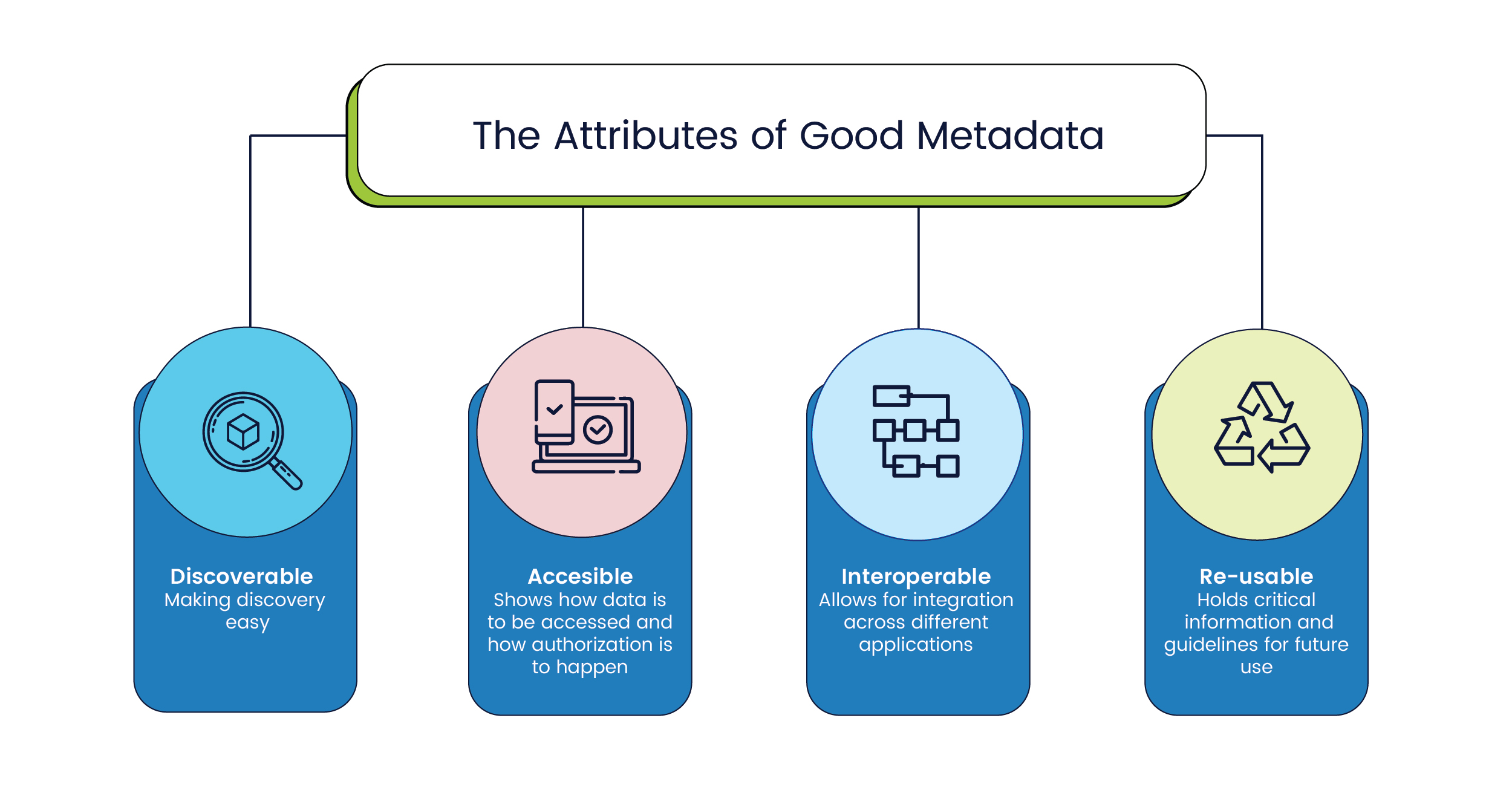
As you can see, Discoverable is front and center. Accessible relates to usability—knowing how to get and open the data. Interoperable and Re-usable are the ultimate goals, combining all three of our principles. Data is only truly interoperable and re-usable if it can be found, used, and correctly interpreted.
Conclusion
In this lesson, we established the fundamental importance of metadata. We moved from the abstract definition of "data about data" to a practical understanding of its role in making datasets functional and valuable for the wider research community.
Key Takeaways:
- Metadata is the contextual information that describes your data, such as variable definitions, units of measurement, and collection methodology.
- Without metadata, raw data is often unusable and uninterpretable.
- The three primary roles of metadata are to make a dataset:
- Discoverable: So it can be found by interested researchers.
- Usable: So it can be opened, read, and technically manipulated.
- Interpretable: So its meaning, context, and limitations can be correctly understood.
Preview of the Next Lesson:
Now that we have established why metadata is so critical, we can begin learning how to create it. In the next lesson, we will introduce the SAD framework you saw in the module title. We will break down the three primary categories of metadata—Structural, Administrative, and Descriptive—and learn to identify examples of each within datasets related to bra design and relationship studies.