Introduction
Welcome back. In our previous lesson, we explored the "S" in our SAD framework: Structural Metadata. We defined it as the blueprint of a dataset, examining how the organization of data in bra design spec sheets and relational database models for relationship studies gives the data its fundamental shape and context.
In this lesson, we turn to the "A" in SAD: Administrative Metadata. Our learning goal is to identify administrative metadata, focusing on key examples like data collection dates, access permissions on sensitive files, and data retention policies. This type of metadata is less about the data's internal structure and more about its management, provenance, and lifecycle. It answers the critical questions of who, when, where, and how regarding the data's creation, handling, and preservation.
1. What is Administrative Metadata?
While structural metadata is the skeleton, administrative metadata is the logbook and the set of rules governing the data asset. It tracks the data from its birth to its eventual archival or deletion, ensuring it is managed properly, securely, and in compliance with any relevant policies or regulations.
This diagram visually separates the three types of metadata. For Administrative metadata, focus on the questions it helps answer.
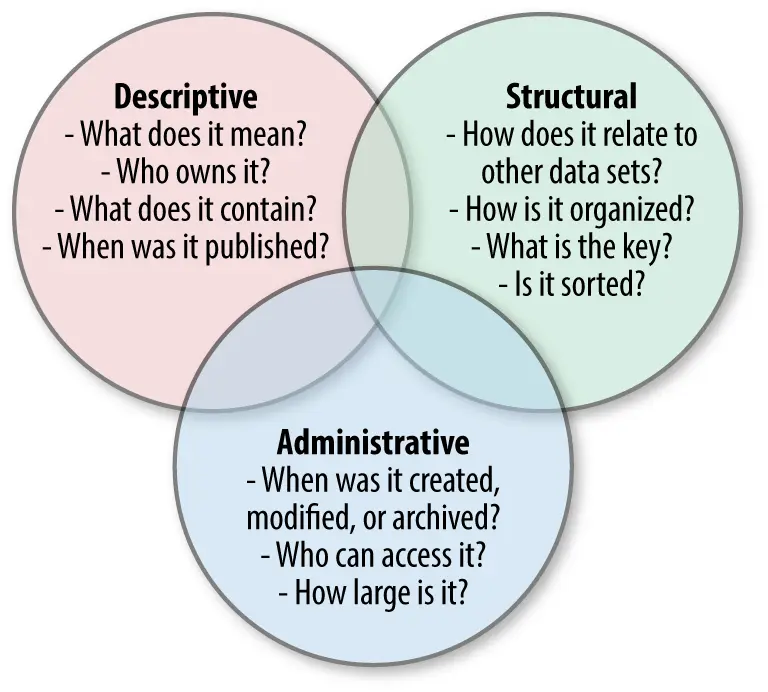
To build on this visual and establish a more formal definition, the following reading breaks down the key elements of administrative metadata.
Types of Metadata in Data Governance: A Complete Guide
This guide from OvalEdge provides a clear and concise definition of administrative metadata and its role in data governance. It will help us itemize the specific pieces of information we should look for.
Please read the section titled 'Administrative metadata.' Pay close attention to the 'Key elements' listed: Creation Date, File Format, Access Rights, Retention Period, and Version History. These will be our focus for the rest of the lesson.
As the article highlights, administrative metadata is crucial for managing the data lifecycle, ensuring compliance (think GDPR or IRB requirements), and maintaining security. Let's now see how to identify these elements in your specific domains of interest.
2. Administrative Metadata in Bra Design
In the context of designing and manufacturing lingerie, administrative metadata is essential for project management, quality control, and protecting intellectual property. Let's revisit the key elements using this lens.
-
Creation & Modification Dates: Think of the digital files for a bra pattern. The "Date Created" on the CAD file is a piece of administrative metadata. More importantly, the "Date Modified" and version history (e.g.,
Pattern_v1.2_final,Pattern_v1.3_revised-cup) are critical for tracking design changes. On the garment 'SPEC SHEET' from our last lesson, theDELIVERY DATEandSEASONfields also serve this temporal, administrative function. -
Access Rights: This is about who is permitted to do what with the data.
- The final pattern files might be read-only for the marketing team but have full read/write access for the lead designer and pattern maker.
- The costing spreadsheet, which contains sensitive financial data, would have highly restricted access, perhaps limited to the business owner and production manager. These access control lists, whether managed by a simple file system or a corporate server, are administrative metadata.
-
Retention Policies: This dictates how long data is kept.
- A company might have a policy to archive all design specifications for 7 years to handle potential customer complaints or manufacturing defects.
- Material safety data sheets for fabrics and dyes might need to be kept for a legally mandated period. The policy defining this period (
Retain for 10 years, then destroy) is administrative metadata that governs the data lifecycle.
-
File Format & Owner: Simple but vital information like the file type (
.aifor Adobe Illustrator,.dxffor pattern cutting software) and the designatedTECH DESIGNERorData Ownerare also core pieces of administrative metadata. They tell you what software you need and who to ask if you have questions.
3. Administrative Metadata in Social Research
When dealing with data on human subjects, especially in sensitive areas like non-monogamous relationships, administrative metadata becomes intertwined with research ethics. The principles of CTO POC (Consent, Transparency, Openness, Privacy, Ownership, Current) that you use in your course directly inform, and are documented by, administrative metadata.
The decisions made during the ethics approval process are a primary source of administrative metadata.
[PDF] (Some) Research Data Management Best Practices
This presentation on research data management best practices directly connects ethics applications and consent forms to data handling policies. It shows how administrative metadata is defined before data collection even begins.
Please read the slides covering 'Pre-Research Participant consent & Information letters' and 'Pre-Research Ethics applications' (slides 17-20). Focus on how statements about data preservation/destruction, security/confidentiality, and future use directly define the administrative metadata for a research project.
Let's apply the elements of administrative metadata to your proposed study of single-female-multiple-male polyamorous dynamics.
-
Data Collection Dates: The exact date an interview was conducted or a longitudinal survey was administered is a crucial piece of administrative metadata. It provides the temporal context for analyzing how relationships evolve.
-
Access Permissions & Security: This is paramount. The administrative metadata must specify:
- Who has access to the raw, identifiable interview recordings? (e.g.,
Principal Investigator only). - Who can access the de-identified transcripts? (e.g.,
Research team members listed on IRB-protocol-123). - Where is the data stored? The ethics application might state: "Data will be stored on the university's encrypted server, in a folder accessible only to the PI." This location and the encryption status are administrative metadata. The "Don'ts" mentioned in the presentation (e-mail, dropbox) are policies about preventing the creation of insecure data copies, which is also a form of administrative control.
- Who has access to the raw, identifiable interview recordings? (e.g.,
-
Data Retention Policies: The consent form and ethics application are where this is formally declared. For example:
- "Identifiable data (audio recordings) will be destroyed 5 years after the conclusion of the study."
- "De-identified transcripts and coded data will be archived in the university's secure data repository indefinitely for future research."
These statements are the retention policy—a key piece of administrative metadata that governs the long-term fate of the dataset.
-
Data Ownership and Provenance: Administrative metadata clarifies ownership (e.g., the university or the funding institution) and provenance (who collected the data, using what instrument). An
interviewer_IDcolumn in a dataset is a simple example that links a specific record back to the person who collected it, which is useful for quality control.
In essence, much of a Data Management Plan (DMP), which is required by many funding agencies, is a formal document for defining the administrative metadata of a research project before it starts. It's the proactive management of the data's entire lifecycle.
Conclusion
In this lesson, we have focused on Administrative Metadata, the component of our SAD framework concerned with the management and lifecycle of data. We've seen that it's not just a technical afterthought but a critical component of responsible and effective data handling.
Key Takeaways:
- Administrative metadata answers the "who, when, where, and how" of data management.
- Key elements include data creation/modification dates, access rights, retention policies, file formats, and ownership.
- In a design context, it helps manage intellectual property and production workflows.
- In a research context, administrative metadata is inextricably linked to ethics, defining the policies for security, privacy, and data longevity that are promised to participants and ethics boards.
Preview of the Next Lesson:
We have now covered "S" for Structural and "A" for Administrative. In our next lesson, we will complete the SAD framework by exploring "D" for Descriptive Metadata. This is the metadata that describes the content of the dataset to make it discoverable and understandable, answering the question, "What is this data about?"