Hello! Welcome to the next lesson in our heat transfer series.
In our previous lessons, we've dissected the three fundamental modes of heat transfer: conduction, convection, and radiation. We explored the governing laws for each—Fourier's law, Newton's law of cooling, and the Stefan-Boltzmann law. Most recently, we delved into the specifics of radiation spectra with Wien's displacement law.
Today, we'll begin the crucial process of synthesis. In nearly all real-world and JEE Advanced problems, these modes don't occur in isolation. Heat often conducts through a solid, then convects and radiates away from its surface simultaneously. Our learning outcome for this lesson is to formulate the steady-state energy balance for systems with simultaneous conduction, convection, and radiation. This means learning how to set up the governing equation based on the principle of energy conservation, which is the first and most critical step in solving complex heat transfer problems.
1. The Principle of Energy Balance
The foundation for analyzing combined heat transfer is the first law of thermodynamics, which is a statement of the conservation of energy. For any system or region in space, we can write:
A special and very common case is steady state. This condition implies that the temperature at any point within the system does not change with time. Consequently, the amount of energy stored within the system is constant, and its rate of change is zero.
For a system in steady state, the energy balance simplifies to:
Or, if there's no internal energy generation (e.g., from a chemical reaction or electric current):
This simple equation is our primary tool. The challenge lies in correctly identifying all the "in" and "out" energy streams, which can be any combination of conduction, convection, and radiation.
The Surface Energy Balance
A very common scenario involves applying this balance to a surface. Since a surface has no volume, it cannot store energy or have energy generated within it. Therefore, for any surface in steady state, the sum of all heat transfer rates to the surface must equal the sum of all heat transfer rates from the surface.
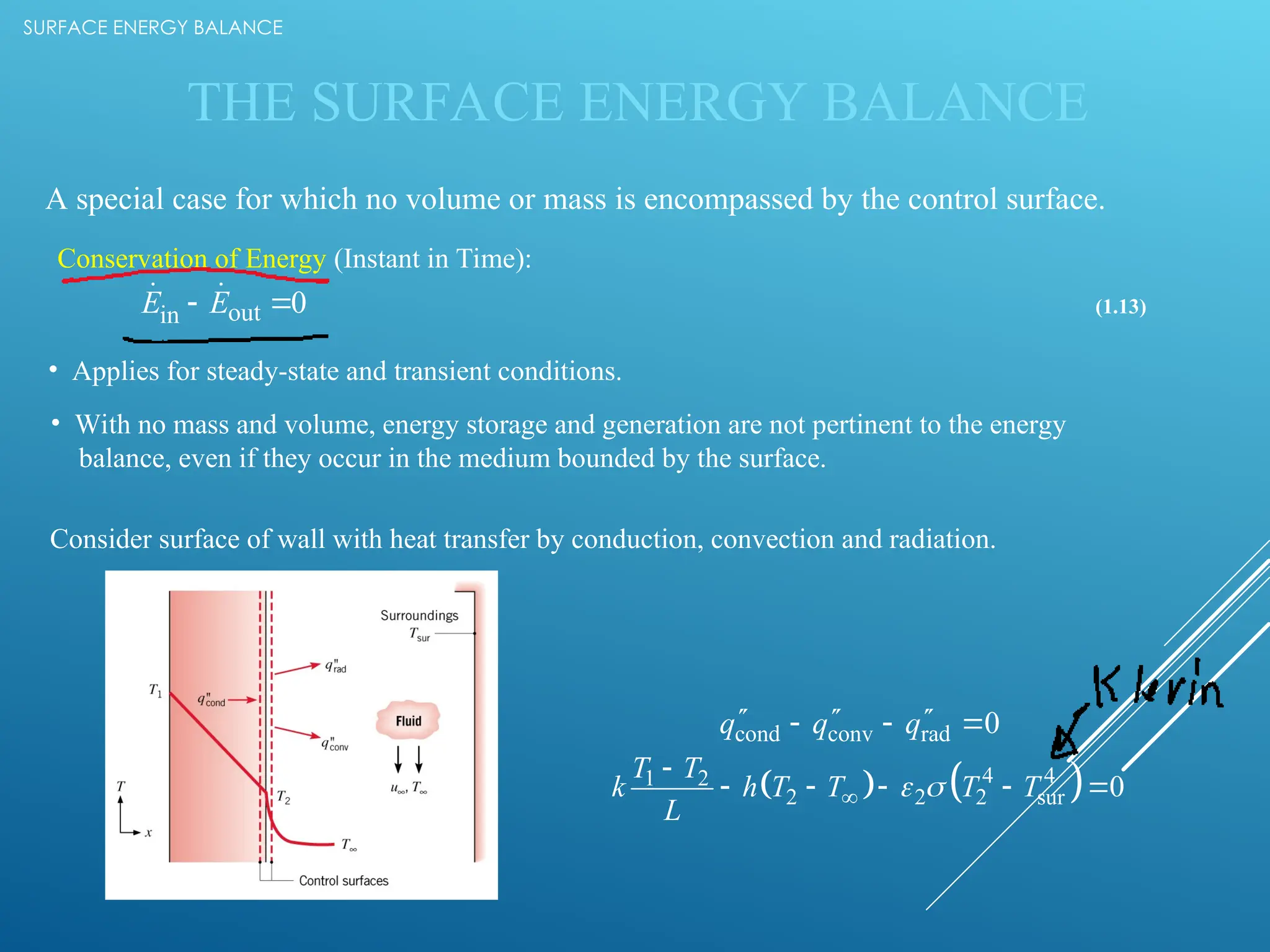
As shown in the image, the balance equation for the heat fluxes (rate of heat transfer per unit area, denoted by ) is:
Substituting the rate equations we've learned gives:
Here, is the surface temperature, is the surrounding fluid temperature for convection, and is the temperature of the distant surroundings for radiation. This is the kind of equation we will be formulating today.
2. The Thermal Resistance Network Analogy
Given your background in CS and mathematics, you'll find the analogy to electrical circuits extremely useful. We can model heat flow as current, temperature difference as voltage, and the opposition to heat flow as resistance.
- Conduction Resistance:
- Convection Resistance:
When multiple heat transfer paths exist, we can combine these resistances in series or parallel, just like electrical resistors.
- Series: Heat flows sequentially through multiple layers (e.g., conduction through a wall, then convection from the surface). The total resistance is .
- Parallel: Heat has multiple paths to flow from one point to another (e.g., convection and radiation leaving a surface simultaneously). The equivalent resistance is .
While the non-linear term in radiation makes its resistance temperature-dependent, the circuit analogy remains a powerful way to visualize the problem structure.
This document from Purdue University introduces the concept of using thermal circuits for combined heat transfer problems. Reading the first page will give you a good visual sense of this powerful analogy.
Please read the text on the first page of the PDF (labeled 'Page 26'). Focus on the bullet points that explain how thermal circuits, energy balances, and series/parallel resistances are used to solve steady-state problems. You don't need to analyze the specific window example in detail.
3. Formulating the Energy Balance: Worked Examples
Let's apply these ideas to formulate the balance equations for some typical JEE Advanced scenarios. The goal here is to correctly set up the final equation.
Example 1: Conduction, Convection, and Radiation from a Wall
Consider the situation in the image below. Heat is conducted through a wall of thickness . The outer surface at is at temperature . This surface loses heat to a surrounding fluid at temperature via convection and to the larger surroundings at temperature via radiation. The temperature at the inner surface is .

Our task: Formulate the steady-state energy balance at the outer surface ().
- Identify the System: The control surface is the outer face of the wall at .
- Identify Energy Transfers:
- Energy In: Heat arrives at the surface via conduction through the wall. .
- Energy Out: Heat leaves the surface via two parallel paths:
- Convection: .
- Radiation: . (Assuming surface emissivity is ).
- Apply Steady-State Balance: .
- Write the Full Equation:
The area can be cancelled out. This equation now relates all the temperatures and system properties. In the next lesson, we would use this to solve for an unknown like or .
Example 2: Steady State with Pure Radiation (JEE Advanced 2012)
Let's analyze a problem from your practice set. This problem deals with a pure radiation balance.
Previous Years JEE Advanced Questions
We'll now examine a past JEE Advanced problem that is a perfect example of a steady-state energy balance. This will demonstrate how the principle applies even when only one mode of heat transfer is dominant.
Please locate and read Question 23 on page 7. We will break down the formulation of the solution.
Problem (Q23): Three large parallel black plates are maintained at temperatures 2T, , and 3T. We need to find the temperature of the middle plate, , under steady-state conditions.
-
Identify the System: The middle plate (plate 2).
-
Identify Energy Transfers: The plate is in a vacuum, so only radiation matters. It receives radiation from plate 1 (at 2T) and plate 3 (at 3T). It emits radiation from both of its surfaces. A simpler way to think about this, since it's a thin, highly conductive plate, is that the net heat it receives from the hotter plate (3) must be equal to the net heat it loses to the colder plate (1).
-
Apply Steady-State Balance:
The net radiative heat transfer rate between two large parallel black plates is given by . -
Write the Equation:
- Heat transfer from 3 to 2:
- Heat transfer from 2 to 1:
Setting these equal gives:
This is our final formulated equation. Solving it gives .
Test your understanding!
Consider a small spherical ball placed in a large, evacuated chamber. The ball's surface has an electrical heater embedded in it, providing a constant power . The chamber walls are maintained at a constant temperature . The ball has radius , emissivity , and in steady state, its surface temperature is .
Formulate the steady-state energy balance equation for the ball.
Show answer
- System: The spherical ball.
- Energy Transfers:
- Energy In: Heat is generated internally by the heater at a rate .
- Energy Out: The ball loses heat to the chamber walls via radiation. Since the chamber is large, we can model this as radiation to surroundings at . The rate is , where .
- Steady-State Balance: . In this case, , , and .
This is the energy balance equation.
Example 3: Energy Balance in a Dynamic System
Sometimes the problem involves a change in temperature but asks for a rate, which still requires an energy balance.
Consider Problem 18 from the same PDF (LINK). Water in a container is heated by a 1 kW coil, while simultaneously losing heat to the environment at a rate of 160 J/s. This is not a steady-state problem (temperature is rising), but we can still write an instantaneous energy balance.
- Energy In: J/s (from the coil).
- Energy Out: J/s (dissipation to surroundings).
- Energy Stored: The net energy goes into increasing the water's internal energy. Rate of storage = .
The energy balance is .
This formulation shows that the net rate of energy gain by the water is 840 J/s. This allows you to calculate the total time for a given temperature change.
Conclusion
Today, we've established the universal framework for solving problems with multiple heat transfer modes: the steady-state energy balance. This approach transforms complex physical situations into solvable algebraic equations.
Key Takeaways:
- The cornerstone of combined heat transfer analysis is the energy conservation principle. For steady-state systems, this simplifies to Rate of Energy In = Rate of Energy Out.
- The first step in any problem is to define your system (a surface, a volume) and identify all modes of energy transfer (conduction, convection, radiation) crossing its boundaries.
- By substituting the correct rate equation for each mode, you can formulate a single energy balance equation that models the entire system.
- The thermal resistance network is a powerful analogy, especially for systems with series and parallel heat flow paths, that can help visualize the problem structure.
Preview of the Next Lesson:
We have focused today on formulating the energy balance equation. In our next lesson, we will shift our focus to solving these equations. We will tackle problems where we need to find an unknown equilibrium temperature or a specific heat flow rate, which often involves solving non-linear equations (due to the term in radiation). This will complete your toolkit for handling combined heat transfer problems at the JEE Advanced level.