Hello! Welcome back to our study of heat transfer.
In the last lesson, we focused on the total energy radiated by a body using the Stefan-Boltzmann law (). We saw that the total power emitted is a strong function of temperature. However, that law doesn't tell us about the quality or "color" of the emitted radiation. Why does a hot piece of iron glow first red, then orange, then white as it gets hotter?
Today, we'll answer that question. Our goal is to apply Wien's displacement law and analyze blackbody radiation spectra. This law provides the crucial link between a body's temperature and the specific wavelength at which it radiates most intensely. Mastering this concept is essential, as many advanced problems require you to use both the Stefan-Boltzmann and Wien's laws in tandem.
1. The Blackbody Radiation Spectrum
When an object radiates heat, it doesn't emit energy at just a single wavelength. Instead, the energy is distributed across a continuous spectrum of wavelengths. For a theoretical ideal emitter, a blackbody, the shape of this energy distribution curve depends only on its temperature.
To visualize this, let's watch a short video that introduces the experimental basis for Wien's analysis.
Class 11 Physics | Heat Transfer | #26 Wien's Black Body Radiation Laws | For JEE & NEET
This video from Physics Galaxy provides an excellent visual introduction to the blackbody radiation spectrum. It shows how the distribution of radiated energy across different wavelengths changes with temperature.
Watch the video from the beginning until 02:37. Focus on how the graph of 'spectral emission energy' vs. 'wavelength' is plotted and, most importantly, how the peak of this curve shifts as the temperature of the blackbody increases.
As you saw, the graph plots the intensity of radiation at each specific wavelength. There are two key features to notice on these curves:
- The Area Under the Curve: The total area under the curve represents the total power radiated per unit area. As temperature increases, the area grows rapidly. This corresponds to the Stefan-Boltzmann law () we studied previously.
- The Peak of the Curve: For any given temperature, there is a specific wavelength, , at which the radiation intensity is at its maximum. As the temperature increases, this peak shifts to shorter wavelengths.
This shift is what Wien's displacement law describes.
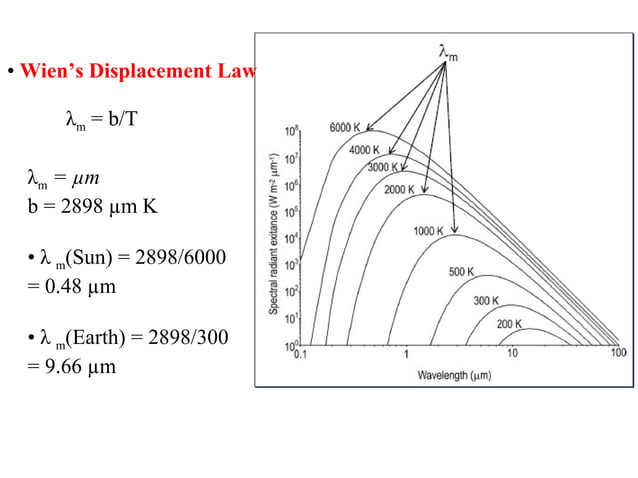
2. Wien's Displacement Law
Wien's experiments led to a simple but profound mathematical relationship between the peak wavelength and the absolute temperature of a blackbody.
Let's continue with the same video to get a formal statement of the law.
Class 11 Physics | Heat Transfer | #26 Wien's Black Body Radiation Laws | For JEE & NEET
The next part of the video formally states Wien's displacement law and introduces an important consequence related to the peak intensity.
Watch from 02:37 to 07:43. The first part (until 04:24) states Wien's displacement law. Pay attention to the formula and the value of Wien's constant. The second part introduces Wien's 5th Power Law, which describes how the height of the peak itself changes with temperature. This is another useful relation for advanced problems.
To summarize the key points:
Wien's Displacement Law states that the wavelength of maximum emission, , is inversely proportional to the absolute temperature of the blackbody.
where is Wien's displacement constant, approximately .
This simple law elegantly explains the changing color of a heated object. As increases, decreases, moving from the infrared, through red, orange, and towards the blue/violet end of the spectrum. The sun, at about 5800 K, has its peak emission in the visible spectrum, which is why it appears white to us.
Wien's 5th Power Law is an extension that tells us the peak intensity on the spectral curve, , is proportional to the fifth power of the absolute temperature.
A Deeper Look: The Origin and a Subtle Pitfall
Given your background, you'll appreciate that these laws aren't just empirical fits. They are direct consequences of Planck's Law of Blackbody Radiation, a cornerstone of quantum mechanics. Planck derived a function that perfectly describes the entire spectral curve.
Wien's displacement law is derived by finding the maximum of this function, which involves taking the derivative with respect to and setting it to zero:
Solving this equation for yields the relation . This places Wien's law on a solid theoretical foundation.
A Conceptual Pitfall:
It's tempting to assume that if you find the frequency corresponding to the peak of the frequency spectrum, it would simply be . This is incorrect. The reason is subtle: the spectral intensity is a density function. is power per unit wavelength, while is power per unit frequency. Because and are non-linearly related (), a uniform interval in wavelength does not correspond to a uniform interval in frequency. Differentiating Planck's law with respect to frequency yields a different peak. This is a classic trap in advanced conceptual questions.
3. Analyzing Spectra and Solving JEE Advanced Problems
Now, let's apply these concepts, which is the core skill for your exam preparation. The most common use of Wien's law in JEE Advanced is to determine the temperature of a body when its peak emission wavelength is known, often as a first step before applying the Stefan-Boltzmann law.
Let's look at some typical scenarios.

Test your understanding!
Looking at the graph for Star A and Star X, which star has a higher surface temperature? How do you know?
Show answer
Star X has a higher surface temperature. According to Wien's displacement law, . The peak of Star X's energy output is at a shorter wavelength (shifted to the left/blue side) compared to Star A's peak. A shorter implies a higher temperature .
Multi-Step Problem Walkthrough
Let's tackle a typical JEE Advanced problem that combines Wien's law and the Stefan-Boltzmann law.
Previous Years JEE Advanced Questions
This PDF contains a collection of previous years' JEE Advanced questions. We will analyze Question 14, which is a perfect example of a multi-step radiation problem.
Locate Question 14 (and its solution) on page 5. We will break down the logic step-by-step.
Problem Statement (Q14): Three discs, A, B, and C having radii 2 m, 4 m, and 6 m respectively are coated with carbon black. The wavelengths corresponding to maximum intensity are 300 nm, 400 nm, and 500 nm, respectively. The power radiated by them are , , and . Which is maximum?
Thought Process & Solution:
-
Deconstruct the Goal: The question asks to compare the total power radiated ().
-
Identify the Governing Law for Power: The total power radiated is given by the Stefan-Boltzmann law: . Since they are coated with carbon black, we assume they are ideal blackbodies, so . The area is . So, .
-
Identify the Missing Variable: We have the radii (), but we don't have the temperatures ().
-
Find the Connection: The problem gives us the peak wavelengths (). This is the key. We can use Wien's displacement law to relate to .
-
Apply Wien's Law: We know , which means , or .
-
Combine the Laws: Now substitute the expression for into the power equation:
This gives us a direct way to compare the powers using the given information. -
Calculate the Ratios: Now we can find the ratio . Let's use the values in units of (m) for radius and (100 nm) for wavelength to keep numbers simple.
-
Conclusion: Comparing the values, is the largest.
This systematic approach—identifying the goal, finding the right physical laws, and combining them algebraically—is crucial for solving complex JEE problems.
Test your understanding: Another JEE problem
Now, try applying the same logic to Question 21 from the same PDF resource (LINK, page 6).
Problem: Two spherical bodies A (radius 6 cm) and B (radius 18 cm) are at temperatures and . The maximum intensity in the emission spectrum of A is at 500 nm and in that of B is at 1500 nm. Considering them to be black bodies, what will be the ratio of the rate of total energy radiated by A to that of B?
Show answer
- Goal: Find the ratio .
- Power Law: . For spheres, , so . The ratio is .
- Find Temperature Ratio using Wien's Law: .
So, .
Given nm and nm, we get . - Combine and Calculate:
The ratio of the rate of total energy radiated by A to that of B is 9.
Conclusion
Today we've delved into the "color" of thermal radiation, moving beyond just the total energy. You are now equipped to analyze blackbody spectra and solve problems using Wien's displacement law.
Key Takeaways:
- A hot body emits radiation across a spectrum of wavelengths, with a peak intensity at a specific wavelength, .
- Wien's Displacement Law () provides the inverse relationship between this peak wavelength and the body's absolute temperature.
- This law explains why objects change color as they are heated.
- A common problem-solving pattern for JEE Advanced involves using Wien's law to find temperature information from spectral data, and then using that temperature in the Stefan-Boltzmann law to calculate total power.
Preview of the Next Lesson:
We have now studied the three modes of heat transfer—conduction, convection, and radiation—in detail. In our next lesson, we will begin to integrate these concepts. We will learn how to formulate the steady-state energy balance for systems where conduction, convection, and radiation occur simultaneously. This will involve setting up and solving energy balance equations for real-world scenarios, such as a heated object losing heat to the air and its distant surroundings at the same time.