Hello! Let's dive into our final lesson on combined heat transfer.
In our last session, we focused on the crucial first step: formulating the steady-state energy balance equation, , for systems involving conduction, convection, and radiation. You learned how to identify the relevant heat transfer modes and translate a physical scenario into a mathematical equation.
Today, we complete the process. Our goal is to solve for equilibrium temperature or heat flow in problems involving combined heat transfer modes. This means taking the equations we learned to formulate and using them to find concrete answers. We'll navigate the algebraic challenges, particularly the non-linearities introduced by radiation, and apply these skills to solve problems structured like those you'll encounter in the JEE Advanced exam.
1. From Formulation to Solution: A Quick Recap
Recall the steady-state energy balance. For any surface or volume where temperature is not changing with time, the rate of energy entering must equal the rate of energy leaving (plus any energy being generated).
Let's look at a comprehensive example using the thermal resistance analogy.
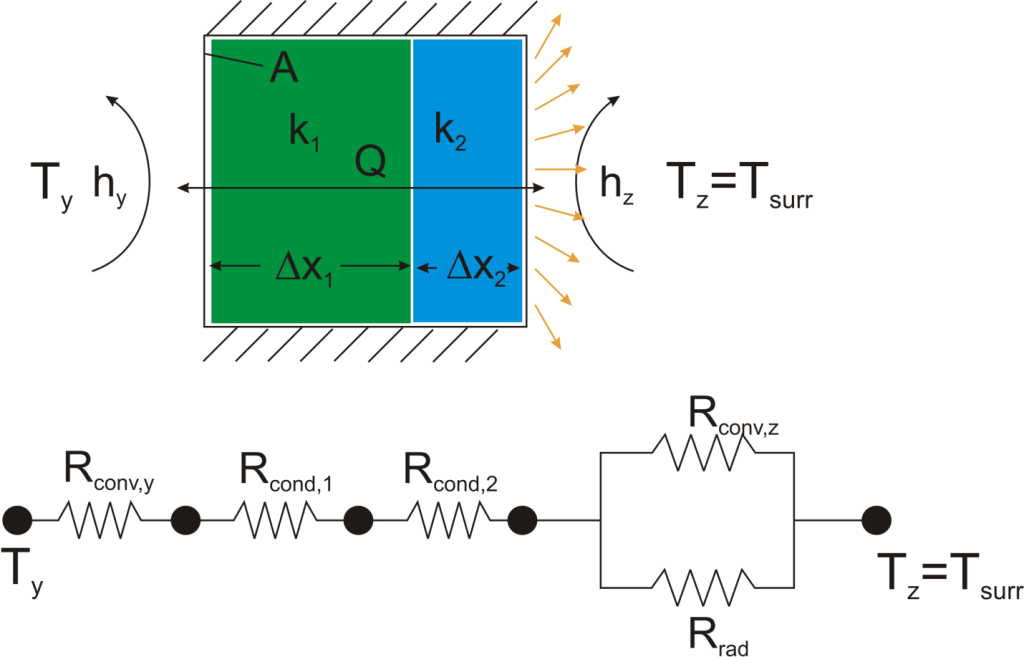
As the diagram illustrates, the total heat flow from the fluid on the left to the surroundings on the right is:
Where the total resistance is a combination of series and parallel components:
The challenge, as we noted last time, is that the radiation resistance, , is not a simple constant. It depends on temperature, which is often the very quantity we are trying to find. The term for radiation heat transfer is . Because of this dependency, we usually solve the energy balance equation directly rather than relying solely on the resistance network.
2. Solving for Net Heat Flow with Radiation
A common problem involves finding the net heat transferred from an object that is both emitting and absorbing radiation. Let's analyze this with a clear, step-by-step example.
Thermal Conductivity, Stefan Boltzmann Law, Heat Transfer, Conduction, Convecton, Radiation, Physics
This video from The Organic Chemistry Tutor provides an excellent walkthrough of calculating net heat transfer for an object interacting with its surroundings. It clearly distinguishes between emitted and absorbed energy.
Please watch the segment from 18:12 to 25:20. The narrator calculates the energy radiated by a sphere and the energy it absorbs from its surroundings to find the net rate of energy loss. Pay close attention to how the two temperatures (object and surroundings) are used.
As the video demonstrates, the key steps are:
- Calculate the Rate of Emission: The object radiates heat based on its own temperature, .
- Calculate the Rate of Absorption: The object absorbs radiation from its surroundings. If the surroundings are large and at a uniform temperature , the incident radiation is that of a blackbody at . The absorbed heat is:
For a gray body, emissivity equals absorptivity (). - Calculate Net Heat Flow: The net rate of heat transfer is the difference between what leaves and what enters.
This final equation is the tool you'll use to solve for either the net heat flow (if temperatures are known) or one of the temperatures (if the net heat flow is known, e.g., if it's balancing an internal heat source).
Important: Remember to always use absolute temperature (Kelvin) in radiation calculations.
3. Solving for Parameters in Complex Systems
JEE Advanced problems often require you to set up an energy balance and then use an additional piece of information from the problem to solve for a specific parameter, which might not be temperature or heat flow directly. Let's tackle a classic problem of this type.
Previous Years JEE Advanced Questions
Now, let's analyze a problem where steady-state heat conduction leads to phase changes. This problem requires you to equate the heat flows calculated from Fourier's Law to the energy needed for melting and evaporation.
Please read Question 20 from the PDF. It describes a metal rod heated at a point P, with its ends A and B in contact with ice and boiling water, respectively.
Let's break down the solution method for this problem.
Problem Analysis:
- A rod AB of length
10xis heated at point P, which is at a distancelxfrom end A. - Temperatures: , , .
- In steady state, heat flows from the hot point P to both ends A and B via conduction.
- The heat reaching end A melts ice (). The heat reaching end B evaporates water ().
- Key Constraint: "equal amounts of water and ice evaporate and melt per unit time." This means . Let's call this rate .
Formulation and Solution:
-
Write the heat flow equations:
- Heat flow from P to A:
- Heat flow from P to B:
-
Connect heat flow to phase change:
-
Use the key constraint: Since is the same for both, we can write:
Substituting the expressions for and : -
Solve for the unknown, l:
The terms and cancel out.
Plugging in the values for and :
This problem is a perfect illustration of the JEE Advanced approach: combining fundamental principles (Fourier's law, latent heat) and using a specific constraint in the problem to solve for a system parameter.
Test your understanding!
Imagine the setup in Problem 20 is slightly modified. The point P is still at 400°C, and end A is in ice at 0°C. However, end B is now connected to a large heat sink maintained at 200°C. If the rate of heat flowing into the ice at A is equal to the rate of heat flowing into the sink at B (), what is the value of ?
Show answer
The setup is: .
Using Fourier's law:
4. Solving for Equilibrium in Powered Systems
Another common problem archetype involves a system with a constant power input (like a heater) that must be balanced by heat loss to the surroundings. The goal is often to find a required power, a final temperature, or an operating time.
Let's analyze Problem 28 from the same PDF resource (LINK), which concerns a water cooler.
Problem Analysis:
- A device generates heat at a constant rate: .
- A water cooler removes heat at a constant rate .
- The water itself can absorb heat, causing its temperature to rise.
- System is thermally insulated, so energy is conserved.
- Initial water temp: 10°C. Max final water temp: 30°C. So, .
- Water volume: 120 litres, which means mass .
- Operating time: .
- We need to find the minimum value of .
Formulation and Solution:
-
Energy Balance over the time interval :
The total energy generated by the device must be equal to the total energy removed by the cooler plus the total energy absorbed by the water. -
Express energies in terms of rates and temperatures:
Here, is the specific heat of water (4200 J/kg°C). -
Solve for P:
The problem asks for the minimum power . The cooler needs to work the least when the water absorbs the maximum possible amount of energy. This occurs when the water temperature rises by the maximum allowed amount, , over the full 3-hour period. -
Plug in the numbers:
This problem shows how to apply the energy balance principle over a finite time interval and use the problem's constraints ("minimum P") to set up the final calculation.
Conclusion
You have now completed the journey from identifying individual heat transfer modes to formulating and solving complex problems where they act in concert. This ability to set up and solve energy balance equations is the core skill for this entire topic.
Key Takeaways:
- Solving for equilibrium temperature or heat flow involves applying the steady-state energy balance () and solving the resulting algebraic equation.
- Be prepared to handle the non-linear term in radiation problems. The net heat transfer is the difference between emission (based on object temp) and absorption (based on surroundings temp).
- JEE Advanced problems frequently link heat transfer to other physical phenomena (like phase change) or impose system-level constraints (like total operating time). These constraints provide the key to solving for the required variable.
- Always start by identifying your system, all energy flows in and out, and any energy generation. This structured approach is your most reliable tool.
Preview of the Next Module:
We will now shift our perspective from the macroscopic world of heat flow to the microscopic world of molecules. In the next module, we'll begin our study of the Kinetic Theory of Gases. We will explore how the collective motion of countless individual particles gives rise to the macroscopic properties we observe, such as pressure and temperature. This will build the foundation for our deep dive into Thermodynamics.