Hello! Welcome to the next lesson in our journey through thermodynamics.
In our last session, we explored the Carnot cycle and established the absolute upper limit for the efficiency of any heat engine, given by . This is a powerful theoretical benchmark. Today, we shift our focus to a more practical, though still idealized, model that describes the engine in most gasoline-powered cars: the Otto cycle.
Your learning outcome for this lesson is to analyze the Otto cycle and derive its thermal efficiency in terms of the compression ratio. This is a classic and essential analysis for JEE Advanced, as it combines the first law, properties of ideal gases, and the definitions of thermodynamic processes into a single, cohesive problem.
1. The Ideal Otto Cycle
The Otto cycle is an idealized model for the four-stroke cycle of a spark-ignition (SI) internal combustion engine. It consists of four distinct thermodynamic processes, which we can visualize on a Pressure-Volume (P-V) diagram.
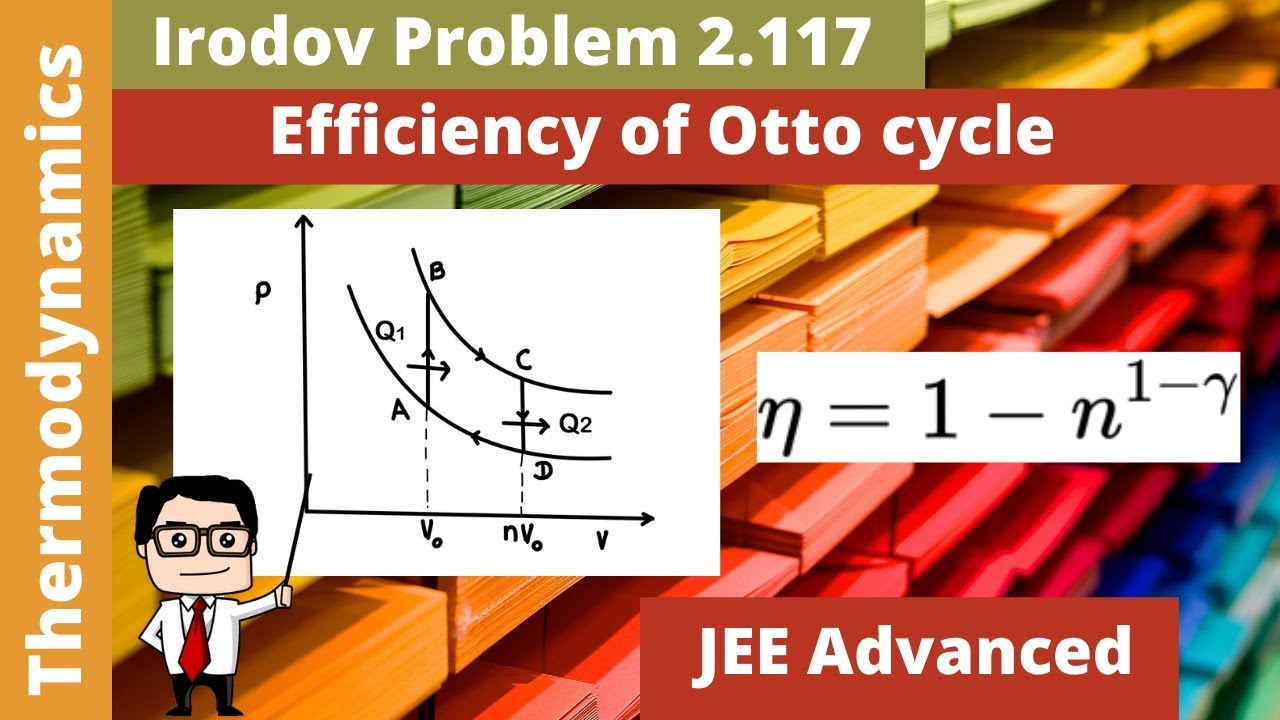
The four processes are:
- A → B: Adiabatic Compression. The fuel-air mixture is compressed rapidly, so we assume no heat exchange occurs. Work is done on the gas.
- B → C: Isochoric Heat Addition. At minimum volume, the spark plug ignites the mixture. This happens so quickly that the piston doesn't have time to move. Pressure and temperature increase dramatically as heat is added.
- C → D: Adiabatic Expansion (Power Stroke). The hot, high-pressure gas expands, pushing the piston down and doing work. Again, this is assumed to be rapid and without heat exchange.
- D → A: Isochoric Heat Rejection. At maximum volume, an exhaust valve opens, and the hot gas is replaced by a cooler mixture. This is modeled as a constant-volume process where the gas rejects heat to return to its initial state.
2. Deriving the Thermal Efficiency
Our goal is to derive the efficiency, , for this cycle. As with any heat engine, we start with the fundamental definition:
The following video provides a very clear, step-by-step derivation. We will walk through it together.
Physics 29 Efficiency Of Heat Engines (14 of 14) The Otto Cycle
Watch this video from the Michel van Biezen channel to see how the efficiency formula is derived. First, we'll focus on expressing the heat terms using the first law and specific heat.
Watch the first 4 minutes and 42 seconds (from 00:00 to 04:42). Pay attention to: The identification of the four processes on the P-V diagram. How the first law (\Delta U = Q - W) simplifies for an isovolumetric process (where W=0). How this leads to expressions for the heat added (Q_H) and heat rejected (Q_C) in terms of temperatures and the molar specific heat at constant volume, C_v.
As shown in the video, since processes B→C and D→A are isochoric (constant volume), no work is done. The first law of thermodynamics () simplifies to .
- Heat Addition (B → C): The heat absorbed from the hot reservoir (the combustion) is:
- Heat Rejection (D → A): The heat rejected to the cold reservoir (the exhaust) is . Since this is negative (heat leaving), the positive quantity of heat rejected is:
Substituting these into the efficiency formula, the terms cancel out, leaving:
This expression is correct, but not very useful in practice as it depends on four different temperatures. A much more powerful result is obtained by expressing the efficiency in terms of a single, physical parameter of the engine.
3. The Role of the Compression Ratio
The key engineering parameter of an Otto cycle engine is its compression ratio, denoted by . It's the ratio of the maximum volume to the minimum volume of the gas in the cylinder.
Because processes A→B and C→D are adiabatic, we can use the relationship , where . This is the crucial step that connects the temperatures to the compression ratio.
Now, let's watch the rest of the derivation.
Physics 29 Efficiency Of Heat Engines (14 of 14) The Otto Cycle
Continue with the same video to see how the adiabatic process equations are used to replace the temperatures in the efficiency formula with the compression ratio.
Watch from 04:42 to 11:02. Focus on: How the relation TV^{\gamma-1} = \text{constant} is applied to the two adiabatic strokes (A→B and C→D). The algebraic substitution that allows all temperature terms to be eliminated in favor of the compression ratio, r. The final, elegant expression for the efficiency of the Otto cycle.
Let's summarize the key algebraic steps from the video.
For the adiabatic compression (A→B):
For the adiabatic expansion (C→D):
Substituting these relationships into our temperature-based efficiency formula leads to a remarkable simplification:
To simplify this, we can use an alternative relation from the adiabatic expansion: . Substituting this and :
This simplifies to the final result:

4. Analysis and Application
This formula is a cornerstone of engine analysis. It tells us that the ideal Otto cycle efficiency depends only on two factors:
- The compression ratio (): Higher means higher efficiency. This is why high-performance engines often have high compression ratios.
- The adiabatic exponent (): A gas with a higher (e.g., a monatomic gas where ) will yield higher efficiency than one with a lower (e.g., a diatomic gas like air where ).
Practical Limitation: Why don't we just make engines with extremely high compression ratios? As you compress the fuel-air mixture, its temperature rises. At very high compression, the temperature can become high enough to ignite the fuel before the spark plug fires. This phenomenon, known as pre-ignition or "knocking," is inefficient and can damage the engine. The octane rating of gasoline is a measure of its resistance to knocking.
Test your understanding! (JEE Pattern)
An ideal Otto engine has a compression ratio of . The working substance is a diatomic ideal gas (). The minimum and maximum temperatures reached during the cycle are K and K.
- Calculate the thermal efficiency of this Otto engine.
- Calculate the maximum possible theoretical efficiency for any engine operating between these temperature extremes ( and ).
- Why are the two efficiencies different?
Show answer
-
Otto Efficiency:
We use the formula derived today:To evaluate , you can use the approximation . Since and , is slightly greater than 2. A more precise calculation gives .
The efficiency of the Otto cycle is approximately 56.5%.
-
Maximum (Carnot) Efficiency:
The maximum possible efficiency is the Carnot efficiency, operating between the highest and lowest temperatures of the cycle.The maximum theoretical efficiency is 85%.
-
Reason for the Difference:
The Otto engine is less efficient than a Carnot engine operating between the same temperature extremes. This is because in the Otto cycle, the heat is not added and rejected at constant temperatures.- Heat is added during the isochoric process B→C, as the temperature rises from to .
- Heat is rejected during the isochoric process D→A, as the temperature falls from to .
A Carnot engine, by contrast, absorbs all its heat at the single highest temperature and rejects all its heat at the single lowest temperature , which is the most efficient way possible.
Conclusion
In this lesson, we moved from the purely theoretical Carnot cycle to the more practical Otto cycle. By systematically applying the first law and the adiabatic process equations, you have now derived one of the most important results in engine analysis.
Key Takeaways:
- The ideal Otto cycle consists of two adiabatic and two isochoric processes.
- Its thermal efficiency depends only on the compression ratio and the gas's specific heat ratio .
- The efficiency is given by the formula .
- Higher compression ratios lead to higher efficiency, but are limited by the practical problem of pre-ignition.
Preview of the Next Lesson:
The Otto cycle models gasoline engines where ignition is caused by a spark. What about diesel engines, where compression itself ignites the fuel? In the next lesson, we will analyze the Diesel cycle, which features a different set of processes. We will derive its efficiency and compare its characteristics to the Otto cycle you've just mastered.