Hello! Welcome to your next lesson on heat engines.
In our last session, we analyzed the Otto cycle, the idealized model for gasoline engines. We derived its efficiency as , highlighting that its efficiency is fundamentally linked to the compression ratio and limited by the risk of pre-ignition ("knocking").
Today, we turn our attention to the other major type of internal combustion engine: the diesel engine. Your learning outcome is to analyze the Diesel cycle and derive its thermal efficiency in terms of compression and cutoff ratios. This will complete your understanding of the foundational engine cycles for the JEE Advanced syllabus and allow you to make critical comparisons between them.
The core difference lies in how combustion occurs. While the Otto cycle uses a spark plug to ignite a pre-mixed fuel-air charge, a diesel engine compresses only air to a very high temperature and then injects fuel, which ignites spontaneously. This leads to a different thermodynamic model.
1. The Ideal Diesel Cycle: Processes and Parameters
The Diesel cycle models the operation of a compression-ignition engine. Like the Otto cycle, it consists of four processes, but with one crucial change: heat is added at constant pressure, not constant volume.
Let's visualize the cycle on P-V and T-S diagrams.
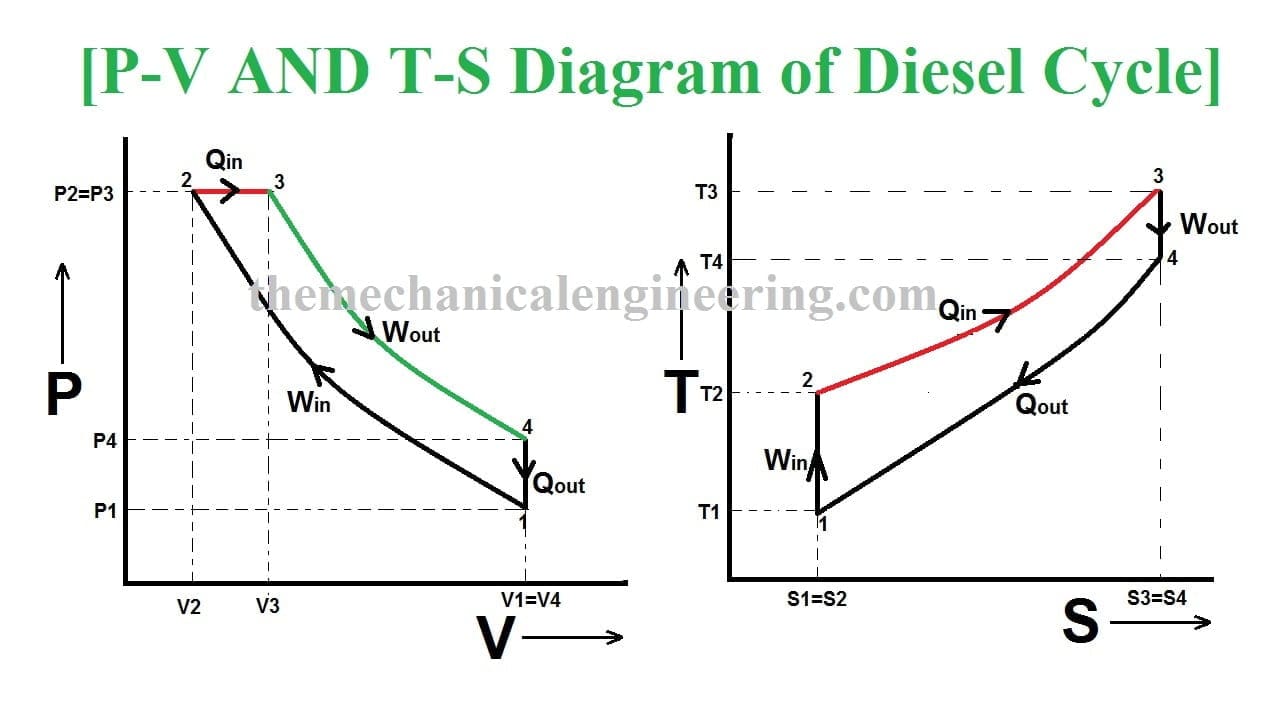
The four processes are:
- Process 1 → 2: Isentropic Compression. Pure air in the cylinder is compressed adiabatically. Work is done on the gas.
- Process 2 → 3: Isobaric Heat Addition. At the point of maximum compression (minimum volume), fuel is injected. It ignites, and the combustion pushes the piston outward. This process is modeled as occurring at constant pressure as the gas expands. Heat is added to the system.
- Process 3 → 4: Isentropic Expansion (Power Stroke). The hot, high-pressure gas continues to expand adiabatically, doing work.
- Process 4 → 1: Isochoric Heat Rejection. At maximum volume, a valve opens, and heat is rejected at constant volume as the gas cools down to its initial state.
Two important ratios define this cycle:
- Compression Ratio (r): The ratio of the maximum volume to the minimum volume.
- Cutoff Ratio (): The ratio of the volume after combustion (fuel "cutoff") to the volume before combustion. This is unique to the Diesel cycle.
Since the volume increases during heat addition, .
2. Deriving the Thermal Efficiency
Our goal is to find the efficiency, , starting from the fundamental definition:
First, let's express the heat exchanged in terms of temperature changes. We assume we are working with moles of an ideal gas.
- Heat Addition (2 → 3, Constant Pressure):
- Heat Rejection (4 → 1, Constant Volume):
Substituting these into the efficiency formula, the terms cancel:
where . As with the Otto cycle, this expression is correct but not practical. We need to express it using the engine's physical ratios, and .
The following derivation involves a sequence of substitutions using the ideal gas law and adiabatic relations. It's a classic problem that requires careful, sequential logic. To guide you through this, let's use a detailed video walkthrough.
What is the Expression for the efficiency of Diesel Cycle - Gas Power Cycles - Thermodynamics
This video from Ekeeda provides a very clear, step-by-step derivation of the Diesel cycle efficiency. It meticulously works through each process to establish the relationships between the temperatures.
Watch the segment from 08:01 to 30:47. Don't worry about memorizing every line; focus on the strategy: Initial Setup (08:01 - 17:17): See how the heat terms are defined and substituted into the efficiency formula, leading to the expression in terms of temperatures and \gamma that we just derived. Temperature Relations (17:17 - 30:47): This is the crucial part. Pay close attention to how the presenter uses the properties of each of the four processes to find expressions for T_2, T_3, and T_4 in terms of T_1, r, and \rho. Follow the logic for each step.
3. Assembling the Final Formula
Let's recap the strategic steps from the video to relate the temperatures. This is an excellent exercise in applying thermodynamic principles, exactly the kind of multi-step thinking required for JEE Advanced.
-
For : (Process 1→2, Isentropic Compression)
-
For : (Process 2→3, Isobaric Expansion)
Using the Ideal Gas Law, since , we have . -
For : (Process 3→4, Isentropic Expansion)
We know . So, the volume ratio is .
Now, we substitute these four temperature expressions (, , , and ) into our efficiency formula:
Factor out the common terms:
This simplifies to the final expression for the efficiency of an ideal Diesel cycle:
4. Analysis and Comparison with the Otto Cycle
This formula is rich with physical meaning.

Let's compare this to the Otto cycle efficiency:
The Diesel cycle efficiency formula is identical except for the new bracketed term: .
Since the cutoff ratio and , it can be shown mathematically that this bracketed term is always greater than 1. (For those interested, this can be proven by analyzing the function for ).
This leads to a crucial theoretical point:
For the same compression ratio (), the Otto cycle is more efficient than the Diesel cycle.
So why are diesel cars often more fuel-efficient in practice? The answer lies in the compression ratio. Because diesel engines compress only air, they can use much higher compression ratios () without causing knocking. Gasoline engines are limited to lower ratios (). The significant gain in efficiency from the much higher in a diesel engine more than compensates for the inherent efficiency disadvantage from its cycle structure.
Test your understanding! (JEE Pattern)
An ideal Diesel engine has a compression ratio and a cutoff ratio . It uses air as the working substance, for which .
- Calculate the thermal efficiency of this engine.
- Calculate the efficiency of an ideal Otto engine with the same compression ratio ().
- Based on your results, which cycle is theoretically more efficient for the same compression ratio?
Hint for calculation: You may need to calculate and . Approximations: , and .
Show answer
-
Diesel Efficiency:
First, let's calculate the value of the bracketed term:
Now, let's calculate the efficiency:The efficiency of the Diesel engine is approximately 63.0%.
-
Otto Efficiency (same r):
The efficiency of the comparable Otto engine is approximately 68.4%.
-
Conclusion:
As expected, for the same high compression ratio of 18, the Otto cycle (68.4%) is theoretically more efficient than the Diesel cycle (63.0%). The practical advantage of the diesel engine comes from its ability to operate safely at this high compression ratio, whereas a gasoline engine cannot.
Conclusion
Congratulations on completing the analysis of the Diesel cycle. You have now mastered the two fundamental models for internal combustion engines.
Key Takeaways:
- The Diesel cycle is defined by four processes: isentropic compression, isobaric heat addition, isentropic expansion, and isochoric heat rejection.
- Its performance is characterized by the compression ratio and the cutoff ratio .
- The thermal efficiency is given by the formula .
- For a given compression ratio, the Diesel cycle is less efficient than the Otto cycle. However, practical diesel engines are often more efficient overall because they operate at much higher compression ratios.
Preview of the Next Lesson:
We have focused on devices that take heat and produce work (heat engines). What about devices that do the opposite? In the next lesson, we will explore refrigerators and heat pumps. We will define their measure of performance, the coefficient of performance (COP), and analyze how they work within the framework of thermodynamics.