Hello! Welcome back to our study of heat engines.
In our last lesson, we established a systematic method for calculating the thermal efficiency of any heat engine, . We also encountered a problem from an IIT Kanpur resource that hinted at a cycle being "impossible" because its calculated efficiency was too high. This naturally leads to the question: Is there an upper limit to the efficiency of a heat engine?
Today, we will answer that question by exploring the work of Sadi Carnot. This lesson introduces the most efficient theoretical engine possible and the fundamental theorem that governs the performance of all heat engines. Your learning outcome is to apply the Carnot theorem and calculate the maximum possible efficiency for a reversible engine. Mastering this concept is crucial, as it provides a powerful benchmark for analyzing and solving thermodynamics problems in the JEE Advanced.
1. The Carnot Cycle: An Idealized Benchmark
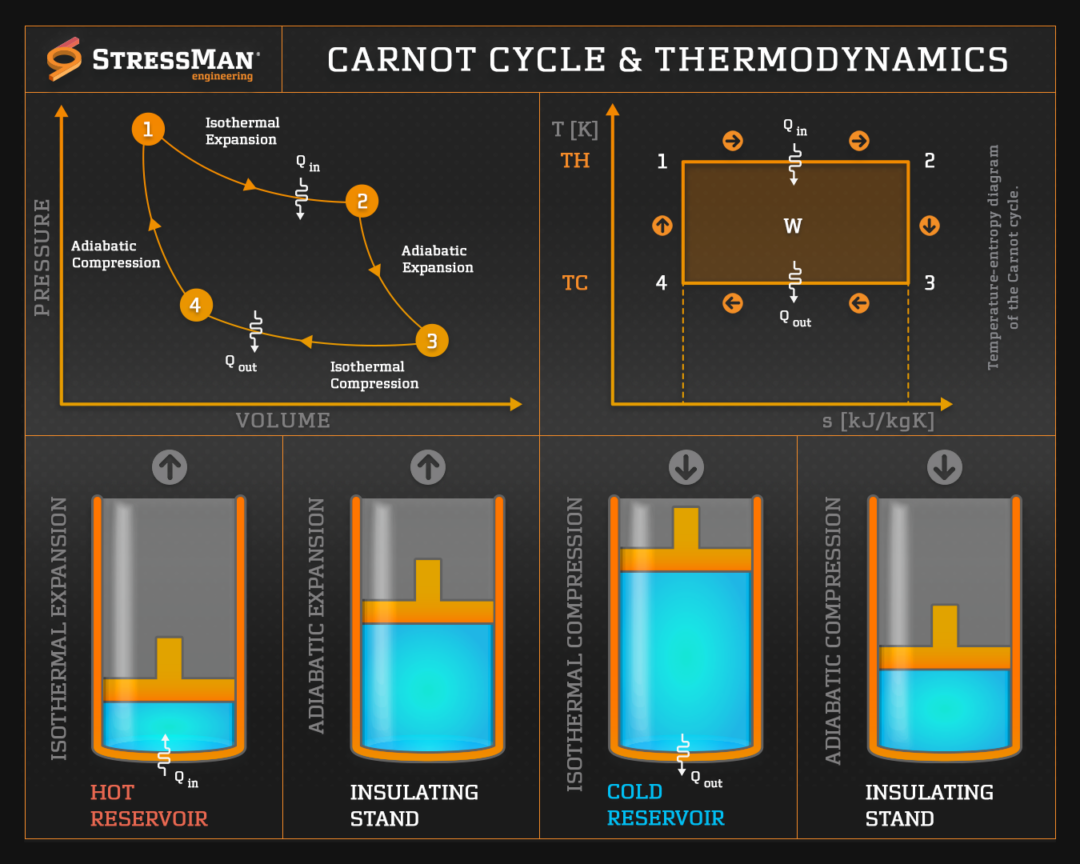
Sadi Carnot conceived of an ideal, reversible cycle that operates between two heat reservoirs at constant temperatures, a hot source at and a cold sink at . This cycle, known as the Carnot cycle, consists of four fully reversible processes:
- Isothermal Expansion at : The gas absorbs heat from the hot reservoir and does work as it expands.
- Adiabatic Expansion: The gas is thermally isolated and continues to expand. It does work, and its temperature drops from to .
- Isothermal Compression at : The gas is compressed, and it rejects heat to the cold reservoir.
- Adiabatic Compression: The gas is isolated again and compressed back to its initial state, with its temperature rising from back to .
2. Efficiency of the Carnot Engine
Recall the general formula for efficiency:
For the special case of a reversible cycle, like the Carnot cycle, it can be proven that the ratio of heat exchanged is equal to the ratio of the absolute temperatures of the reservoirs.
This elegant result comes from the second law of thermodynamics, specifically the fact that the net change in entropy for any reversible cycle is zero (). The heat absorbed at increases entropy by , and the heat rejected at decreases it by . For the total change to be zero, these must be equal in magnitude.
The following video provides a clear derivation of this relationship using the Clausius theorem, which is a more general and powerful approach than relying on the ideal gas law. Given your background, you'll appreciate the conciseness of this thermodynamic argument.
This video from Physical Chemistry demonstrates how the Carnot efficiency formula is a general result for any reversible engine, derived from the first and second laws of thermodynamics.
Watch from 04:22 to 09:14. Focus on two key ideas: How the efficiency is first expressed in terms of heats (\eta = 1 + Q_C/Q_H), using the first law for a cycle (remembering their convention might differ slightly). How the Clausius theorem (\Delta S_{cycle} = Q_H/T_H + Q_C/T_C = 0) is used to substitute temperatures for heats, leading to the final efficiency formula.
By substituting the temperature ratio into the general efficiency formula, we arrive at the famous equation for Carnot efficiency:
Crucial points to remember:
- This formula gives the efficiency of any reversible engine operating between two reservoirs.
- Temperatures and must be in Kelvin. This is a common source of error in exam problems.
Test your understanding!
A scientist proposes a heat engine that operates between the boiling point of water (100°C) and the freezing point of water (0°C). What is the maximum possible theoretical efficiency of this engine?
Show answer
First, convert the temperatures to Kelvin:
- Hot reservoir: K
- Cold reservoir: K
Now, apply the Carnot efficiency formula:
The maximum possible efficiency is 26.8%. No engine, no matter how perfectly designed, can do better while operating between these two temperatures.
3. Carnot's Theorem: The Ultimate Limit
The Carnot efficiency formula is more than just a result for one ideal cycle. It represents a fundamental limit for all heat engines, a concept formalized in Carnot's Theorem.
The theorem has two parts:
- No engine operating between two heat reservoirs can be more efficient than a reversible engine operating between the same two reservoirs.
- The efficiency of all reversible engines operating between the same two reservoirs is the same, regardless of the working substance or the details of the cycle.
This means is the absolute "speed limit" for efficiency. Any real engine will be less efficient due to irreversible processes like friction and finite-rate heat transfer.
The proof of this theorem is a classic example of reductio ad absurdum (proof by contradiction), a logical structure you're familiar with from mathematics and computer science. It assumes a "super-efficient" engine exists and shows that coupling it with a reversed Carnot engine (a refrigerator) would lead to a violation of the Second Law of Thermodynamics.
Carnot Engine: Principles, Parts, Diagram & Applications
The following resource from Allen provides a concise statement of Carnot's theorem and a clear walkthrough of the proof by contradiction. Understanding this proof deepens your conceptual grasp of the Second Law.
Read section 10.0, 'Carnot Theorem'. Focus on the logical flow: Assume an irreversible engine 'I' is more efficient than a reversible engine 'R' (\eta_I > \eta_R). Use this assumption to show it implies that the combined system can transfer heat from a cold reservoir to a hot one with no external work input. Recognize that this outcome violates the Clausius statement of the Second Law, thus proving the initial assumption must be false.
4. Problem-Solving with Carnot's Theorem
In JEE Advanced, Carnot's theorem is not just a theoretical point; it's a practical problem-solving tool.
- Benchmark for comparison: You can calculate the efficiency of a given real engine and compare it to the Carnot efficiency to see how well it performs.
- Finding unknowns: If a problem states an engine is "ideal," "reversible," or has "maximum efficiency," that is your cue to use the formula.
- Feasibility check: If you calculate the efficiency of a cycle to be greater than the Carnot efficiency for its operating temperatures, you have made an error.
This next video is an excellent resource that focuses on exactly these kinds of problems.
Carnot Cycle & Heat Engines, Maximum Efficiency, & Energy Flow Diagrams Thermodynamics & Physics
The Organic Chemistry Tutor channel provides a set of well-explained examples that apply the Carnot efficiency formula and compare ideal vs. real engine performance.
Watch the video from 01:50 to 08:56. Pay close attention to: How the relationship |Q_H|/|Q_C| = T_H/T_C is used for a Carnot engine to find an unknown heat transfer (Problem 2). The distinction between calculating the actual efficiency of an engine (using \eta = W/Q_H) and its ideal or maximum (Carnot) efficiency (using \eta = 1 - T_C/T_H) (Problem 3).
5. Advanced Application: Engines in Series
A classic JEE Advanced problem involves coupling two Carnot engines in series. The heat rejected by the first engine is used as the heat input for the second.
Test your understanding! (JEE Advanced Pattern)
Two Carnot engines, A and B, are operated in series. Engine A receives heat from a reservoir at K and rejects heat to a reservoir at an intermediate temperature . Engine B receives the heat rejected by engine A and, in turn, rejects heat to a reservoir at K.
Calculate the temperature if the work outputs of the two engines are equal ().
Show answer
This is a great problem that tests your understanding of efficiency and energy balance. Let's denote the heat flows as follows:
- : Heat absorbed by A from the source at .
- : Heat rejected by A and absorbed by B at .
- : Heat rejected by B to the sink at .
The work done by each engine is the difference between the heat it absorbs and rejects:
We are given , so:
Now, we use the property of Carnot engines that relates heat and temperature ratios:
- For engine A:
- For engine B:
Substitute these expressions for and into our work-balance equation:
We can cancel from all terms (since it's non-zero):
Solving for , we get:
Plugging in the values:
The intermediate temperature is 650 K. Notice that when the work outputs are equal, the intermediate temperature is the arithmetic mean of the source and sink temperatures.
(A similar example is Solved Example 5 in the Testbook resource LINK.)
Conclusion
Today we have established the absolute theoretical limit on the performance of any heat engine. This is a profound concept that stems directly from the Second Law of Thermodynamics.
Key Takeaways:
- A Carnot engine is an idealized, reversible engine operating in a cycle of two isothermal and two adiabatic processes.
- Its efficiency, which is the maximum possible for any engine operating between temperatures and , is given by (with temperatures in Kelvin).
- Carnot's Theorem states that no engine can be more efficient than a reversible one, and all reversible engines between the same two temperatures have the same efficiency.
- This theorem provides a powerful benchmark for problem-solving and checking the feasibility of a proposed engine.
Preview of the Next Lesson:
We now know the upper limit for efficiency. But what about more realistic models of the engines we use every day? In our next lesson, we will analyze the Otto cycle, the idealized thermodynamic cycle that describes the functioning of a typical gasoline-powered internal combustion engine. We will derive its efficiency and see how it compares to the Carnot ideal.