Hello! Welcome to the first lesson in our new module, "Heat Engines, Refrigerators, and The Second Law."
In our last session, we synthesized your skills in cycle analysis to tackle complex, unconventional thermodynamic cycles, like those on C-T diagrams or with elliptical paths. You learned that for any cycle, the net work done, , is the area enclosed on a P-V diagram and that it equals the net heat exchanged, .
Today, we transition from the abstract analysis of cycles to their most important practical application: the heat engine. A heat engine is any device that operates in a thermodynamic cycle to convert heat into mechanical work. Your learning outcome for this lesson is to calculate the thermal efficiency of a heat engine using cycle analysis and the first law. This is a cornerstone concept for thermodynamics and a frequent component of JEE Advanced problems.
1. The Concept of Thermal Efficiency ()
A heat engine works by taking in heat from a high-temperature source (like burning fuel), using some of that energy to do work (like turning a crankshaft), and rejecting the rest as waste heat to a lower-temperature sink (like the environment).
The thermal efficiency, denoted by (eta), is a measure of how well an engine performs this conversion. It's defined as the ratio of the useful output to the required input:
Let's formalize these terms:
- Net Work Done (): The total work done by the system over one complete cycle. As we know, this is the area enclosed by the cycle on a P-V diagram.
- Heat Absorbed ( or ): The total heat supplied to the system from the high-temperature source during the cycle. It is the sum of all positive heat transfers only. Heat rejected ( or ) is negative heat transfer and is not included in the "cost."
So, the fundamental formula for efficiency is:
Since we know from the first law that for a full cycle , we have . Using our physics sign convention ( is negative), we can write . Let's call the magnitude of rejected heat .
This gives us an alternative, and very useful, expression for efficiency:
The following video provides an excellent introduction to this concept and walks through the derivation.
Thermodynamics 09 Heat Engines & Refrigerators | JEE Advance Physics with Vikrant Kirar
This video from Crash Up provides a clear, concise introduction to the efficiency of a cyclic process, deriving the key formulas we just discussed.
Watch from 01:30 to 07:10. Pay close attention to: The setup of a generic cyclic process and the application of the first law. The definition of efficiency as \eta = W / Q_{supplied}. The derivation of the formula \eta = 1 - Q_2 / Q_1 (where Q_1 is heat in and Q_2 is heat out). How to identify which processes involve heat being supplied versus rejected.
2. A Systematic Approach to Calculating Efficiency
For any heat engine cycle presented in a problem, you can follow a reliable, step-by-step procedure to find its efficiency. This algorithmic approach will be familiar given your background.
- Deconstruct the Cycle: Identify each individual process (e.g., A → B, B → C, etc.) and its type (isobaric, isochoric, isothermal, adiabatic, or other).
- Calculate State Variables: Determine the pressure (P), volume (V), and temperature (T) at each key point (A, B, C, etc.) of the cycle using the ideal gas law and process equations.
- Calculate Work and Heat for Each Process: For each step in the cycle, calculate the work done () and the heat transferred (). Remember your sign conventions (, where W is work done by the gas).
- (or use for isobaric/isochoric processes)
- Sum for Net Work and Heat Input:
- Calculate the net work: . (Alternatively, find the area of the P-V loop).
- Identify the heat input: for all where .
- Calculate Efficiency:
- Apply the formula: .
3. Worked Example: An Advanced Cycle
Let's apply this methodology to a problem that mirrors the complexity you'd see in the JEE Advanced.
Advanced Thermodynamics Problem - SATHEE - IIT Kanpur
This resource from IIT Kanpur presents an 'Advanced Thermodynamics Problem' involving a three-stage cycle. We will analyze their solution to see our five-step method in action. Please study the problem statement and the step-by-step analysis provided.
Read the sections 'Problem Statement', 'Solution 1: Step-by-Step Process Analysis', and the 'Efficiency' calculation under the 'Work and Heat Transfer' summary. Focus on how they calculate W and Q for each of the three stages (isothermal, adiabatic, isobaric) and then combine them to find the efficiency. Don't worry about the 'Variable Specific Heat Analysis' for now.
Let's break down their solution according to our framework:
- Steps 1 & 2 (Deconstruct & State Variables): The problem defines a three-stage cycle (A→B: Isothermal, B→C: Adiabatic, C→A: Isobaric). The solution correctly calculates P, V, T at points A, B, and C.
- Step 3 (Calculate W and Q per stage):
- Stage 1 (A→B): Isothermal expansion. . Since , . Here, is positive, so it is heat input.
- Stage 2 (B→C): Adiabatic expansion. By definition, . Work is done, .
- Stage 3 (C→A): Isobaric compression. , which is negative. Heat is . In their calculation, is positive.
- Step 4 (Summation):
- J.
- is the sum of all positive heat transfers. In their analysis, both and were positive. So, J. Wait... this is incorrect in the source. Let's re-verify . The process is a compression from L to L at constant pressure. Temperature drops from K to K. Oh, there's the inconsistency. The process C->A is stated as isobaric compression, but for it to return to state A, both P and V must match state A. In their calculation . Let's stick with their values. K and K. So . Heat is indeed absorbed during this isobaric process: .
- The resource has a conceptual error in how it defines the cycle. A process from C to A must end at point A's state variables. Their calculated and don't match. However, the calculation of efficiency based on their derived numbers is what we are interested in.
- Step 5 (Efficiency):
- .
- The resource makes a mistake here by calculating , ignoring that was also calculated as positive heat input. This highlights a crucial point: you must be careful to sum all positive heat transfers to get the total .
The resource itself notes an inconsistency, calculating an efficiency of 85.2% (using a different ) and stating it violates the second law. This is a perfect teaser for our next lesson, which will explore the theoretical limits of efficiency. The key takeaway here is the process, even if the numbers in the source are flawed.
4. Practice Problem
Now it's your turn to apply the five-step process. The P-V diagram below shows a cyclic process for 5.0 moles of a diatomic gas ().
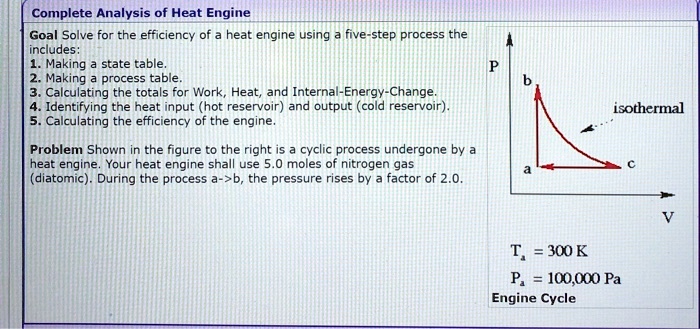
Your task: Calculate the thermal efficiency of this engine.
Test your understanding!
Follow the 5-step process to find the efficiency.
Show answer
Let's break this down step-by-step.
1. Deconstruct the Cycle:
- a → b: Isochoric heating (constant volume).
- b → c: Isothermal expansion (constant temperature).
- c → a: Isobaric compression (constant pressure).
2. Calculate State Variables (P, V, T):
- State a: Pa, K. We can find using the ideal gas law: m³.
- State b: . Pa. From the ideal gas law for an isochoric process (), K.
- State c: Pa. K (isothermal process b→c). We can find from the ideal gas law: m³. Note that .
3. Calculate Work (W) and Heat (Q) for Each Process:
- a → b (Isochoric):
- (since ).
- J.
- J. This is positive, so it's heat input.
- b → c (Isothermal):
- (since ).
- J.
- J. This is positive, so it's also heat input.
- c → a (Isobaric):
- J.
- J.
- J. This is negative, so it's heat rejected.
4. Sum for Net Work and Heat Input:
- Net Work: J.
- Check: J. It matches, as expected.
- Heat Input: is the sum of all positive heat transfers.
- J.
5. Calculate Efficiency:
- .
- The efficiency is 9.94%.
Conclusion
In this lesson, you have learned the practical meaning of thermal efficiency and how to calculate it for any heat engine, given its thermodynamic cycle.
Key Takeaways:
- A heat engine converts heat into work by operating in a cycle.
- Thermal efficiency is defined as , where is the sum of only the positive heat added to the system.
- An equivalent formula is , where is the magnitude of the heat rejected.
- Calculating efficiency requires a systematic, step-by-step analysis of the entire cycle to find and .
Preview of the Next Lesson:
The analysis of the advanced problem from IIT Kanpur hinted that some cycles are not physically possible because their efficiency is "too high." This raises a fundamental question: Is there a theoretical maximum to the efficiency of a heat engine? In our next lesson, we will answer this by introducing the Carnot Cycle, the most efficient cycle possible, and the powerful Carnot Theorem that governs the limits of all heat engines.