Hello! Welcome to the next lesson in our journey through the properties of gases.
In the previous lesson, we moved beyond the ideal gas model and derived the van der Waals equation. You learned how it corrects for the two major faulty assumptions of the ideal gas law:
- Finite molecular volume, corrected by the
nbterm. - Intermolecular attractive forces, corrected by the
an²/V²term.
The full equation is:
Today, our goal is to put this equation into practice. We will move from the theoretical derivation to quantitative application, focusing on the problem-solving strategies required for JEE Advanced. You will learn to use the van der Waals equation to calculate gas properties and analyze its behavior in different scenarios.
1. Solving for Pressure in a Real Gas
A common task is to calculate the pressure of a real gas given its volume, temperature, and the number of moles. Unlike the simple ideal gas law, solving for P or V in the van der Waals equation requires some algebraic rearrangement.
Solving for pressure (P) is the most straightforward rearrangement:
Notice the two components:
- The first term, , represents the pressure due to kinetic energy, but corrected for the reduced volume available to the molecules. This term is higher than the ideal gas pressure.
- The second term, , is the reduction in pressure due to intermolecular attractions.
The following video demonstrates how to use this rearranged formula to solve for the pressure of a real gas and compares the result with the ideal gas law, showing how the deviation becomes more significant at higher pressures (smaller volumes).
10.4 Real Gases & the Van der Waals Equation | General Chemistry
This segment from the video 'Real Gases & the Van der Waals Equation' by Chad's Prep clearly demonstrates how to calculate pressure. It works through two examples for methane, one at low pressure and one at high pressure.
Please watch from 05:44 to 11:26. Pay close attention to how the calculated pressure from the van der Waals equation deviates from the ideal gas pressure, especially when the volume is small (and thus pressure is high).
As you saw, at lower pressures, the ideal gas law is a decent approximation. However, at higher pressures, the correction terms become significant, and the van der Waals equation gives a more accurate result.
Test your understanding!
Let's try a problem similar to one found in textbooks.
Assume you have a 10.0 L flask containing 0.200 moles of methane () gas at 27°C (300 K).
Calculate the pressure exerted by the gas using both the ideal gas law and the van der Waals equation.
Given constants for methane:
Compare the two pressure values.
Show answer
1. Ideal Gas Law Calculation:
2. Van der Waals Equation Calculation:
First, let's calculate the correction terms:
- Pressure correction term:
- Volume correction term:
Now, plug these into the rearranged equation:
Comparison:
The pressure calculated by the van der Waals equation (0.4921 atm) is slightly lower than that from the ideal gas law (0.4926 atm). In this case, the attractive forces (the a term's effect) slightly outweigh the effect of the reduced volume (the b term's effect). The difference is small because the gas is at relatively low pressure and high volume.
2. Advanced Application: Graphical and Algebraic Problems
For JEE Advanced, you'll need to go beyond simple substitution. Problems often require you to rearrange the van der Waals equation into a different form to analyze a graph or solve for one of the constants. Given your background in mathematics, you'll find that these problems often hinge on algebraic manipulation.
Example 1: Linearizing the Equation for Graphical Analysis
Consider the following problem, which is based on a past JEE question.
Problem: For one mole of a van der Waals gas with and at a temperature of , the plot of vs is a straight line. If the y-intercept is 24.63 L·atm and the slope is -1.5 L²·atm/mol, what is the value of the van der Waals constant a? ( is the molar volume, ).
Strategy:
To solve this, we must rearrange the van der Waals equation into the form of a line, , where and .
-
Start with the van der Waals equation for one mole ():
-
The problem states :
-
Distribute :
-
Rearrange to get the desired linear form:
Now, compare this to :
- The slope
- The y-intercept
From the problem statement, the slope is -1.5. Therefore, , which means .
This approach of linearizing equations is a powerful technique for graphical problems in physics and chemistry.
Example 2: The Cubic Form of the Equation
The van der Waals equation can be rearranged into a cubic polynomial in terms of volume, . This is another common setup for advanced problems.
Let's look at this JEE Advanced style question:
JEE Advanced 2025 Mock Problem
This problem requires you to express the van der Waals equation as a cubic polynomial in molar volume and find the ratio of specific coefficients. This is a great test of your algebraic skills.
Focus on 'Question 1' in the resource. It reads: 'Molar volume (Vm) of a van der Waals gas can be calculated by expressing the van der Waals equation as a cubic equation with Vm as the variable. The ratio (in mol dm−3) of the coefficient of Vm^2 to the coefficient of Vm for a gas having van der Waals constants a = 6.0 dm^6 atm mol−2 and b = 0.060 dm^3 mol−1 at 300 K and 300 atm is ______. '
Let's work through the derivation of the cubic form.
- Start with the molar form ():
- Multiply both sides by to clear the fraction:
- Expand the left side:
- Group all terms on one side and organize by powers of :
- Divide by to make the leading coefficient 1 (a standard form for polynomials):
Now you have a cubic equation in . The problem asks for the ratio of the coefficient of to the coefficient of .
- Coefficient of :
- Coefficient of :
You have all the values needed to calculate this ratio. Give it a try!
3. Conceptual Application: Liquefaction and Isotherms
Finally, let's connect the equation back to the physical phenomenon of liquefaction. As we discussed, a large constant a implies strong intermolecular attractions, making a gas easier to liquefy. The van der Waals equation can qualitatively predict this behavior.
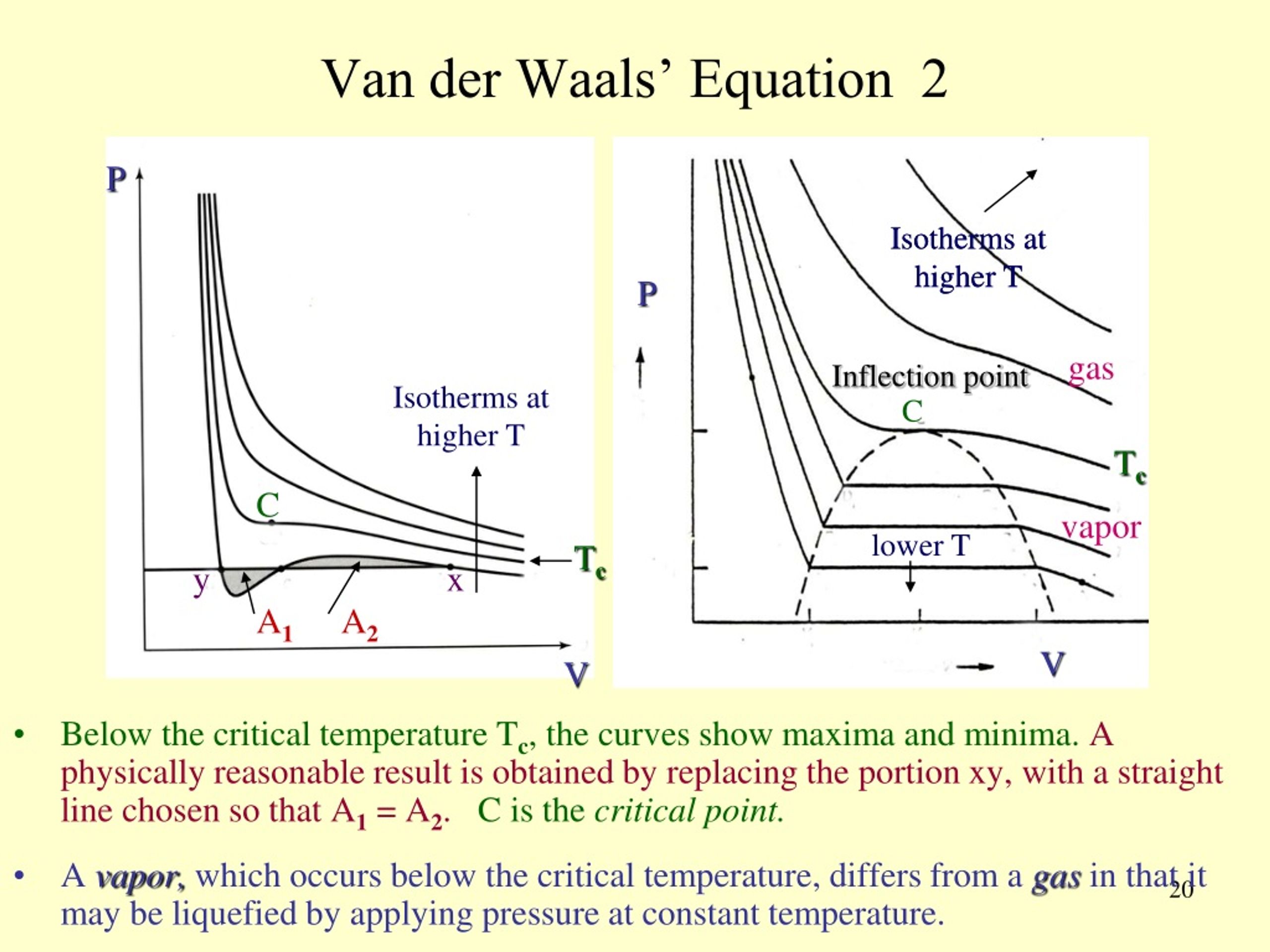
The key points are:
- A gas can only be liquefied by applying pressure if its temperature is below its critical temperature ().
- The
S-shaped curves below are a mathematical artifact of the cubic equation. The physically real process is the flat line, representing the equilibrium between gas and liquid phases during condensation. - The critical point (C) is an inflection point on the critical isotherm where the gas and liquid phases become indistinguishable.
The following brief video segment revisits a conceptual problem linking the a value to liquefaction.
Gaseous State L6 | Van Der Waals Equation | JEE & NEET Chemistry 2022 | Pahul Sir
This short clip from the 'Gaseous State L6' video by Pahul Sir directly applies the concept of the 'a' constant to a typical conceptual question about liquefaction.
Watch from 53:29 to 59:08. The main takeaway is the direct relationship: higher 'a' value implies stronger intermolecular forces, which means the gas is more easily liquefiable.
This conceptual link is frequently tested in questions that ask you to rank gases by their ease of liquefaction or by their deviation from ideal behavior, given a table of their a and b constants.
Conclusion
Today we moved from theory to practice. You've seen how the van der Waals equation is not just a formula to memorize, but a tool to be manipulated and applied to solve complex problems.
Key Takeaways:
- The van der Waals equation can be rearranged to solve for pressure, showing deviations from ideal behavior that become significant at high pressures.
- For JEE Advanced, you must be prepared to handle algebraic and graphical problems by linearizing the equation or expressing it as a polynomial.
- Conceptually, the equation explains why gases can be liquefied below their critical temperature, a phenomenon directly linked to the strength of intermolecular forces quantified by the
aconstant.
Preview of the Next Lesson:
In the final lesson of this module, we will introduce the compressibility factor (Z). This quantity provides a standardized measure of how much a real gas deviates from ideal behavior and leads to the powerful concept of the Law of Corresponding States. This will tie together everything we've learned about ideal and real gases.