Hello! Welcome to your second lesson on real gases.
In our last session, we established that the ideal gas law, , is a simplification that breaks down under high pressure and low temperature. We identified the two faulty assumptions from the Kinetic Theory of Gases that are responsible for this breakdown:
- The volume of gas molecules is negligible.
- There are no intermolecular forces between gas molecules.
Today, we will address these limitations head-on. Our goal is to understand the van der Waals equation, a more realistic model for gases. Specifically, you will learn how this equation introduces two correction terms, represented by constants a and b, to account for intermolecular forces and finite molecular size, respectively. This is a crucial step towards mastering the advanced problems you'll encounter.
1. Correcting the Ideal Gas Law
The logic behind the van der Waals equation is to take the ideal gas law, , and adjust the pressure and volume terms to reflect reality.
- The real volume available for gas molecules to move in is less than the container volume, because the molecules themselves take up space.
- The pressure exerted by a real gas is less than what an ideal gas would exert, because attractive forces between molecules pull them back slightly as they approach the container walls.
We will now explore how these corrections are mathematically formulated.
2. Deriving the Correction Terms
The following video provides a detailed, step-by-step derivation of both the pressure and volume corrections, explained in a style that is very well-suited for JEE preparation. We will watch it in two parts.
The Pressure Correction (The 'a' term)
First, let's focus on how to account for intermolecular forces. These forces are attractive, which means they reduce the pressure a real gas exerts compared to an ideal gas. The video explains the logic behind quantifying this pressure reduction.
Gaseous State L6 | Van Der Waals Equation | JEE & NEET Chemistry 2022 | Pahul Sir
Watch this first segment from the video 'Gaseous State L6 | Van Der Waals Equation' by Pahul Sir on the Catalysis by Vedantu channel. It details the reasoning behind the pressure correction term.
Please watch from 06:59 to 32:19. Focus on understanding why the pressure reduction is proportional to the square of the gas density ((n/V)^2). The core idea is that both the number of molecules hitting the wall and the inward pull they experience depend on the concentration of molecules.
As explained in the video, the pressure of a real gas, , is lower than the ideal pressure, . To correct for this, we must add a term to the real pressure. This correction term must account for the strength of intermolecular attraction, which is proportional to the square of the molar density .
This gives us the pressure correction:
Here, a is the van der Waals constant for pressure. It is a measure of the magnitude of the intermolecular attractive forces for a particular gas. A larger value of a signifies stronger attraction between molecules.
The Volume Correction (The 'b' term)
Next, let's correct for the fact that gas molecules are not dimensionless points; they have a finite size. This means the volume available for movement is smaller than the total volume of the container.
Gaseous State L6 | Van Der Waals Equation | JEE & NEET Chemistry 2022 | Pahul Sir
Now, let's continue with the same video to understand the volume correction.
Watch from 32:19 to 49:02. The key takeaway here is understanding that we must subtract an 'excluded volume' from the total container volume to find the true volume available for gas particles to move in.
The volume correction is more straightforward. The total volume of the container, , is not the volume the gas molecules can actually move in. We must subtract the volume effectively occupied by the molecules themselves. This "excluded volume" is proportional to the number of moles, .
This gives us the volume correction:
Here, b is the van der Waals constant for volume. It represents the excluded volume per mole of gas and is related to the physical size of the gas molecules. A larger value of b corresponds to larger molecules.
3. The Complete van der Waals Equation
Now, we simply substitute our corrected pressure and volume terms back into the ideal gas equation, . For simplicity, we'll now write as and as .
This is the van der Waals equation. It provides a much better description of real gas behavior than the ideal gas law.
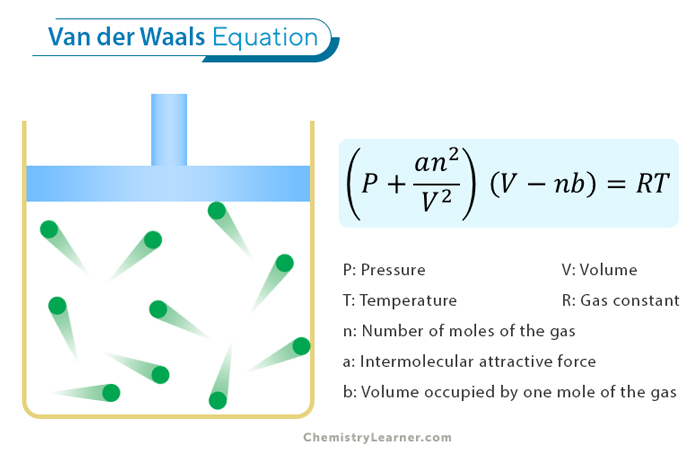
To solidify your understanding, the following text provides a concise, formal summary of the molecular interpretation for each correction term.
Section 7.5: Equations of State
This reading from a physical chemistry textbook by T.W. Shattuck clearly explains the molecular basis for the van der Waals equation.
Read the first four paragraphs of Section 7.5, starting from 'The integral in Eq. 7.4.5...' and ending with '...The final corrected pressure is then given as (P + a (n/V)2)'. This will reinforce the physical reasoning behind each correction.
4. Physical Significance of a and b
For the JEE Advanced, it's not enough to just know the equation. You must understand the physical meaning of the constants a and b, as questions often require you to compare the properties of different gases based on their values.
- Constant
a(Intermolecular Attraction): A largeavalue means strong attractive forces. Gases with strong forces (e.g., polar molecules like or ) can be liquefied more easily because the molecules "want" to stick together. A gas with a smallavalue (e.g., noble gases like or ) behaves more ideally and is harder to liquefy. - Constant
b(Molecular Volume): A largebvalue means the gas molecules themselves are physically larger. For example, thebvalue for ethane () is larger than that for methane ().
The following video provides a quick and clear summary of what these two correction terms stand for.
10.4 Real Gases & the Van der Waals Equation | General Chemistry
This short clip from Chad's Prep offers a very direct explanation of the meaning of the van der Waals constants 'a' and 'b'.
Watch from 04:01 to 05:44. Pay close attention to how the video links the 'a' term to attractive forces and the 'b' term to molecular volume. Also, note the important conclusion: the gas with the smallest 'a' and 'b' values will behave most ideally.
Test your understanding!
You are given two gases, Ammonia () and Neon ().
- Which gas do you expect to have a larger van der Waals constant 'a'? Why?
- Which gas do you expect to be more easily liquefied?
- The van der Waals constant 'b' for is 0.037 L/mol, and for it is 0.017 L/mol. What does this tell you about their relative molecular sizes?
Show answer
- Ammonia () will have a much larger 'a' value. is a polar molecule capable of strong hydrogen bonding, which results in powerful intermolecular attractive forces. Neon () is a nonpolar atom with only very weak London dispersion forces.
- Because of its much larger 'a' value (stronger attractions), Ammonia is far more easily liquefied than Neon.
- The larger 'b' value for indicates that the effective volume of an ammonia molecule is greater than that of a neon atom.
Conclusion and Preview
In this lesson, we have demystified the van der Waals equation. By building upon the limitations of the ideal gas model, we have seen how systematic corrections for molecular volume and intermolecular forces lead to a more powerful equation of state.
Key Takeaways:
- The van der Waals equation adjusts the ideal gas law with two correction terms.
- The pressure term is corrected by adding to account for intermolecular attractive forces, quantified by the constant
a. - The volume term is corrected by subtracting to account for the finite volume of gas molecules, quantified by the constant
b. - A large
aimplies strong forces and easier liquefaction. - A large
bimplies a larger molecular size.
Now that you have a solid conceptual grasp of this equation, we are ready to put it to work.
Preview of the Next Lesson:
In our next session, we will focus on the practical application of the van der Waals equation. You will learn how to rearrange and use it to solve numerical problems for real gases, calculating quantities like pressure or temperature and comparing the results to those predicted by the ideal gas law.