Welcome to our fourth lesson. In our previous sessions, we established the fundamental building blocks of research: classifying variables by type (categorical, numerical) and by their role as independent (cause) or dependent (effect). You now understand that most research is about investigating the relationship between these variables.
Today, we move from the 'what' to the 'how'. This lesson introduces the primary blueprints for medical studies, known as study designs. We will explore the four most common designs you'll encounter and be asked to analyze: cross-sectional, case-control, cohort, and the randomized controlled trial (RCT). Understanding these designs is non-negotiable for a biostatistician. They determine the strength of a study's conclusions, the types of questions it can answer, and, as we'll see later, the appropriate statistical tools for analysis.
The Big Picture: Observational vs. Experimental Studies
The first and most important distinction in study designs is whether the researcher is a passive observer or an active participant. This splits all research into two broad categories.
- Observational Studies: The researcher measures exposures (IVs) and outcomes (DVs) as they naturally occur in a population, without intervening or assigning any treatment. The goal is to observe associations.
- Experimental (or Interventional) Studies: The researcher actively intervenes by assigning an exposure (e.g., a new drug, a surgical procedure) to one group of participants and comparing their outcomes to a control group that does not receive the intervention. The goal is to determine causality.
This fundamental split is illustrated in the flowchart below.

To hear this distinction explained, let's turn to a familiar channel.
Study Design - Case-control study, Cross-sectional study, Cohort study (Prospective, Retrospective)
This video from Medicosis Perfectionalis effectively contrasts observational studies (where you just look) with interventional studies (where you actively do something).
Watch the segment from where the narrator explains the core difference and lists examples of each type. Pay close attention to the repeated, crucial mantra: "correlation is not the same as causation."
With this framework in mind, let's examine the specific designs, starting with the three main types of observational studies.
Observational Designs: From a Snapshot to a Feature Film
Observational studies are the workhorses of epidemiology and clinical research, especially when it's unethical or impractical to conduct an experiment. They differ primarily in their timing and direction of inquiry.
A fantastic, concise overview of these designs is provided in the video "Epidemiological Studies: A Beginners guide". I encourage you to watch the relevant sections as we go through each design.
1. Cross-Sectional Studies: The Snapshot
A cross-sectional study is like taking a single photograph of a population at one point in time. Both the exposure (IV) and the outcome (DV) are measured simultaneously.
- Key Question: What is happening right now?
- Primary Measure: Prevalence (the proportion of a population with a disease or condition at a specific time).
- Example: Surveying a sample of hospital doctors to determine the prevalence of burnout and simultaneously asking about their current weekly work hours. You can see if there's an association, but you can't be sure if the long hours caused the burnout or if burned-out doctors are less efficient and thus work longer hours.
Epidemiological Studies: A Beginners guide
The "Let's Learn Public Health" video provides a clear, simple explanation of this design.
Watch the section on cross-sectional studies to solidify your understanding of them as "prevalence studies" or a "snapshot" of health.
The major limitation of this design is its inability to determine the temporal sequence of events. Because you measure exposure and outcome at the same time, you cannot confidently say which came first.
2. Case-Control Studies: Looking Backward
A case-control study is a retrospective design. It starts with the outcome and looks backward in time to find the exposure.
- Key Question: What happened in the past?
- Logic: You identify a group of individuals who have the disease (the "cases") and a comparable group who do not have the disease (the "controls"). You then investigate their past histories to see if the cases were more likely to have been exposed to a specific risk factor than the controls.
- Primary Measure: Odds Ratio (which we will learn to calculate in a future lesson).
- Example: To investigate a link between a rare brain cancer and mobile phone use, you would recruit patients with that cancer (cases) and a similar group of people without it (controls). You would then ask both groups about their mobile phone usage over the last 10-15 years.
Epidemiological Studies: A Beginners guide
The same video gives an excellent explanation of the case-control approach.
Watch the segment from that describes how case-control studies work, starting with cases and controls and comparing their past exposures.
Case-control studies are particularly efficient for studying rare diseases, as you start with the diseased individuals rather than waiting for them to appear. However, their biggest weakness is their reliance on memory, which can lead to recall bias (cases may remember their past exposures differently than controls).
3. Cohort Studies: Looking Forward
A cohort study is typically a prospective design that follows a group (or "cohort") of people over time. It starts with the exposure and looks forward to the outcome.
- Key Question: What will happen in the future?
- Logic: You recruit a group of people who are free of the disease at the start. You classify them based on their exposure status (e.g., smokers vs. non-smokers). You then follow both groups over a period of time to see who develops the disease.
- Primary Measure: Relative Risk or Risk Ratio.
- Example: The famous British Doctors' Study, which enrolled a large cohort of doctors in 1951, classified them by their smoking status, and followed them for decades, conclusively linking smoking to lung cancer.
Epidemiological Studies: A Beginners guide
Now, let's look at the final observational design in this video.
Watch the section on cohort studies. It explains how these studies follow groups over time and are powerful for determining the cause of a disease.
The great strength of a cohort study is that it establishes temporality—the exposure clearly comes before the outcome. This makes it a much stronger design for inferring causality than a cross-sectional or case-control study. The main downsides are the high cost and long duration.
There are also retrospective cohort studies, where the researcher uses existing historical records (e.g., patient files, employee records) to define a cohort in the past and follows them forward in the records to the present to see what outcomes have occurred.
For a deeper dive and comparison of these observational designs, the following article provides excellent detail.
Design, applications, strengths and weaknesses of cross-sectional ...
This article from Health Knowledge UK offers a comprehensive breakdown of each observational study type, including their strengths and weaknesses.
Please read the following three sections: Cross-sectional Studies. Case Control Studies. Cohort Studies. As you read, focus on the "Strengths and Weaknesses" lists for each design. This is crucial for critically appraising research.
Experimental Design: The Randomized Controlled Trial (RCT)
When the goal is to prove that an intervention causes an outcome, the gold standard is the Randomized Controlled Trial (RCT). It is the only design that directly tests a cause-and-effect relationship.
- Logic: A sample of patients is recruited. They are then randomly allocated to either an "intervention group" (receiving the new drug or treatment) or a "control group" (receiving a placebo or the current standard treatment). Both groups are then followed over time, and their outcomes are compared.
- Key Feature: Randomization. By randomly assigning participants, we aim to make the two groups as similar as possible in every way except for the intervention they receive. This minimizes the risk of confounding variables influencing the result.
- Example: A study testing a new cholesterol-lowering drug. A large group of patients with high cholesterol are randomly assigned to receive either the new drug or a placebo pill. After one year, the change in cholesterol levels and the rate of heart attacks are compared between the two groups.
Epidemiological Studies: A Beginners guide
The "Let's Learn Public Health" video concludes with a great summary of RCTs.
Watch the final main section on interventional studies, focusing on the mechanics and advantages of the randomized controlled trial. Pay attention to the concept of "blinding."
For a more detailed, text-based explanation, let's turn to an article written for clinicians.
Clinical research study designs: The essentials - PMC
This article from the journal Pediatric Research gives an excellent overview of experimental designs, which are central to clinical practice.
First, read the brief introduction to Experimental study design. Then, read the section on Clinical trial and the specific subsection on the Randomized clinical trial. This section formally defines the RCT and why it is considered the "gold standard."
The Hierarchy of Evidence
Not all evidence is created equal. The different study designs we've discussed can be organized into a pyramid, known as the hierarchy of evidence. This pyramid ranks study designs based on how well they control for bias and their ability to establish a causal relationship.
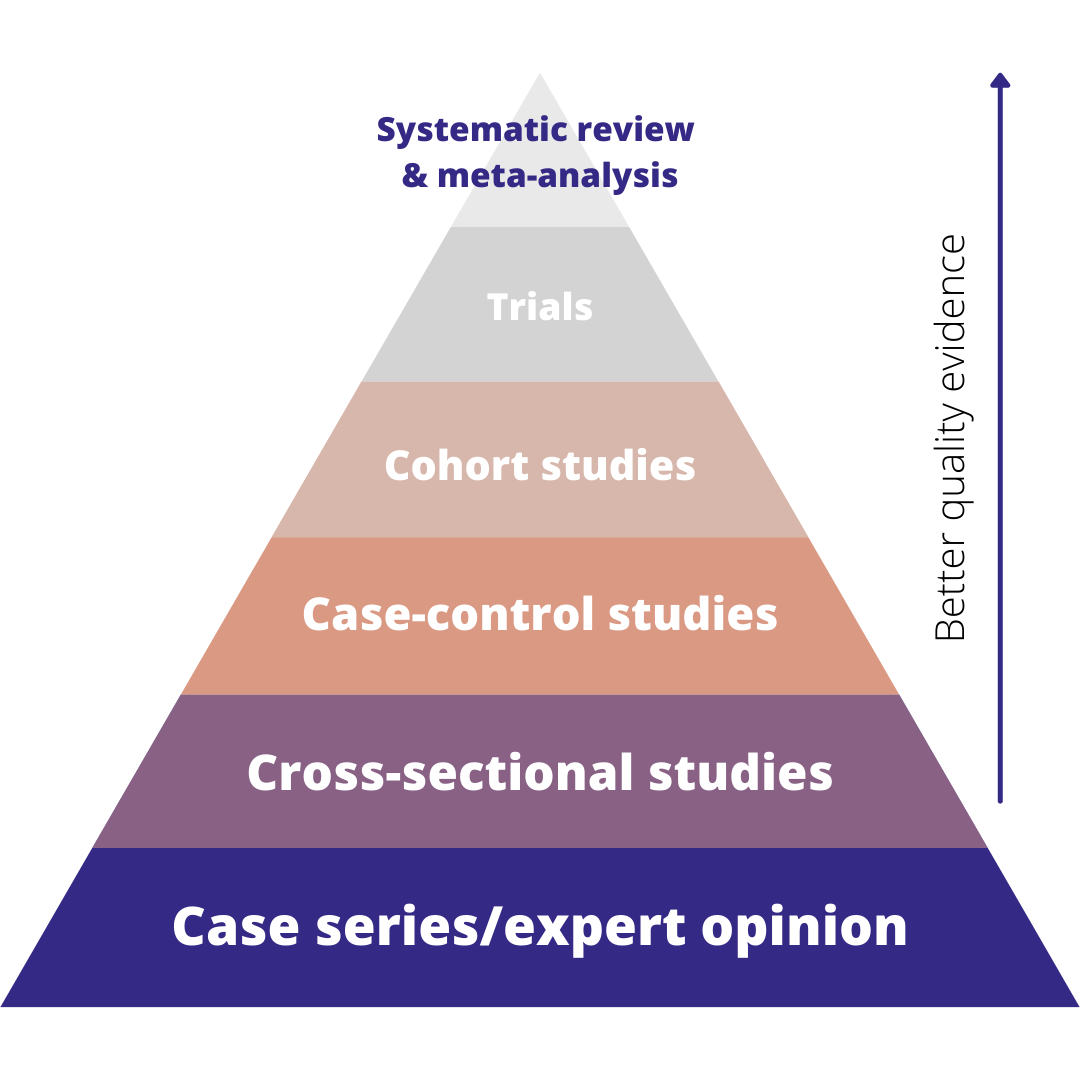
As a biostatistician, a large part of your job will be to understand where a particular study sits on this pyramid. An RCT provides much stronger evidence than a case-control study, which in turn provides stronger evidence than a collection of case reports. Understanding this hierarchy is essential for critically appraising the literature and advising researchers.
Conclusion
In this lesson, we have mapped out the principal strategies used in medical research to investigate relationships between exposures and outcomes. Your ability to identify and understand these designs is the first step toward selecting the right statistical analysis.
Here are the key takeaways:
- Studies are either observational (observing what happens) or experimental (intervening and observing the result).
- Cross-sectional studies provide a "snapshot" in time to measure prevalence.
- Case-control studies look backward from disease to exposure and are good for rare diseases.
- Cohort studies look forward from exposure to disease, establishing a clear temporal sequence.
- Randomized controlled trials (RCTs) are the gold standard for determining causality, using random assignment to minimize bias.
- These designs form a hierarchy of evidence, with RCTs at the top, reflecting their strength in making causal claims.
In our next lesson, we will begin to connect these designs to their statistical consequences. You'll learn how the choice of study design directly influences the statistical methods and measures—like odds ratios and relative risks—that you will use to analyze the data.