In our previous lesson, we established a solid blueprint for structuring a single 2-hour workshop session. You now have a four-part framework—Introduction, Instruction, Practice, and Debrief—to create a logical and engaging rhythm within any one of your five sessions.
Now, we will zoom out from the individual session to look at the entire 5-session workshop as a complete narrative arc. Just as a film's pacing changes from the exposition in Act I to the rising action of Act II and the resolution of Act III, your workshop needs a deliberate rhythm across its entire 10-hour duration. This lesson focuses on orchestrating that rhythm.
Your goal is to balance the proportion of theory, demonstration, and hands-on practice across the 5-session arc. We will explore models and tools that help you move beyond thinking about time in one session to choreographing the learning journey across the whole workshop, ensuring your students build lasting competence.
Why Doing is the Best Teacher
As a sound professional, you know that you can't learn to mix a film by only reading books about it. You learn by getting your hands on the console, pushing faders, and training your ears. This principle is at the heart of effective workshop design. Educational research confirms this intuition.

The Learning Pyramid shows that while lectures and reading have their place, the most profound learning—the kind that sticks—comes from active participation. Your workshop's success will depend on maximizing the time students spend in the "active" part of the pyramid. Our goal is to design a workshop that is heavily weighted towards the base of this pyramid.
The Cycle of Experiential Learning
How does "doing" actually translate into learning? A powerful model for this is Kolb's Experiential Learning Cycle. It describes a four-stage process that is directly applicable to your workshop design.
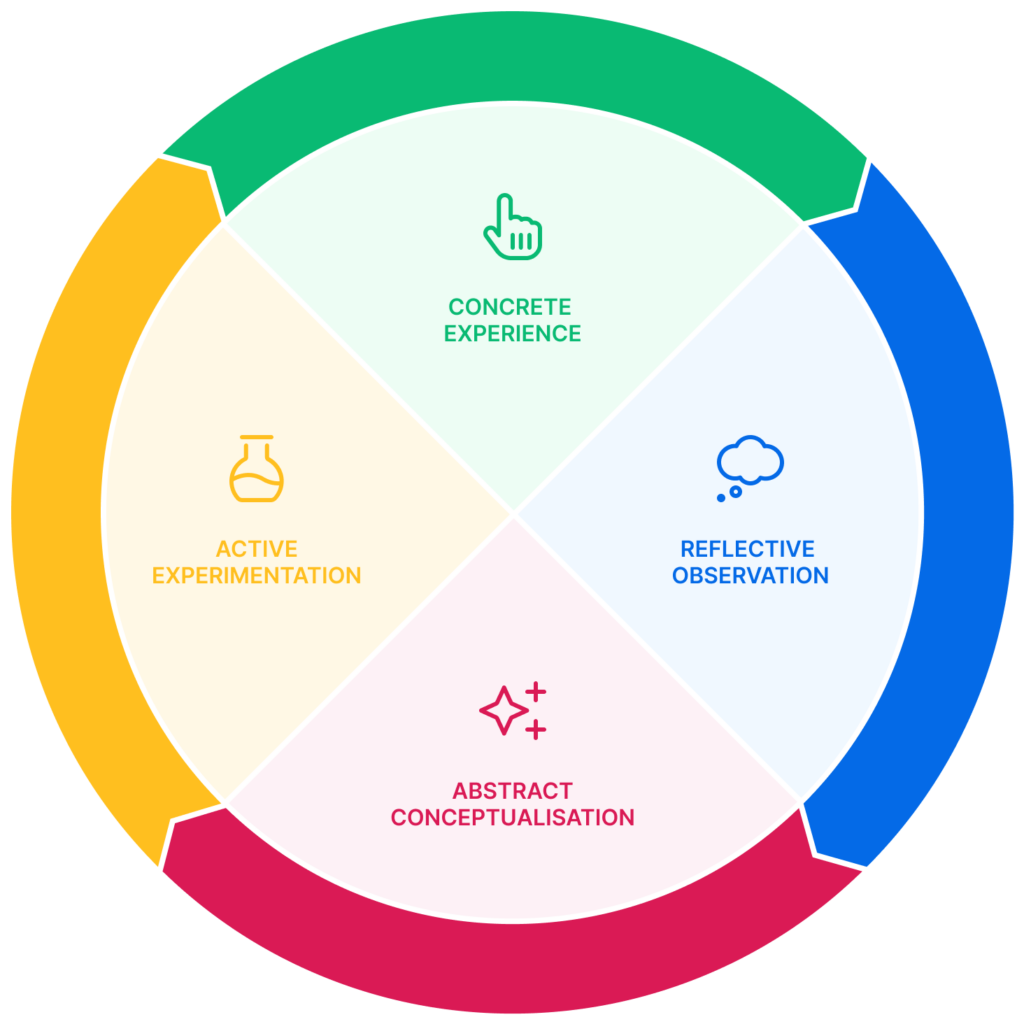
This cycle mirrors the session structure we discussed in the last lesson:
- Concrete Experience: The student engages in a hands-on Practice activity (e.g., trying to boom a scene).
- Reflective Observation: The student and instructor review what happened during the Debrief (e.g., "Why was there so much handling noise?").
- Abstract Conceptualization: The student forms a new idea or understanding based on the reflection, often guided by your Instruction (e.g., "Ah, my grip was too tight. I need to hold the pole lightly.").
- Active Experimentation: The student plans how to test this new understanding in the next Practice attempt (e.g., "This time, I'll relax my hands and let the pole balance itself.").
Your job as a facilitator is to guide students through this cycle, not just once, but repeatedly, both within a single session and across the entire workshop.
A Guiding Philosophy: The 70-20-10 Model
If the Learning Pyramid tells us why active learning is important, the 70-20-10 model gives us a practical rule of thumb for how to balance our activities. It's a framework used in corporate training that suggests learning happens most effectively through a particular blend of experiences.
How to Apply the 70-20-10 Framework in a L&D Strategy
This article from Training Magazine provides a clear overview of the 70-20-10 model and how to apply it. It's a philosophy, not a rigid formula, but it provides excellent guidance for designing a hands-on workshop like yours.
Please read the introduction to understand the model's origins. Then, focus on the section What the 70-20-10 Model Means, which breaks down the three components. Finally, review the section on Actionable Steps to see how these ideas translate into concrete design choices.
As you read, consider how the model maps onto your workshop:
- 10% Formal Learning: This is your direct instruction—the theory and concepts you present. It's the essential foundation.
- 20% Social Learning: This happens when students learn from each other during group exercises, give and receive feedback, and interact with you as a coach and mentor during practice.
- 70% Experiential Learning: This is the heart of your workshop—the hands-on practice where students are tackling challenges, operating equipment, and solving problems.
Your workshop plan should reflect this ratio, dedicating the vast majority of time to students actively working with sound equipment and concepts.
Visualizing Your Workshop's Rhythm: The Learning Arc
So, how do you plan this balance across five sessions? A fantastic tool for this is the Learning Arch. It helps you visualize the entire workshop as a journey with a deliberate flow of energy and activity.
The Learning Arch method, developed at the Kaospilot school in Denmark, distinguishes between two types of activity:
- High Action: Periods of active, experiential learning and practice. This is the "doing."
- Low Action: Periods of reflection, analysis, and theoretical understanding. This is the "thinking."
A well-designed learning journey is a balanced dance between these two states.
[PDF] Learning Arch Design - Hogeschool Rotterdam
This guide provides a deep dive into the Learning Arch methodology. It's a powerful way to design engaging and effective learning journeys of any length. We'll focus on the core concepts that apply directly to your workshop.
First, read the paragraph describing learning in equilibrium to understand the core idea of balancing different learning moments. Next, find the definition of high and low action at the end of "Step 2". This is the central concept for our lesson. Then, read about the technique of Knowledge Disturbance. This is a brilliant strategy for integrating theory ("low action") into a practice-heavy workshop. Finally, look at the diagram of the Experience Control Panel. This visual shows the "dials" you can turn as a designer, especially the balance between PRACTICE V THEORY and HIGH ACTION V LOW ACTION.
Applying the Learning Arch to your 5-session workshop, the overall shape should look something like this:
-
Session 1: Foundations of Sound. You start with a necessary dose of "low action" (theory, concepts, vocabulary) but quickly move into "high action" (a simple, hands-on activity) to make the concepts tangible. You might deliver theory in small bursts using the "Knowledge Disturbance" technique—giving students just enough information to complete the next practical task.
-
Sessions 2-4: Pre-Production & Production. The arc climbs steeply into sustained "high action." These sessions should be dominated by demonstration and, most importantly, hands-on practice. Your role here shifts from being a lecturer to a coach, circulating, providing feedback, and helping students solve problems as they arise. Theory is minimal and delivered only when needed. This approach uses scaffolding, where you provide significant support and demonstration at the start but gradually reduce it as students build their own competence.
-
Session 5: Post-Production & Integration. The arc begins its "landing." This session would involve a final, more complex "high action" task (e.g., editing a short scene they recorded). This is followed by a significant "low action" segment—a final debrief, peer review, and reflection where students consolidate everything they've learned across all five sessions.
Your Turn: Sketch Your Workshop's Learning Arc
Now, let's make this tangible for your film sound workshop.
Exercise (15 minutes):
- Take a piece of paper and draw a horizontal line to represent the 5 sessions of your workshop.
- Sketch a "learning arc" over these five sessions, showing the intended balance of "high action" (practice) and "low action" (theory/reflection). Think about where the energy should be highest and where moments of quiet reflection are needed.
- For each of the 5 sessions, estimate the percentage of time you'll dedicate to Theory/Demonstration versus Hands-on Practice.
Example Sketch:
| Session | Topic | Theory/Demo % (Low Action) | Practice % (High Action) | Notes |
|---|---|---|---|---|
| 1 | Foundations | 40% | 60% | Establish core concepts, then immediate practice. |
| 2 | Pre-Production | 30% | 70% | Script breakdown exercise, location scouting simulation. |
| 3 | Production 1 (Boom) | 20% | 80% | Brief demo, then extensive hands-on boom practice. |
| 4 | Production 2 (Lavs & Mix) | 20% | 80% | Brief demo, then practice wiring talent and mixing. |
| 5 | Post-Production | 30% | 70% | Dialogue editing practice, followed by a final group review. |
This exercise will give you a high-level map of the entire learning journey, ensuring it's not just a collection of topics but a cohesive, practice-driven experience.
Conclusion
You've now moved from designing a single scene to plotting the entire narrative of your workshop. By consciously planning the rhythm of your five sessions, you ensure that students are not just passive recipients of information but active participants in their own learning.
Key Takeaways:
- Effective learning is active, not passive. Prioritize "doing" over "listening."
- The 70-20-10 model provides a useful guideline: aim for roughly 70% of workshop time to be experiential, hands-on practice.
- The Learning Arc is a powerful tool for visualizing the balance of "high action" (practice) and "low action" (theory/reflection) across your entire workshop.
- The balance should shift: start with foundational theory, move to sustained practice with "just-in-time" knowledge, and conclude with an integrative project and deep reflection.
Having established the overall rhythm and balance of your workshop, our next step will be to start populating it with specific content. In the next lesson, we will zoom in on your first session and apply these principles to select and sequence the core concepts for your "Foundations of Film Sound" session.