Hello! Welcome to the sixth lesson in our module on the chemical foundations of life.
In our previous lessons, we've explored carbohydrates and lipids. We saw that while carbohydrates are classic polymers built from monosaccharide monomers, lipids are a more diverse group unified by their hydrophobic nature rather than a repeating structural unit.
Today, we move on to proteins, the most versatile macromolecules in living organisms. They are the "workhorses" of the cell, performing a vast array of tasks from catalyzing reactions and transporting substances to providing structural support and sending signals. This lesson addresses the learning outcome: Describe the structure of amino acids and explain how peptide bonds form polypeptide chains. We'll look at the fundamental building blocks of all proteins and see how they are linked together to begin the process of building these complex molecular machines.
1. The Building Blocks: Amino Acids
Just like polysaccharides are polymers of monosaccharides, proteins are polymers of amino acids. There are 20 common types of amino acids that cells use to build thousands of different proteins.
Let's begin with a video that introduces the basic structure of an amino acid.
Proteins & Amino Acids | Biochemistry
This video from Dr Matt & Dr Mike provides a quick and clear overview of the fundamental structure that all amino acids share.
Watch from the beginning to 01:40. Focus on the three main components of every amino acid: the amine group, the carboxyl group, and the functional 'R' group.
As the video showed, every amino acid has the same fundamental structure:
- A central carbon atom, called the alpha (α) carbon.
- An amino group (-NH₂).
- A carboxyl group (-COOH).
- A hydrogen atom (-H).
- A variable side chain, known as the R group.
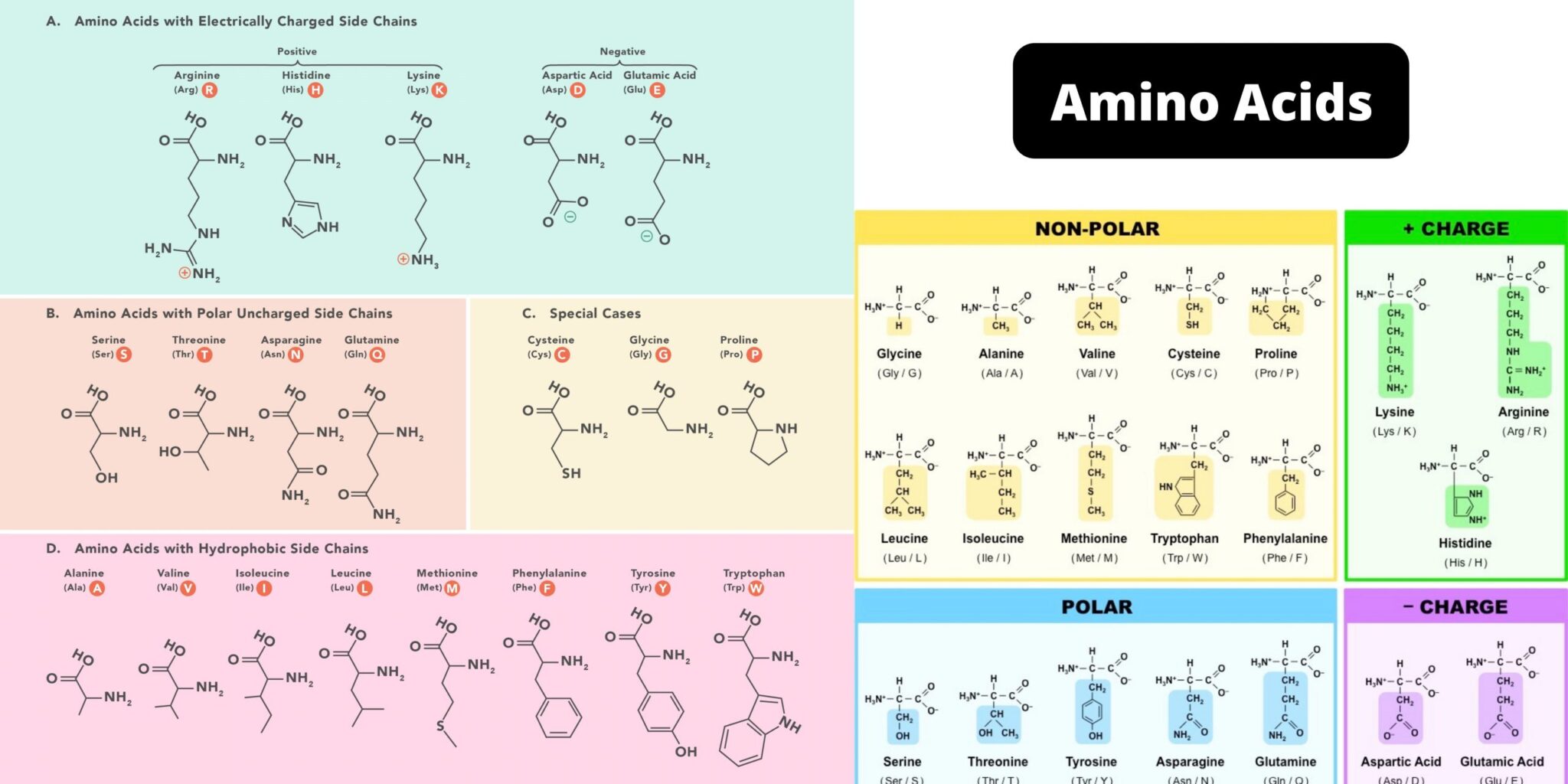
The R group is what makes each of the 20 amino acids unique. Its chemical properties—whether it is nonpolar (hydrophobic), polar (hydrophilic), acidic, or basic—determine how the amino acid will behave and interact with other amino acids in a protein chain.
For a more detailed look at this structure and to see the 20 common amino acids, let's turn to a reading from Khan Academy.
Introduction to proteins and amino acids (article)
This article, 'Introduction to proteins and amino acids,' provides a detailed breakdown of amino acid structure and includes a very useful chart categorizing the 20 common amino acids by the properties of their R groups.
Read the section titled 'Amino acids'. Pay close attention to the chart showing the 20 amino acids. You don't need to memorize them all now, but try to appreciate the variety in their R groups (highlighted in blue).
As you read, you may have noticed that amino acids are typically shown in an ionized form, called a zwitterion. At the pH found inside a cell (around 7.2-7.4), the amino group picks up a proton and becomes positively charged (-NH₃⁺), while the carboxyl group loses a proton and becomes negatively charged (-COO⁻). This is the physiologically correct state of amino acids.
2. Forming Chains: The Peptide Bond
Now that we understand the monomer, how do we build the polymer? Amino acids are linked together by a covalent bond called a peptide bond.
This process is another example of dehydration synthesis (or a condensation reaction), a concept we first encountered when building carbohydrates and lipids. The carboxyl group of one amino acid reacts with the amino group of the next amino acid. In this reaction, a molecule of water is removed, and a peptide bond forms between the carboxyl carbon of the first amino acid and the amino nitrogen of the second.

This next video clip visualizes this dehydration reaction.
Proteins & Amino Acids | Biochemistry
Let's return to the video from Dr Matt & Dr Mike. This segment shows the dehydration reaction that forms a peptide bond and introduces the term 'polypeptide'.
Watch from 02:23 to 03:19. Observe how the water molecule is removed to link the two amino acids.
3. A Deeper Look at the Chemistry
For those interested in the chemical mechanism, the formation of a peptide bond involves a nucleophilic attack. This may sound complex, but it's a fundamental concept in organic chemistry. The following video provides a more advanced, university-level explanation of how the electrons move to form the bond. It also elegantly connects the idealized reaction with the more realistic zwitterion form of amino acids we discussed earlier.
Peptide bond formation | Macromolecules | Biology | Khan Academy
This Khan Academy video, 'Peptide bond formation,' provides a deeper dive into the chemical mechanism of this reaction.
Watch the video from 00:31 to the end (08:24). The first part (up to 2:39) reviews the condensation reaction. The next section (2:39-5:25) explains the electron movements, which is a more advanced view. The final section (from 5:25) explains how the reaction proceeds from the zwitterion state, which is how amino acids exist in the cell.
4. Polypeptides: Chains with Direction
When two amino acids join, they form a dipeptide. As more amino acids are added, the chain grows. A long chain of amino acids linked by peptide bonds is called a polypeptide.
A crucial feature of a polypeptide is its directionality. No matter how long the chain is, it will always have two distinct ends:
- An N-terminus (or amino terminus), which is the end with a free amino group (-NH₃⁺).
- A C-terminus (or carboxyl terminus), which is the end with a free carboxyl group (-COO⁻).
By convention, scientists always write and read the sequence of amino acids in a polypeptide from the N-terminus to the C-terminus. This directionality is also critical for the process of protein synthesis in the cell.
Let's do one last reading to solidify this concept.
Introduction to proteins and amino acids (article)
This section of the Khan Academy article describes how peptide bonds create polypeptide chains and formally introduces the concept of N- and C-termini.
Read the section titled 'Peptide bonds'. Focus on understanding the directionality of the polypeptide chain.
It's important to note that a "polypeptide" is not yet a "protein." A polypeptide is the linear sequence of amino acids, like a string of beads. A functional protein is that polypeptide chain (or multiple chains) folded into a precise and stable three-dimensional structure.
Test your understanding!
Consider the following dipeptide: Glycine-Alanine (Gly-Ala).
- Which amino acid is at the N-terminus and which is at the C-terminus?
- How many peptide bonds are in this molecule?
- How many water molecules were released to form it?
- If you were to add a third amino acid, Serine, to the C-terminus of this dipeptide, which functional group on Alanine would react with which functional group on Serine?
Show answer
- By convention, the sequence is written from N- to C-terminus. Therefore, Glycine is at the N-terminus, and Alanine is at the C-terminus.
- There is one peptide bond linking the two amino acids.
- One water molecule was released during the dehydration synthesis reaction to form the peptide bond.
- To add Serine to the C-terminus, the carboxyl group of Alanine would react with the amino group of Serine.
Conclusion
In this lesson, we established the fundamental principles of protein structure. We saw that proteins are polymers constructed from 20 different amino acid monomers, each with a unique R group that gives it specific chemical properties.
Key Takeaways:
- Proteins are polymers of amino acids.
- All amino acids share a common structure: a central carbon, an amino group, a carboxyl group, and a variable R group.
- The R group's chemical properties (nonpolar, polar, charged) define the amino acid's identity and behavior.
- Amino acids are linked by covalent peptide bonds through dehydration synthesis.
- A chain of amino acids is a polypeptide, which has a direction, with an N-terminus (free amino group) and a C-terminus (free carboxyl group).
Preview of the next lesson:
A polypeptide chain is just the beginning. For a protein to perform its specific function, this chain must fold into a complex, stable, three-dimensional shape. In our next lesson, we will explore the four levels of protein structure, from the linear sequence of amino acids (primary structure) to the intricate folding that creates the final, functional protein.