Hello! Welcome to the fifth lesson in our module on the chemical foundations of life.
In the last two lessons, we explored carbohydrates. We saw how simple monomers (monosaccharides) link together to form polymers, and how a subtle change in their chemical bonds creates molecules with entirely different functions—from easily accessible energy in starch to the tough structural support of cellulose.
Today, we turn to the second major class of biological macromolecules: lipids. This lesson addresses the learning outcome: Describe the structure and diverse functions of lipids, including fats, phospholipids, and steroids. Unlike carbohydrates, lipids are not defined by a repeating monomer-polymer structure. Instead, they are grouped together by a common physical property: they are all nonpolar and hydrophobic, meaning they do not mix with water.
1. What Unifies Lipids?
Lipids are a diverse group of molecules that include fats, oils, waxes, phospholipids, and steroids. Their functions are just as varied, ranging from long-term energy storage to forming cell membranes and acting as hormones. So, what do they all have in common? Their hydrophobic nature. This is because their structures are dominated by nonpolar carbon-hydrogen bonds.
To get a better sense of this diverse group, let's start with a short introductory video.
Lipids - Fatty Acids, Triglycerides, Phospholipids, Terpenes, Waxes, Eicosanoids
This clip from The Organic Chemistry Tutor introduces lipids, highlighting their defining characteristic (being nonpolar and hydrophobic) and outlining their major functions.
Watch the first two minutes of the video (00:00 to 02:18). Pay attention to the main reason lipids are grouped together and the general functions mentioned.
Now, let's dive into the three most important types of lipids you need to know.
2. Fats (Triglycerides): Energy Storage and Insulation
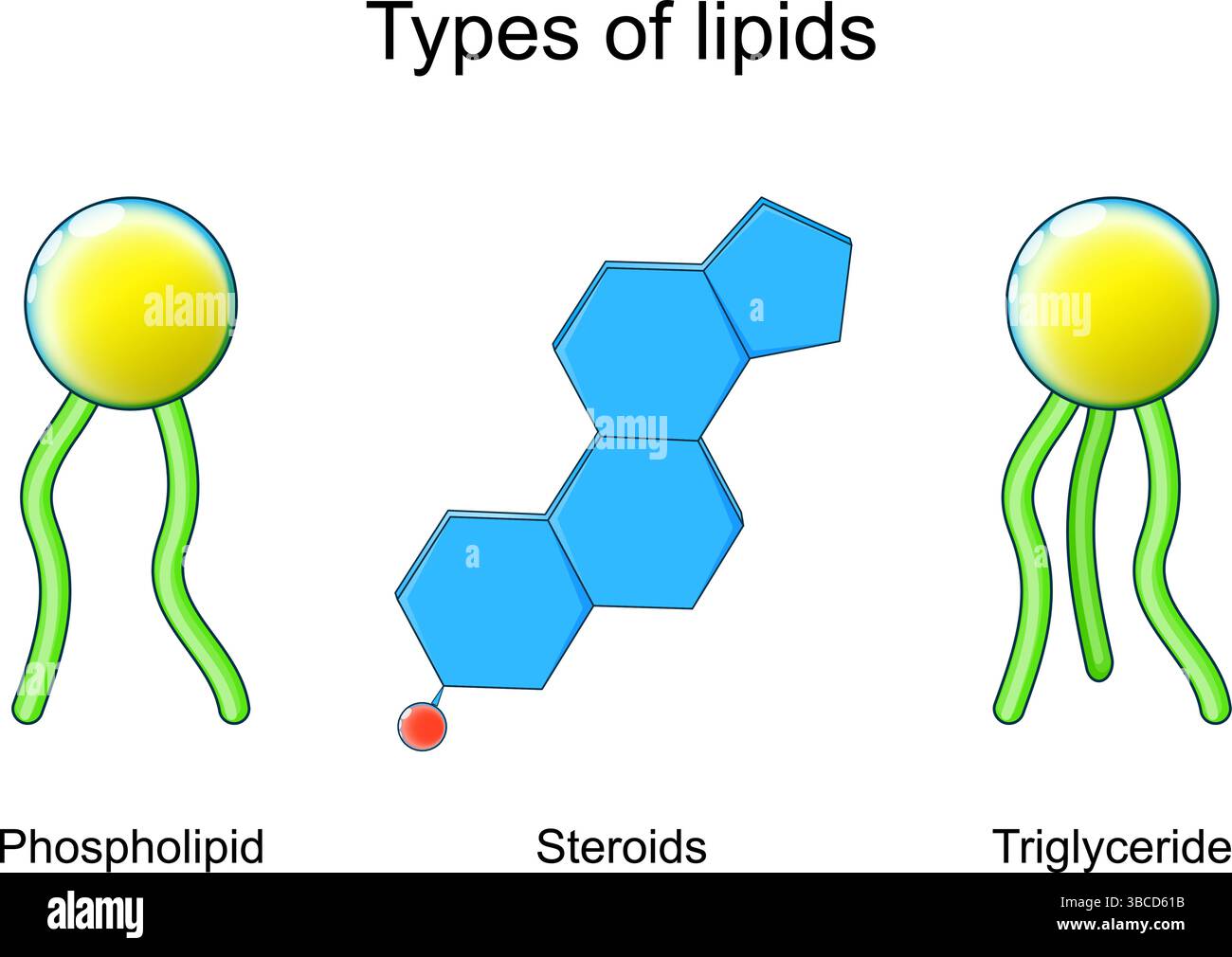
When we talk about "fats" in a dietary context, we are usually referring to triglycerides (also called triacylglycerols). These are the primary lipids used for long-term energy storage in both plants (as oils) and animals.
Building Blocks of a Fat
A fat molecule is constructed from two types of smaller molecules through dehydration synthesis reactions:
- Glycerol: A three-carbon alcohol with a hydroxyl group (-OH) attached to each carbon.
- Fatty Acids: Long hydrocarbon chains with a carboxyl group (-COOH) at one end.
To form a triglyceride, three fatty acid molecules each bond to one of the glycerol's hydroxyl groups. This process releases three molecules of water, just as we saw with the formation of polysaccharides.
Saturated vs. Unsaturated Fatty Acids
The properties of a fat are determined by its fatty acid chains. There's a crucial structural difference here:
- Saturated Fatty Acids: The hydrocarbon chain has only single bonds between the carbon atoms. The chain is "saturated" with the maximum number of hydrogen atoms. This results in a straight, linear shape.
- Unsaturated Fatty Acids: The hydrocarbon chain contains one or more double bonds.
- Monounsaturated: One double bond.
- Polyunsaturated: Two or more double bonds.
These double bonds, typically in a cis configuration in nature, create a "kink" or bend in the fatty acid chain.
This kink is incredibly important. Straight, saturated fatty acids can pack together tightly, making them solid at room temperature (e.g., butter, lard). In contrast, the bent unsaturated fatty acids cannot pack as closely, so they remain liquid at room temperature (e.g., olive oil, canola oil).
The following video provides a clear explanation of fatty acids and how they combine with glycerol to form triglycerides.
Lipids - Fatty Acids, Triglycerides, Phospholipids, Terpenes, Waxes, Eicosanoids
Let's return to The Organic Chemistry Tutor video. This segment details the structure of saturated and unsaturated fatty acids, and then illustrates the dehydration synthesis reaction that forms a triglyceride.
Watch from 02:18 to 08:08. Focus on: The visual difference between a straight saturated fatty acid and a 'kinked' unsaturated one. How glycerol and three fatty acids join, releasing water molecules. The primary function of triglycerides as energy storage molecules.
3. Phospholipids: The Architects of Cell Membranes
Phospholipids are essential for life as we know it because they form the basic fabric of all cell membranes. Their structure is brilliantly suited for this job.
A phospholipid is similar to a triglyceride, but with a key modification:
- It has a glycerol backbone.
- It has two fatty acid tails attached.
- The third position on the glycerol is occupied by a negatively charged phosphate group.
This structure makes the phospholipid an amphipathic molecule:
- The fatty acid tails are nonpolar and hydrophobic ("water-fearing").
- The phosphate group (the "head") is polar/charged and hydrophilic ("water-loving").
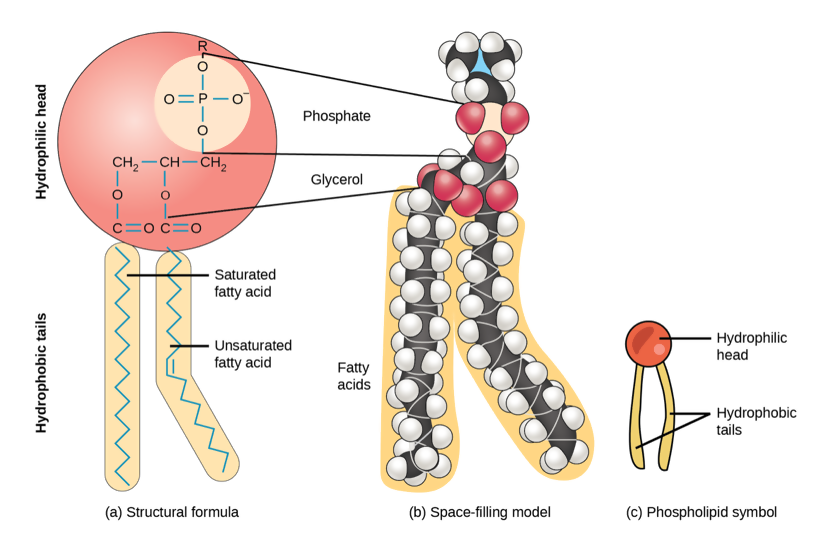
When placed in water, phospholipids spontaneously arrange themselves to keep their hydrophobic tails away from the water. They form a phospholipid bilayer, a double layer where the hydrophilic heads face the watery environment inside and outside the cell, while the hydrophobic tails are tucked away in the middle. This bilayer is the fundamental structure of the plasma membrane.
This next clip will show you exactly what this looks like.
Lipids - Fatty Acids, Triglycerides, Phospholipids, Terpenes, Waxes, Eicosanoids
This short clip explains the amphipathic structure of phospholipids and how it leads to the formation of the cell membrane.
Watch from 08:08 to 09:51. Observe how the polar head and nonpolar tails are oriented in the phospholipid bilayer.
To further solidify your understanding of these crucial molecules, take a few minutes to read the following text.
The OpenStax Biology 2e textbook provides a detailed description of fats, phospholipids, and their components. This reading will reinforce what you've just seen in the videos.
Read the sections 'Fats and Oils' and 'Phospholipids'. Pay close attention to the figures illustrating the formation of a triacylglycerol and the structure of the phospholipid bilayer.
4. Steroids: Signaling and Structure
The final group of lipids, steroids, have a chemical structure that is very different from fats and phospholipids. They are characterized by a carbon skeleton consisting of four fused rings.
Cholesterol is the most common steroid and is the precursor from which other steroids, such as the sex hormones testosterone and estradiol, are synthesized. Although it sometimes has a negative reputation in popular health discussions, cholesterol is essential for animal life. It has two main functions:
- A component of cell membranes: Cholesterol is wedged between phospholipid molecules in the plasma membranes of animal cells, where it helps regulate the membrane's fluidity.
- A precursor to other molecules: It is used by the body to synthesize all other steroids, including hormones that act as long-distance signaling molecules, and vitamin D.
Let's watch the final clip on steroids.
Lipids - Fatty Acids, Triglycerides, Phospholipids, Terpenes, Waxes, Eicosanoids
This last segment describes the characteristic four-ring structure of steroids and gives key examples like cholesterol and cortisol.
Watch from 09:51 to 11:38. Note the fused-ring structure that is common to all steroids shown.
The OpenStax reading also provides an excellent summary of steroids.
This final reading from Biology 2e describes the structure and function of steroids, focusing on cholesterol.
Read the section titled 'Steroids' to round out your understanding of this lipid class.
Test your understanding!
You are analyzing three unknown lipids.
- Lipid A is the most abundant molecule in the membrane of a human red blood cell.
- Lipid B is found in large quantities in the fat tissue of a bear preparing for hibernation.
- Lipid C is a hormone that triggers the development of male secondary sexual characteristics.
Identify each lipid as a fat (triglyceride), a phospholipid, or a steroid, and explain your reasoning based on its function.
Show answer
- Lipid A is a phospholipid. Phospholipids are the primary structural components of cell membranes.
- Lipid B is a fat (triglyceride). Fats are the body's main form of long-term energy storage, which a hibernating bear would rely on.
- Lipid C is a steroid. Steroids, like testosterone, function as hormones that regulate physiological processes like development.
Conclusion
In this lesson, we explored the diverse world of lipids. Unlike the other macromolecules, they are defined not by a common structure, but by their shared hydrophobic property. This property dictates their function, whether it's packing energy tightly, forming a barrier around a cell, or sending a chemical message through the body.
Key Takeaways:
- Lipids are a diverse group of hydrophobic molecules crucial for various biological functions.
- Fats (Triglycerides) consist of a glycerol molecule bonded to three fatty acids. They are the primary molecules for long-term energy storage. The saturation of their fatty acid tails determines if they are solid or liquid at room temperature.
- Phospholipids are amphipathic molecules with a hydrophilic phosphate head and two hydrophobic fatty acid tails. This structure allows them to form the phospholipid bilayer that makes up all cell membranes.
- Steroids are characterized by a four-fused-ring structure. Cholesterol is a key steroid that maintains membrane fluidity in animal cells and serves as a precursor for steroid hormones like testosterone.
Preview of the next lesson:
We have now examined carbohydrates and lipids. Next, we will move on to proteins, arguably the most functionally diverse of all macromolecules. We will start by describing the structure of their building blocks, amino acids, and see how they are linked together by peptide bonds to form long polypeptide chains.