Hello! Welcome to the fourth lesson in our module on the chemical foundations of life.
In our last lesson, we learned about the building blocks of carbohydrates: monosaccharides like glucose. We saw how they link together via dehydration synthesis to form disaccharides. We also briefly introduced polysaccharides as long chains of these monomers. A critical point was the distinction between alpha () and beta () glucose, which will be central to our discussion today.
This lesson directly addresses the learning outcome: Compare the structure and function of key storage (starch, glycogen) and structural (cellulose, chitin) polysaccharides. We will explore how the simple difference in linking or glucose monomers creates molecules with vastly different properties and purposes in living organisms.
The Big Picture: Storage vs. Structure
Polysaccharides generally fall into two main functional categories:
- Storage Polysaccharides: These are used to store energy. Their structure is designed for easy breakdown (hydrolysis) to release monosaccharides when energy is needed. The key players here are starch (in plants) and glycogen (in animals).
- Structural Polysaccharides: These are used to build strong materials, like cell walls and exoskeletons. Their structure is designed for rigidity and resistance to breakdown. We will focus on cellulose (in plants) and chitin (in fungi and arthropods).
Let's begin by exploring the storage molecules.
1. Storage Polysaccharides: Starch and Glycogen
Starch and glycogen are polymers built from -glucose monomers. The orientation of the -glycosidic bonds causes these polymers to form helical (coiled) structures, which are ideal for packing a lot of glucose into a small space.
To see how their specific structures relate to their function, please watch the following video.
A-Level Biology - Carbohydrates: Polysaccharides - Starch | Glycogen | Cellulose (2026/27 exams)
This video from Cognito provides a clear, animated explanation of starch and glycogen, focusing on how their branching patterns relate to their roles as energy storage molecules in plants and animals.
Watch the video from 00:58 to 03:45. Pay close attention to: The two forms of starch: unbranched amylose and branched amylopectin. The types of glycosidic bonds (\alpha-1,4 and \alpha-1,6) and how they create branches. Why glycogen is even more branched than starch and how this benefits animals.
Starch: Plant Energy Storage
As you saw, starch is the primary way plants store glucose produced during photosynthesis. It's found in granules within plant cells, commonly in roots (like potatoes) and seeds. Starch consists of two types of molecules:
- Amylose: A simple, unbranched chain of -glucose molecules linked by -1,4 glycosidic bonds. This structure coils into a helix.
- Amylopectin: A branched polymer. The main chain is linked by -1,4 bonds, with branches formed by -1,6 glycosidic bonds occurring every 24-30 glucose units.
Glycogen: Animal Energy Storage
Glycogen is the animal equivalent of starch. It is stored mainly in the liver and muscle cells. Its structure is very similar to amylopectin—a polymer of -glucose with both -1,4 and -1,6 linkages—but it is much more highly branched.
This high degree of branching is crucial. Enzymes can break down glycogen starting from many ends simultaneously, allowing for the very rapid release of glucose into the bloodstream. This is vital for animals, which often have higher metabolic rates and more immediate energy needs than plants.
2. Structural Polysaccharides: Cellulose and Chitin
Now let's turn to polysaccharides that provide strength and support. The key difference here lies in the monomer: these polymers are built from -glucose or its derivatives.
Cellulose: Plant Structure
Cellulose is the most abundant organic polymer on Earth, forming the primary component of plant cell walls. It provides the rigidity that supports the entire plant.
This next segment of the Cognito video explains the unique structure of cellulose.
A-Level Biology - Carbohydrates: Polysaccharides - Starch | Glycogen | Cellulose (2026/27 exams)
The video now shifts to cellulose, explaining how the use of β-glucose monomers results in a completely different structure and function compared to starch.
Watch from 03:45 to 05:04. Focus on: The use of β-glucose monomers. Why every other glucose molecule must be 'flipped' to form the β-1,4 glycosidic bond. How straight, parallel chains of cellulose are cross-linked by hydrogen bonds to form strong microfibrils.
The -1,4 glycosidic linkages in cellulose create long, straight, unbranched chains. Unlike the coiled structure of starch, these straight chains can lie parallel to each other. Hydrogen bonds form between these adjacent chains, bundling them together into strong cable-like structures called microfibrils. This arrangement gives cellulose its remarkable tensile strength, perfect for building a cell wall.
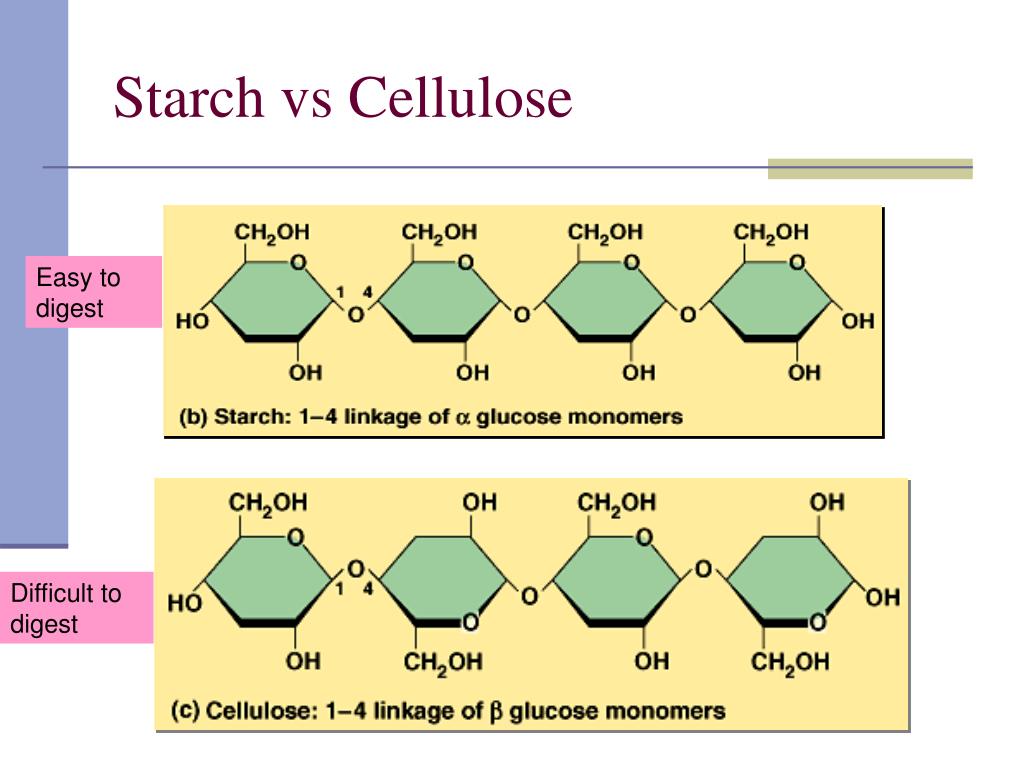
Most animals, including humans, lack the enzyme (cellulase) needed to break the -1,4 bonds of cellulose. Therefore, we cannot digest it for energy. It passes through our digestive tract as "dietary fiber." However, herbivores like cows and termites have symbiotic microorganisms in their digestive systems that produce cellulase, allowing them to unlock the energy stored in cellulose.
Chitin: Fungal and Arthropod Structure
Chitin is another important structural polysaccharide. It's found in the cell walls of fungi and in the exoskeletons of arthropods (like insects, spiders, and crustaceans).
To learn about chitin's unique structure, let's turn to a textual resource.
3.2 Carbohydrates - Biology 2e
The OpenStax Biology textbook provides a concise description of chitin, highlighting its key structural feature: a modified glucose monomer.
Read the two paragraphs under the subheading 'Carbohydrates serve various functions...'. Pay attention to the name of the modified sugar unit that makes up chitin.
As the text explains, chitin is structurally similar to cellulose—it is an unbranched polymer with -1,4 glycosidic linkages. The key difference is the monomer. Instead of glucose, chitin is made from a modified sugar called N-acetylglucosamine. This monomer is essentially a glucose molecule with a nitrogen-containing functional group attached. This addition provides extra strength and chemical resistance, making it an excellent material for protective exoskeletons.

Test your understanding!
A scientist discovers a new polysaccharide. It is composed of unbranched chains of -glucose linked by -1,4 bonds. Based on this structure, would you predict its function is more likely to be for energy storage or for structural support? Why?
Show answer
Its function is likely energy storage. The molecule is made of -glucose, and the -1,4 bonds are the same as those found in amylose (a component of starch). These bonds are readily broken down by enzymes like amylase to release glucose for energy. Structural polysaccharides like cellulose are typically unbranched but are made of -glucose, which forms much more rigid structures that are difficult to digest.
3. Summary: Structure Determines Function
The differences between these four polysaccharides boil down to three key features:
- The glucose monomer used ( vs. ).
- The types of glycosidic bonds (-1,4, -1,6, vs. -1,4).
- The presence and extent of branching.
This final clip and reading summarize these comparisons beautifully.
A-Level Biology - Carbohydrates: Polysaccharides - Starch | Glycogen | Cellulose (2026/27 exams)
Let's conclude with the excellent summary from the Cognito video, which tabulates the differences we've discussed.
Watch the final segment from 05:04 to 06:05. It provides a clear, side-by-side comparison of starch, glycogen, and cellulose.
To solidify this knowledge, read the following short text, which perfectly captures the "structure dictates function" principle for carbohydrates.
This section from Human Biology Pressbooks, titled 'The Right Molecule for the Job,' explicitly connects the structural features of these polysaccharides to their biological roles. It also includes a helpful summary table.
Read the section titled 'The Right Molecule for the Job' and review Table 3.4.2, 'Carbohydrate Comparison'. This will reinforce how branching is suited for energy storage, while tightly packed linear chains are suited for structure.
Conclusion
In this lesson, we dissected how small changes in chemical structure lead to vastly different macroscopic functions. By changing the monomer from -glucose to -glucose, biology creates molecules that can either be easily accessible fuel reserves or incredibly strong building materials.
Here are the key takeaways:
- Storage Polysaccharides (Starch, Glycogen): Composed of -glucose. Their -glycosidic bonds and branched structures allow for compact storage and easy release of glucose for energy. Glycogen's high branching suits the rapid energy demands of animals.
- Structural Polysaccharides (Cellulose, Chitin): Composed of -glucose (or its derivative, N-acetylglucosamine). Their -glycosidic bonds create straight, unbranched chains that pack tightly and form strong, rigid fibers ideal for cell walls and exoskeletons.
Preview of the next lesson: We have now covered the first major class of macromolecules. Next, we will explore lipids. You will see that lipids are a diverse group of molecules, including fats, phospholipids, and steroids, that are grouped together because they are all nonpolar and hydrophobic. We will examine their unique structures and their critical roles in energy storage, membrane formation, and cell signaling.