Hello! In our last lesson, we focused on understanding the "footprint" of a function—its domain and range. Now that we know where a function "lives," we'll learn a powerful and intuitive method for drawing its picture.
Today's goal is to sketch graphs of common functions using transformations. Instead of laboriously plotting point after point, you'll learn to take a basic "parent" function, like or , and shift, stretch, and reflect it to quickly and accurately sketch more complex functions. This skill is not just about drawing; it's about developing a deep visual intuition for how the different parts of a function's equation affect its behavior, a crucial skill for understanding limits, derivatives, and integrals later on.
The Basic Toolkit of Transformations
There are three main types of transformations we can apply to a function's graph:
- Shifts (or Translations): Moving the entire graph up, down, left, or right.
- Scalings (Stretches and Shrinks): Making the graph "taller" and "skinnier" or "shorter" and "wider".
- Reflections: Flipping the graph across the x-axis or y-axis.
These transformations are either vertical (affecting the -values) or horizontal (affecting the -values). A simple rule of thumb helps distinguish them:
- Changes made outside the parent function (e.g., or ) are vertical.
- Changes made inside the parent function (e.g., or ) are horizontal.
Let's begin by reading a resource that provides a clear overview of each of these transformation types.
Transformations of Functions | Calculus I
This article from Lumen Learning provides a structured introduction to all the basic transformations.
Please read through the sections on Vertical and Horizontal Shifts, Vertical and Horizontal Scaling, and Reflections. Pay close attention to the distinction between changes made inside the function, f(x), versus outside.
To summarize and reinforce these rules, here is a handy "cheat sheet" that visually lays out all the transformations. It's a great reference to keep in mind.

Now, let's watch a video that walks through these transformations with examples.
Transformations of Functions | Precalculus
The Organic Chemistry Tutor provides clear, step-by-step examples of each transformation type using common parent functions.
Watch the following segments: Shifts & Reflections: This part covers the basic rules for shifts and reflections. Stretches & Shrinks: This clip introduces vertical and horizontal scaling. Notice how horizontal transformations often feel "opposite" to what you might expect. Examples: Watch the explanations for vertical shifts with y=x^2, horizontal shifts with y=|x|, and reflections with y=\sqrt{x}.
A key pattern to notice is that vertical transformations tend to be intuitive ( moves the graph up), while horizontal transformations are often counter-intuitive ( moves the graph to the left). Why? Because for a horizontal shift like , you need to choose an -value that is 2 less than before to get the same output from .
Combining Transformations: The Order Matters
Applying one transformation is straightforward. But what happens when you have a function like ? This involves multiple transformations, and the order in which you apply them is critical.
The most common source of confusion involves combined horizontal transformations. Consider . Do you shift first, then stretch? Or stretch, then shift? Let's investigate this, as understanding it is key to mastery.
There are two valid ways to approach this, but one is far more intuitive. Let's call them the "literal order" and the "factored order". The Math Doctors blog has an excellent, in-depth explanation.
Combining Function Transformations: Order Matters – The Math Doctors
This article provides a deep dive into the nuances of ordering transformations, which many textbooks gloss over. It will give you a robust framework for handling any combination of transformations.
Start by reading the first part of the article. Focus on the two proposed sequences for graphing f(ax+b). Now, jump to the section "Looking at the graph" and read about the example f(x) = (3x - 9)^2. This is a perfect illustration of why the "shift-then-shrink" order can be confusing and why the "factored" form, f(x)=(3(x-3))^2, is much clearer. Finally, read the exchange in the comments section between "Cal" and "Dave Peterson" starting with Cal's question. This clarifies a crucial conceptual point: horizontal compressions are always relative to the y-axis, not some other point on the graph.
The key takeaway is that for horizontal transformations, factoring is your best friend. If you see an expression like , immediately rewrite it as . This separates the horizontal shrink (by a factor of 2) from the horizontal shift (right by 3).
A reliable order of operations for transformations is:
- Horizontal Stretches, Shrinks, and Reflections (the "a" in )
- Horizontal Shifts (the "h")
- Vertical Stretches, Shrinks, and Reflections (the "c")
- Vertical Shifts (the "k")
In essence: work from the inside of the function out, and always do shifts after stretches/reflections within the same direction (horizontal or vertical).
A Practical Method: Transforming a Table of Points
Another powerful way to manage transformations is to apply them sequentially to the key points of the parent function. This video from Mario's Math Tutoring demonstrates this practical, step-by-step approach.
Shift, Stretch, Reflect Parent Functions by Identifying Transformations and Graph
This video introduces a very clear method for applying a sequence of transformations to a table of coordinates from the parent function.
First, watch this example of transforming the square root function: square root example. Notice how he modifies the x and y columns of the table one step at a time. Next, let's look at a more challenging problem that requires factoring. The presenter uses a "nested dolls" analogy that is very helpful. Pay close attention to how he determines the order for the horizontal transformations: cube root example. Finally, watch this example where he simplifies the function first by factoring out a coefficient: factoring example. This reinforces the idea that rewriting the function can make the transformations much easier to see.
A Worked Example
Let's put it all together. The image below shows the step-by-step process for graphing the function .
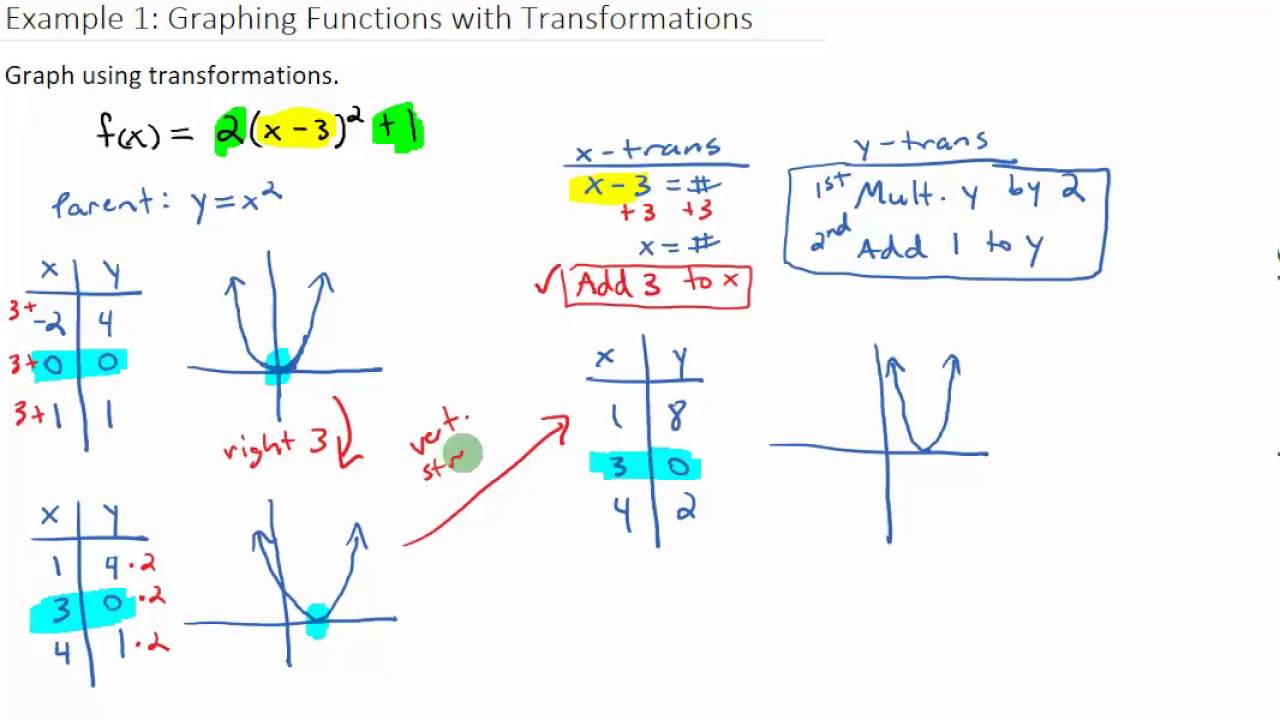
You can see the process clearly:
- Parent: Start with the basic parabola .
- Horizontal Shift: The
(x-3)term shifts the graph 3 units to the right. The vertex moves from (0,0) to (3,0). - Vertical Stretch: The
2in front multiplies all y-values by 2, making the parabola narrower (stretching it vertically). - Vertical Shift: The
+1at the end shifts the entire graph up by 1 unit. The final vertex is at (3,1).
Conclusion
In this lesson, we've built a complete toolkit for visualizing functions through transformations. You've learned to identify shifts, stretches, and reflections from a function's equation and, most importantly, how to apply them in the correct order to accurately sketch a graph.
Here are the key takeaways:
- Transformations are changes made to a simple parent function.
- Changes inside the function are horizontal and often counter-intuitive.
- Changes outside the function are vertical and generally intuitive.
- When dealing with multiple horizontal transformations, like in , it's best to factor the expression to to clearly separate the stretch/shrink from the shift.
- A reliable order for transformations is: Horizontal Stretches/Reflections → Horizontal Shifts → Vertical Stretches/Reflections → Vertical Shifts.
In our next lesson, we will explore the concept of function symmetry. We will learn to classify functions as even, odd, or neither. This connects directly to today's topic, as you'll see that even functions are symmetric with respect to a reflection across the y-axis, a transformation we've just mastered.