Hello and welcome to your first lesson in this calculus refresher course! Our goal is to move beyond just memorizing formulas and to build a deep, intuitive understanding of the core concepts. We'll start this journey by revisiting functions, which are the absolute foundation of everything we will study in calculus.
Today's lesson focuses on two fundamental properties of any function: its domain and range. In simple terms, the domain is the set of all possible inputs a function can accept, while the range is the set of all possible outputs it can produce. Mastering this will be essential, as before we can analyze how a function changes (using derivatives) or find the area underneath it (using integrals), we first need to know where the function is defined and what values it can take.
We will explore the domain and range of the most common functions you'll encounter: polynomials, rational functions, exponentials, logarithms, and trigonometric functions.
What are Domain and Range?
Let's begin by solidifying our understanding of these two key terms and the notation used to describe them. Think of a function as a machine. The domain represents all the types of raw material that the machine is designed to process. The range represents all the possible finished products that can come out of the machine.
For a function , the domain is the set of all valid -values (inputs), and the range is the set of all resulting -values (outputs).
To describe these sets of numbers concisely, we use interval notation. This notation uses parentheses () for endpoints that are not included in the set, and square brackets [] for endpoints that are included.
This article from xaktly.com clearly defines domain and range and introduces interval notation.
Please read the first two parts of the article. Start with the definitions of domain and range. Then, carefully study the section "Set notation," paying close attention to the table that explains how to use brackets and the infinity symbol \infty.
To see this in action, let's watch a short video segment that shows how to identify the domain and range visually from a graph.
Domain and Range Functions & Graphs - Linear, Quadratic, Rational, Logarithmic & Square Root
This video from The Organic Chemistry Tutor provides excellent visual explanations.
Watch the first part of the video, from the beginning until the end of the graphical examples. Focus on how the narrator scans the graph from left-to-right to determine the domain (all covered x-values) and from bottom-to-top to determine the range (all covered y-values).
Polynomial Functions
Polynomials are functions like (a line), (a parabola), or (a cubic).
When you look at these functions, ask yourself: is there any real number that I am forbidden from plugging in? For polynomials, the answer is always no. You can square any number, cube any number, and multiply by any number. Therefore, the domain of any polynomial function is all real numbers, which we write as .
The range, however, depends on the degree (the highest exponent) of the polynomial.
- Odd-degree polynomials (like linear or cubic functions) have graphs that eventually go up forever in one direction and down forever in the other. Their range is also all real numbers, .
- Even-degree polynomials (like quadratic functions) have graphs where both ends point in the same direction (either both up or both down). This creates a minimum or maximum value. The range is therefore restricted. For example, the parabola has its lowest point at , so its range is .
This resource provides a good summary of how domain and range apply to polynomials.
Read the sections on linear and quadratic/cubic functions to see these ideas explained. Then, review the general summary under the heading "Domain & range of polynomial functions" which contrasts odd and even degree polynomials.
Functions with Built-in Restrictions
Many functions are not as accommodating as polynomials. Their domains are naturally restricted. The two most common sources of restrictions are:
- Division by zero: We cannot have a zero in the denominator of a fraction.
- Even roots of negative numbers: We cannot take the square root (or 4th root, etc.) of a negative number and get a real number.
Rational Functions
Rational functions are fractions of polynomials, like .
To find the domain, we focus on the denominator. We must exclude any -value that makes the denominator zero. For , the denominator is zero when . So, the domain is all real numbers except 2. In interval notation, this is . These excluded points in the domain often correspond to vertical asymptotes on the graph, which are vertical lines the function approaches but never touches.
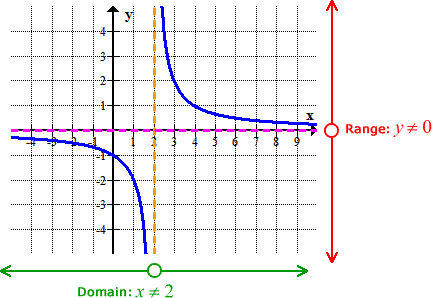
Finding the range of rational functions algebraically can be complex. For now, it's most intuitive to think about it graphically. The range is often restricted by a horizontal asymptote, a -value the function approaches as goes to . We will explore asymptotes in detail in a future lesson.
Root Functions
Consider the basic square root function, . Since we can't take the square root of a negative number, the input must be greater than or equal to 0. So, the domain is . The output is also always non-negative, so the range is as well.
For a more complex root function like , we apply the same logic. The expression inside the radical, , must be non-negative.
So, the domain of is .
This principle is a general strategy: for an even root function, find the domain by setting the expression inside the radical greater than or equal to zero and solving.
Note that this only applies to even roots (square roots, 4th roots, etc.). Odd roots, like the cube root, can handle negative inputs. For example, the cube root of -8 is -2. Thus, the domain and range of are both .
Domain and Range Functions & Graphs - Linear, Quadratic, Rational, Logarithmic & Square Root
The Organic Chemistry Tutor video explains these restricted functions with clear, step-by-step examples.
Please watch the following two segments: First, watch the section on square root functions. Pay attention to how setting the inside of the radical \geq 0 determines the domain. Also, note his explanation of how odd-indexed roots (like a cube root) have no domain restrictions. Next, watch the segment on rational functions. Focus on the core idea: finding the vertical asymptote by setting the denominator to zero, and then removing that x-value from the domain.
Exponential and Logarithmic Functions
Exponential functions, like , and logarithmic functions, like , are inverses of each other. This has a neat consequence: the domain of one is the range of the other, and vice-versa.
-
Exponential Function :
- Domain: You can plug any real number into the exponent. Domain is .
- Range: No matter what power you raise a positive base to, the result is always positive. The graph gets very close to but never touches it. Range is .
-
Logarithmic Function :
- Domain: You can only take the logarithm of a positive number. Domain is .
- Range: The output can be any real number. Range is .
The key takeaway for the domain of a logarithmic function is that the argument of the log must be strictly greater than zero. For example, to find the domain of , we set , which gives . The domain is .
Domain and Range Functions & Graphs - Linear, Quadratic, Rational, Logarithmic & Square Root
Let's return to the Organic Chemistry Tutor video for a clear breakdown of these two function types.
Watch the segments on exponential functions and logarithmic functions. Note the inverse relationship he highlights and the key strategy for finding the domain of a log function: setting the argument greater than zero.
Trigonometric Functions
Finally, let's look at the trigonometric functions.
-
Sine and Cosine: Think about the unit circle. You can find the sine or cosine of any angle, no matter how large or small. So, the domain of both and is . Their output values, however, are always trapped between -1 and 1. So, the range for both is .
-
Other Trig Functions: The other four trig functions () are all defined as ratios. For instance, and . This means we have to worry about division by zero! Their domains are restricted wherever their denominators are zero.
This excellent short video explains the domain and range for all six trig functions, connecting them directly to their definitions.
TR-21: Domain and Range of Trig Functions (Trigonometry series by Dennis F. Davis)
This video from Dennis Davis is a concise and clear summary of domain and range for trig functions.
Please watch from this point to the end. He first covers sine and cosine, then logically derives the domain restrictions for the other four functions based on where their denominators (sine or cosine) are equal to zero.
The image below provides a complete graphical summary of the domain and range for all six trigonometric functions. It's a useful reference to keep in mind.

Conclusion
In this lesson, we established a foundational understanding of domain and range. You learned how to identify the set of all possible inputs (domain) and outputs (range) for the major families of functions that we will use throughout our study of calculus.
Here are the key takeaways:
- Domain is the set of -values a function can accept; Range is the set of -values it can produce.
- The domain of most functions is all real numbers, unless you encounter a restriction.
- The three main sources of domain restrictions are:
- Denominators cannot be zero (in rational functions).
- Expressions inside an even root cannot be negative.
- Arguments of a logarithm must be positive.
- The range is often determined by key features like the vertex of a parabola, horizontal asymptotes, or the amplitude of a sine/cosine wave.
In our next lesson, we will continue building our intuition about functions by learning how to sketch their graphs using transformations. You'll see how shifting, stretching, and reflecting a basic function's graph can help us quickly visualize more complex functions, which will also give us another powerful tool for understanding their domain and range.