Hello! In our last lesson, we saw how to transform functions by shifting, stretching, and reflecting their graphs. Today, we'll dive deeper into one of those transformations—reflection—to explore a fundamental property of functions: their symmetry.
This lesson is all about learning to classify functions as even, odd, or neither. This classification isn't just a labeling exercise; it's a concept with practical implications in calculus. For instance, knowing if a function is even or odd can drastically simplify certain integrals, a topic we'll explore much later. For now, our goal is to build a solid, intuitive understanding of what these terms mean and how to test for them.
We'll start by defining even and odd functions visually, connecting directly to the idea of reflections you've already mastered. Then, we'll translate that visual intuition into a concrete algebraic test that will allow you to classify any function with confidence.
The Visual Language of Symmetry
At its core, classifying a function as even or odd is about identifying its symmetry. There are two main types of symmetry we're interested in.
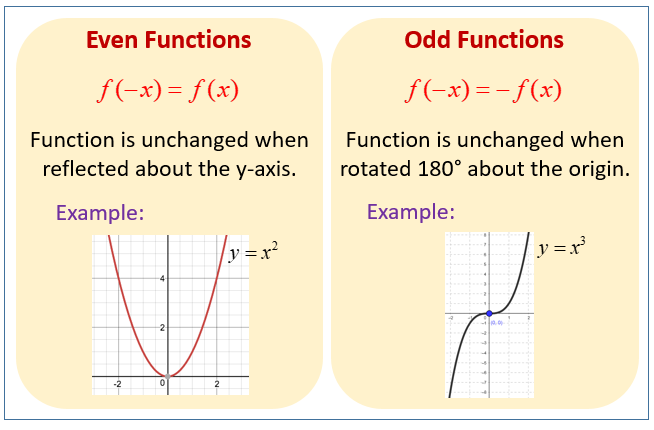
- Even Functions: A function is even if its graph is perfectly symmetric with respect to the y-axis. This means if you reflect the graph across the y-axis, it lands exactly on top of itself. The left side is a mirror image of the right side.
- Odd Functions: A function is odd if its graph is symmetric with respect to the origin. This is a bit trickier to see. It means that if you rotate the entire graph 180° around the origin (the point (0,0)), it will land back on top of itself. Another way to think about it is a "double reflection": first reflect across the y-axis, and then reflect across the x-axis.
The image below provides a great summary of these two concepts.
The Algebraic Test for Symmetry
Visual inspection is great for building intuition, but it's not always precise. To be certain, we need a formal algebraic method. This method stems directly from the graphical definitions.
Remember from our last lesson that replacing with in a function results in a reflection across the y-axis. Let's use this idea.
- For an even function, reflecting across the y-axis does nothing to the graph. Algebraically, this means the "new" function, , must be identical to the original function, .
- For an odd function, reflecting across the y-axis and then the x-axis gets us back to the original graph. A reflection across the y-axis gives us . A reflection across the x-axis is the same as taking the negative of the entire function. So, we are saying that , which is more commonly written as:
This gives us a straightforward procedure: To test a function, simply calculate and compare it to and .
Let's read a short resource that clearly lays out these definitions with simple examples.
This article from Math is Fun provides a concise introduction to the definitions of even and odd functions.
Please read the first two sections, "Even Functions" and "Odd Functions". Pay close attention to the algebraic definitions and the classic examples provided, like x^2 and x^3.
Putting It Into Practice: A Step-by-Step Guide
Now that we have the definitions, let's master the process. Most functions, it turns out, are neither even nor odd. Our algebraic test is the only way to be sure.
The process is always:
- Start with your function, .
- Find an expression for by replacing every with and simplifying.
- Compare your result from step 2 with the original . If they are identical, the function is even.
- If not, compare your result from step 2 with (the original function with its overall sign flipped). If they are identical, the function is odd.
- If it's neither of these, the function is neither even nor odd.
The following article from Purplemath provides excellent, step-by-step worked examples for all three cases.
How are you supposed to tell even and odd functions apart?
This article provides a clear, practical guide to the algebraic method for classifying functions.
Start by reading the section "How do you determine...". Then, carefully follow the algebra in the three worked examples for: the even function the odd function the function that is neither Notice how in the third example, the resulting f(-x) is not equal to f(x) and also not equal to -f(x).
To see this process in action and pick up a useful shortcut, let's watch a video. The presenter offers a very practical approach, including an "easy way" to handle polynomials.
Even, Odd, or Neither Functions The Easy Way! - Graphs & Algebraically, Properties & Symmetry
This video from The Organic Chemistry Tutor provides many worked examples and connects the algebraic tests to graphical properties.
Watch the following segments: The Algebraic Rules: A quick review of the conditions for even, odd, and neither. Even & Odd Polynomials: This shows the "easy way" of looking at exponents as a clue, and then provides the formal algebraic proof. Notice the important step of factoring out a -1 to prove a function is odd. A "Neither" Example: This is a crucial segment showing how to prove a function is neither even nor odd when it contains a mix of even and odd-powered terms.
A Visual Recap and Special Cases
Let's look at a few more graphs to solidify our visual intuition. For each graph below, try to classify it as even (y-axis symmetry), odd (origin symmetry), or neither.

A Few Key Properties
As you work more with these functions, you'll notice some patterns.
- Polynomials: For a polynomial, if all the exponents of are even, the function is even (e.g., , remembering that the constant 5 is really ). If all the exponents are odd, the function is odd (e.g., ). A mix of even and odd exponents results in a function that is neither.
- Sums & Products: There are rules for what happens when you combine even and odd functions, such as
even * odd = odd. While we won't focus on these now, it's good to know they exist and can be useful shortcuts. - The Zero Function: There is exactly one function that is both even and odd: the function . It satisfies (since ) and also (since ).
Conclusion
In this lesson, we explored the concept of function symmetry, learning to classify functions as even, odd, or neither. This skill combines the visual intuition of transformations with a precise algebraic procedure.
Here are the main takeaways:
- Even functions are symmetric about the y-axis. Algebraically, .
- Odd functions are symmetric about the origin. Algebraically, .
- The primary method for classification is to compute and compare it to the original function and its negative, .
- Most functions are neither even nor odd.
- For polynomials, checking if the exponents are all even or all odd provides a quick, intuitive clue.
In our next lesson, we will move on to another fundamental way of manipulating functions: function composition, where we'll build new functions by plugging one function into another. Understanding the basic properties of the functions we're combining, like symmetry, will continue to be a valuable part of our analysis toolkit.