Hello! Welcome to your fourth piano lesson.
In our last session, you learned to read the "map" of piano music—the grand staff. You can now look at a note on the page and know which key to play. That's a huge milestone! We figured out which notes to play (pitch).
Today, we'll focus on the second critical element of music: rhythm. Rhythm answers the question, "how long do I hold each note?" We'll be learning to identify and perform the three most fundamental note values: the whole note, the half note, and the quarter note. Mastering rhythm is what gives music its pulse and feel—it's the core of the infectious grooves in R&B and the driving energy in J-rock.
Part 1: The Beat and Note Durations
Before we look at specific notes, let's distinguish between two ideas: beat and rhythm.
- The Beat: This is the steady, underlying pulse of the music, like a clock's tick. It's what you tap your foot to.
- Rhythm: This is the pattern of long and short sounds (and silences) that are layered on top of the steady beat.
The building blocks of rhythm are notes of different durations. For today, we'll focus on three. A great way to think about their relationship is like a pizza: you can have a whole pizza, two halves, or four quarters. They all take up the same amount of "time" or space.
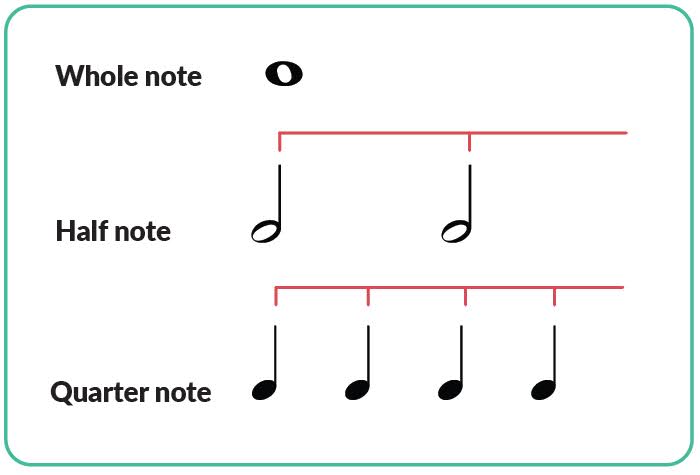
Here's how to recognize them:
- Whole Note (𝅝): An open, empty oval with no stem. It's the longest note value we'll cover today.
- Half Note (𝅗𝅥): An open oval, but with a stem attached.
- Quarter Note (♩): A filled-in, solid oval with a stem.
To get a feel for this, let's read a quick introduction.
Basic Rhythms - Piano Fundamentals for Beginners
The article 'Basic Rhythms' offers a clear explanation of the beat and these fundamental note values, using the pizza analogy to make it intuitive.
In the sections 'The Pulse of Music' and 'Holding the Note', read about basic note values. Focus on the description and visual appearance of the whole, half, and quarter notes. You can ignore the 'eighth note' for now; we'll come back to that in a later lesson.
Part 2: How to Count Rhythms
To play rhythms accurately, you must learn to count a steady beat out loud. Most music you'll play, especially in pop, R&B, and rock, is organized into groups of four beats. We count this as a steady "1, 2, 3, 4... 1, 2, 3, 4..."
Within this four-beat count, our note values fit like this:
- A whole note lasts for all four beats.
- A half note lasts for two beats.
- A quarter note lasts for one beat.
The following video is a fun and effective guide to counting. It also introduces the idea of rests, which are symbols for silence. Understanding rests is just as important as understanding notes!
How to Count Basic Rhythms (Part 1)
The video 'How to Count Basic Rhythms (Part 1)' from The Mento Zone uses clear animations and interactive drills to teach you how to count. It establishes the four-beat framework that is so common in music.
Watch the rhythm introduction covering the first four minutes of the video. Pay close attention to how the narrator counts each note value out loud. Try clapping along with the 'drill time' sections to start feeling the rhythm in your hands.
To summarize what you just saw and to have a handy reference, here is a chart showing the notes and how we count them. For now, just focus on the top two staves and the bottom one.

Part 3: From Counting to Playing on the Piano
Now it's time to take this to the keyboard. The process is simple: instead of clapping, you'll play a note. The key is to keep counting out loud while you play. Your voice is your guide.
We'll use a fantastic resource that breaks this down into simple, actionable steps.
Reading Rhythm Basics (Whole, Half, Quarter Notes and ...
The article 'Reading Rhythm Basics' provides mini-etudes, or short exercises, designed to build your rhythmic precision. We'll use it to practice each note value one by one.
Read the sections 'Whole Note and Whole Rest', 'Half Note and Half Rest', and 'Quarter Note and Quarter Rest'. For each section, follow the 'Physical action sequence' and then try the 'Mini-etudes' on your piano. Use any single key you like (Middle C is a great choice) to focus entirely on the rhythm.
Action Step: Go to your piano and complete the mini-etudes from the reading.
- Set a slow, steady tempo: Count "1-2-3-4" out loud and comfortably. You can also use a free metronome app on your phone (set it to 60 BPM).
- Play the whole note etude: Play Middle C on beat 1 and hold it down through beats 2, 3, and 4. Lift your finger just as you say the next "1".
- Play the half note etude: Play Middle C on beat 1, hold for beat 2, then lift and play it again on beat 3, holding for beat 4.
- Play the quarter note etude: Play Middle C on each beat: 1, 2, 3, and 4.
The goal is precision. A half note must last for exactly two beats—no more, no less. Your counting is the ruler that measures the duration.
Part 4: Mixing Rhythms
Music rarely uses just one type of note. The real fun begins when you mix them! A measure of four beats can be filled with any combination of notes that adds up to four.
For example:
- 1 Half Note (2 beats) + 2 Quarter Notes (1+1 beats) = 4 beats
- 1 Quarter Note (1 beat) + 1 Half Note (2 beats) + 1 Quarter Note (1 beat) = 4 beats
Let's practice this.
Reading Rhythm Basics (Whole, Half, Quarter Notes and ...
We'll return to the 'Reading Rhythm Basics' article to practice combining these different note values.
Read the section 'Mixing Whole, Half, Quarter Notes and Rests in 4/4', starting with beat math. Follow the step-by-step practice method it recommends for each new rhythm: count, then clap, then play. Try playing the rhythmic etudes (one or two notes) at the end of the section.
For even more practice, you can return to the video "How to Count Basic Rhythms (Part 1)" and try the more advanced drills that start at 4:16.
Test your understanding!
Imagine a measure that requires 4 beats. If you have one half note (which takes up 2 beats), how many quarter notes would you need to add to complete the measure?
Show answer
You would need two quarter notes. The half note is worth 2 beats, and each quarter note is worth 1 beat. So, 2 + 1 + 1 = 4.
Conclusion
Fantastic work today! You have now learned the two fundamental components of reading music: pitch (which note to play) and rhythm (how long to play it).
Key Takeaways:
- Rhythm is built on a steady beat.
- The appearance of a note tells you its duration. We covered the whole note (4 beats), half note (2 beats), and quarter note (1 beat).
- Counting out loud in a steady "1, 2, 3, 4" is the most important tool for learning and playing rhythms accurately.
- Different note values can be combined within a measure as long as their beats add up to the total.
In our next lesson, we'll formalize the concept of the four-beat count by exploring time signatures, like 4/4 and 3/4. This will give you the complete framework needed to read and play the rhythm of any basic piece of music.