Hello! Welcome to your fifth piano lesson.
In our last session, we got to grips with the building blocks of rhythm: whole, half, and quarter notes. You learned how to count them within a steady four-beat pulse. This was a crucial first step in understanding not just which notes to play, but when and for how long.
Today, we're going to put that counting into a formal context by learning about time signatures. These are the two numbers you see at the start of a piece of sheet music that act as the rulebook for its rhythm. By the end of this lesson, you will be able to interpret the two most common time signatures, 4/4 and 3/4, and confidently count them while you play. This skill is the absolute foundation for creating a steady, professional sound, whether you're playing a simple melody or a complex R&B or J-rock piece.
Part 1: What is a Time Signature?
A time signature provides two key pieces of information:
- The top number: Tells you how many beats are in each measure (or bar) of music.
- The bottom number: Tells you what kind of note gets one beat.
Think of measures as containers. The time signature tells you how big each container is and what you're using to fill it.
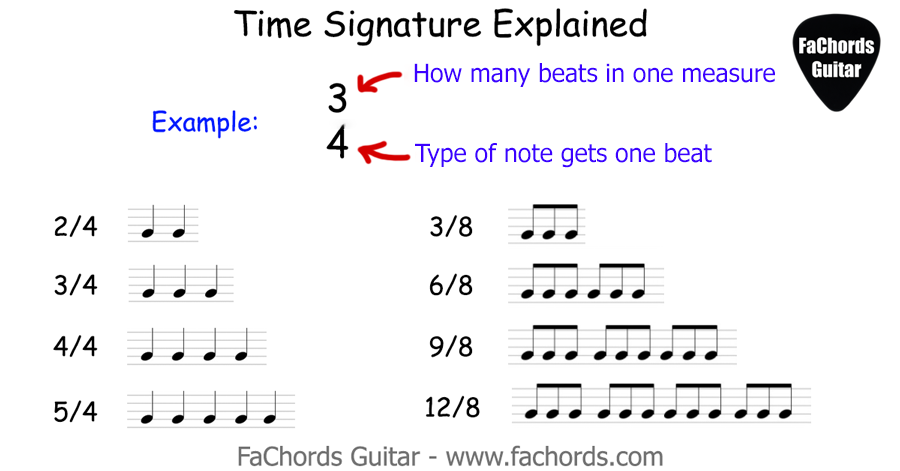
Let's dive into a clear text explanation to solidify this concept.
Master time signatures for better piano skills
The article 'Master time signatures for better piano skills' from Skoove provides a concise breakdown of how to read time signatures. It clearly explains the role of the top and bottom numbers.
Please read the first two sections, 'What are time signatures?' and 'How to read a time signature', which explain time signature basics. Pay close attention to the chart that shows what the bottom number means. For today, we're focusing on '4', which stands for a quarter note.
Part 2: 4/4 Time — The Foundation of Modern Music
You're already familiar with the feel of 4/4 time from our last lesson. It’s often called "common time" because it’s used in the vast majority of pop, rock, R&B, and J-pop music.
- The top 4 means there are four beats per measure.
- The bottom 4 means the quarter note gets one beat.
So, you count "1, 2, 3, 4" for every single measure. Within that measure, you can have any combination of notes that adds up to four beats (e.g., one whole note, two half notes, or one half note and two quarter notes).
This video will help you hear and feel 4/4 time in action.
Understanding Time Signatures in Music ⏰ (Essential Tips for Musicians)
The video 'Understanding Time Signatures in Music' by Pianote gives a great demonstration of 4/4 time. It clearly shows how to count it and helps you recognize its feel.
Starting from the beginning, watch the 4/4 introduction. Listen to how the presenter counts a steady '1, 2, 3, 4' and notice his explanation of the 'downbeat' on beat 1, which gives the music its forward momentum.
Practice in 4/4 Time
Go to your piano. Set a slow, steady tempo by tapping your foot or using a metronome (around 70 BPM is a good start). Play the following exercises on any single note (Middle C is perfect). Count out loud as you play.
Exercise 1:
- Play four quarter notes. (Count: "1, 2, 3, 4")
- Play two half notes. (Count: "1-2, 3-4" — play on 1 and 3, hold through 2 and 4)
- Play one whole note. (Count: "1-2-3-4" — play on 1 and hold through 4)
Repeat this pattern several times. The goal is to make the start of each note land perfectly on the number you are saying.
Part 3: 3/4 Time — The Feel of the Waltz
The next time signature we'll learn is 3/4. It has a very different feel from 4/4.
- The top 3 means there are three beats per measure.
- The bottom 4 means the quarter note gets one beat.
You count this as "1, 2, 3, 1, 2, 3...". It has a characteristic "strong-weak-weak" pulse (1-2-3) that creates a graceful, flowing feel, famously used in waltzes.
Let's return to the Pianote video to see how 3/4 works.
Understanding Time Signatures in Music ⏰ (Essential Tips for Musicians)
The same video from Pianote also has an excellent section on 3/4 time, where it's contrasted with 4/4.
Starting around the 1:47 mark, watch the section on the 3/4 time signature. Notice the different counting pattern ('1, 2, 3') and how the presenter creates the 'waltz' feel on the piano by playing the root note on beat 1 and the rest of the chord on beats 2 and 3.
Practice in 3/4 Time
Back at the piano, let's try some exercises in 3/4 time. Keep your tempo slow and count "1, 2, 3" out loud.
Exercise 2:
- Play three quarter notes. (Count: "1, 2, 3")
- Play one half note followed by one quarter note. (Count: "1-2, 3" — play a note on 1, hold it through 2, then play a new note on 3)
Repeat this pattern. Feel the difference in momentum compared to 4/4 time.
Test your understanding!
You are looking at a piece of music in 3/4 time. One measure contains only a single quarter note. What single note value do you need to add to complete the measure?
Show answer
You would need a half note. A 3/4 measure needs a total of three beats. The quarter note takes up one beat, so you need two more beats to complete the measure. A half note is worth exactly two beats.
Part 4: How to Make Counting Second Nature
Knowing what time signatures mean is one thing; playing with perfect timing is another. It requires practice until the feeling of the pulse becomes automatic. This is perhaps the single most important skill that separates amateur playing from professional playing.
The following video offers a brilliant, step-by-step method for internalizing rhythm.
How To Keep Time While Playing Piano
The video 'How To Keep Time While Playing Piano' from the channel Piano with Nate explains why timing is so crucial and gives you a practical, four-step process to develop a rock-solid internal clock.
Watch the video. Pay special attention to these three parts: The explanation of strong and weak beats. The four-step process to make counting subconscious. The advice on using a metronome effectively.
Action Step:
For the rest of your practice time today, apply the first step of Nate's method to the 4/4 and 3/4 exercises from earlier.
- Set a metronome to a very slow speed (e.g., 60 BPM). You can use a physical one, a free app, or just Google "metronome".
- Choose either the 4/4 or 3/4 exercise.
- Count OUT LOUD along with the metronome's clicks. Make your "1" fall on the accented click if your metronome has one.
- Play the exercise while continuing to count out loud. Your goal is to align your playing perfectly with your voice and the metronome.
Don't worry if this feels awkward at first. It's like learning to pat your head and rub your stomach at the same time. With practice, it will become natural.
Conclusion
Excellent work! Today you've unlocked a core component of musical notation. You can now look at a piece of music and understand its fundamental rhythmic structure.
Key Takeaways:
- A time signature tells you how many beats are in a measure (top number) and which note gets one beat (bottom number).
- 4/4 time is "common time," with four quarter-note beats per measure, counted "1-2-3-4". This is the pulse behind most modern music.
- 3/4 time is "waltz time," with three quarter-note beats per measure, counted "1-2-3". It has a distinct flowing feel.
- The key to mastering rhythm is to count out loud, practice with a metronome, and gradually internalize the pulse until it becomes second nature.
In our next lesson, we will combine our knowledge of notes on the staff with our understanding of rhythm. You'll learn to play a C major five-finger pattern, your first step towards playing melodies with correct fingering and timing.