Hello! Welcome to your third piano lesson.
In our last lesson, you did a fantastic job mapping out the entire piano keyboard, learning to identify every key by name, including sharps and flats. You now know what the notes are called and where to find them on the physical instrument.
Today, we're going to bridge the gap between the piano keys and written music. The goal of this lesson is to learn how to relate notes on the keyboard to their positions on the grand staff. By the end of our session, you'll be able to see a note on a page of sheet music and know exactly which key to play on the piano. This is the foundational skill for reading music and learning the songs you love.
Part 1: The Staff and the Clefs
Written music for the piano uses a system called the Grand Staff. It looks like two sets of lines stacked on top of each other. Let's break down what this means.
A single set of five lines and four spaces is called a staff. The notes of a song are drawn on these lines and in these spaces. The higher a note is placed on the staff, the higher its pitch.
But how do we know which line or space corresponds to which specific note? That's the job of the clef. A clef is a symbol placed at the very beginning of the staff that assigns a specific note to a specific line, acting as a reference point for all other notes.
For piano, we use two clefs simultaneously:
- Treble Clef (𝄞): This clef is for higher-pitched notes. You'll typically play these notes with your right hand.
- Bass Clef (𝄢): This clef is for lower-pitched notes, which you'll usually play with your left hand.
Let's watch a short video that introduces the staff and these two essential clefs.
The Grand Staff Explained: Notes, Names, & Piano Tips
The Hoffman Academy video 'The Grand Staff Explained' offers a great introduction to these core concepts. It will show you what the staff is and what the two clefs look like.
Watch the staff basics. Pay close attention to how notes are placed on lines and spaces, the introduction of the Treble and Bass clefs, and how each one is associated with a hand.
Part 2: Your Three Landmark Notes
When the Treble and Bass staves are joined together by a line and a brace on the left, they form the Grand Staff. This is the standard format for piano sheet music.
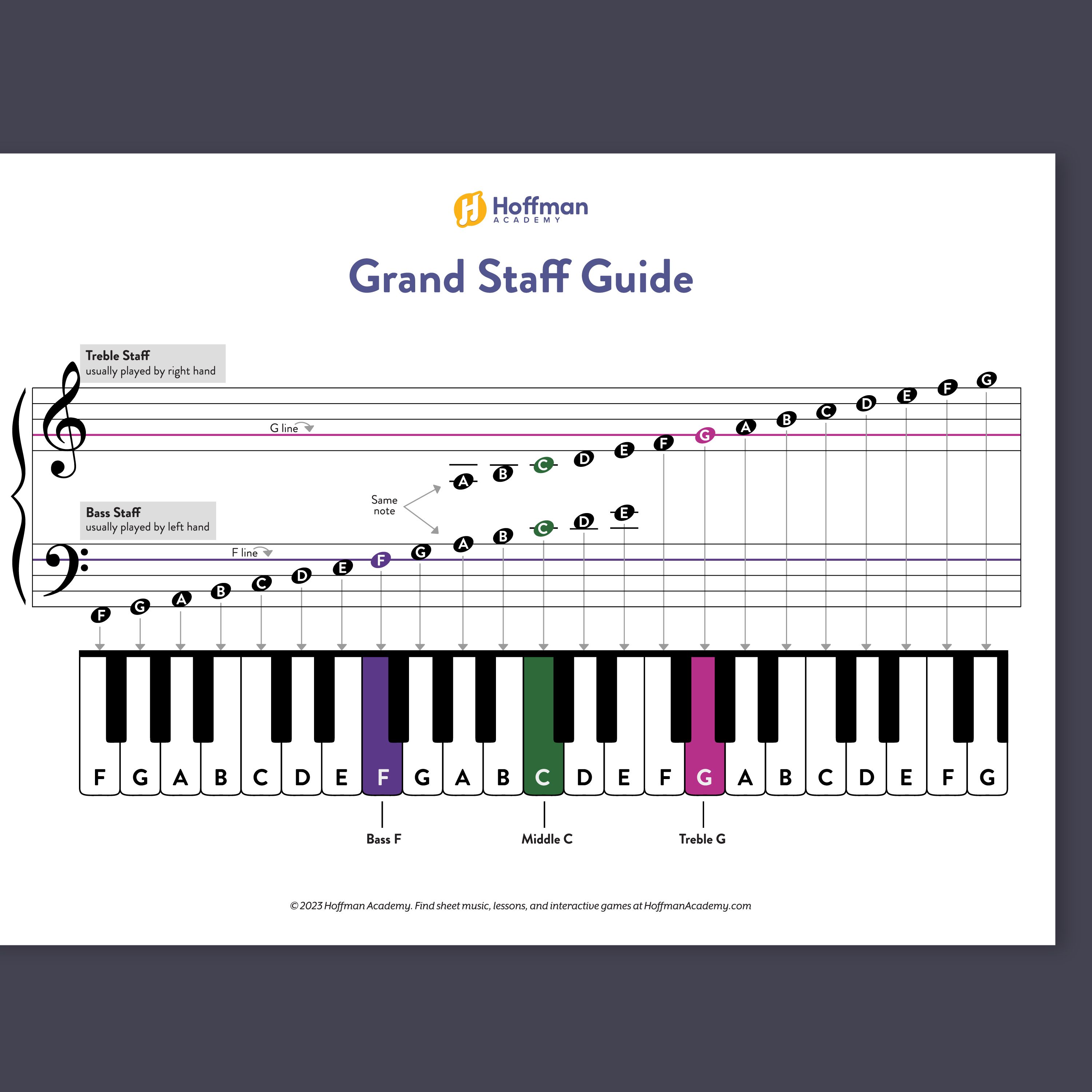
To navigate the grand staff, it's best to start with three crucial "landmark notes" that anchor everything else:
- Treble G: The Treble Clef is also called the G-Clef. Notice how the large swirl of the clef wraps perfectly around the second line from the bottom. That line is the note G—specifically, the G above Middle C.
- Bass F: The Bass Clef is also known as the F-Clef. The two dots of the clef hug the fourth line from the bottom. That line is the note F—the F below Middle C.
- Middle C: This is the most important landmark of all. It's the "bridge" that connects the two staves. Middle C is written on a small, temporary line called a ledger line, either just below the treble staff or just above the bass staff. It's the same pitch in both cases.
Let's get a clearer understanding of how Middle C connects the two staves.
The Staff, Clefs, and Ledger Lines
The resource 'The Staff, Clefs, and Ledger Lines' from musictheory.net provides a brilliant and concise explanation. It shows how the grand staff can be thought of as one large 11-line staff with the middle line removed.
Read the second half of the page, starting from the heading 'Next, let's discuss the Bass Clef...'. As you read the staff concepts, focus on the explanation and diagrams of the 'Grand Staff'. You'll see how Middle C is the note on that imaginary middle line that joins the two clefs.
Action Step: Go to your piano.
- Find and play the G shown as "Treble G" in the image above.
- Find and play the F shown as "Bass F".
- Find and play "Middle C".
Get comfortable locating these three essential landmarks.
Part 3: Reading All the Notes
Once you know your landmarks, you can figure out any other note by simply counting up or down the musical alphabet (A-B-C-D-E-F-G) as you move from line to space.
Notes on the Treble Staff (Right Hand)
Musicians often use mnemonics to quickly remember the note names.
- The notes on the five lines are: E-G-B-D-F. A common mnemonic is "Every Good Boy Does Fine."
- The notes in the four spaces are: F-A-C-E. This spells the word "FACE."
Notes on the Bass Staff (Left Hand)
- The notes on the five lines are: G-B-D-F-A. You can remember this with "Good Boys Do Fine Always."
- The notes in the four spaces are: A-C-E-G. Think "All Cows Eat Grass."
Test your understanding!
- You see a note on the top line of the Treble staff. What note is it?
- You see a note in the bottom space of the Bass staff. What note is it?
- Which note sits on the middle line of the Bass staff?
Show answer
- F (from Every Good Boy Does Fine).
- A (from All Cows Eat Grass).
- D (from Good Boys Do Fine Always).
Now, let's see this in action. The following video is excellent because it shows you the notes on the staff and then demonstrates exactly where to play them on the keyboard.
How to Read & Play Piano SHEET Music (STEP-BY-STEP Explanation for Beginners!)
The video 'How to Read & Play Piano SHEET Music' from The Piano Path will make this connection crystal clear. It walks you through reading and playing notes in both clefs, starting from our landmark, Middle C.
Watch the segment starting about a minute and 15 seconds in. The first part covers the Treble clef, and the second part covers the Bass clef. Notice how moving up on the staff means moving right on the piano, and moving down on the staff means moving left.
This video makes a crucial point: a note on the second line of the treble staff is G, but a note on the second line of the bass staff is B. The clef changes the "map," which is why it's so important to pay attention to which clef you're reading.
Part 4: The Complete Picture
You now have all the pieces: the treble clef, the bass clef, and Middle C connecting them. Let's look at one more diagram that shows a wider range of notes to see how the system extends across the keyboard.

In the previous lesson, you learned about sharps and flats. For now, all the notes we are discussing on the staff lines and spaces refer to the white keys. Notes on black keys are shown by adding a sharp (♯) or flat (♭) symbol next to the note head, which we will work with more in future lessons.
Part 5: Practice Drills
Translating notes from page to piano needs to become second nature. This takes consistent practice. Here’s how you can work on this skill during your daily practice time.
- Landmark Hunt: Look at the "Grand Staff Guide" image. Point to Treble G on the staff, then find and play every G on the upper half of your piano. Do the same for Bass F on the lower half. Finally, play Middle C while looking at its position on both staves.
- Mnemonic Recitation: Play the line notes of the treble clef (E, G, B, D, F) one by one while saying the mnemonic out loud. Do the same for the space notes (F, A, C, E). Repeat for the bass clef. This builds a strong audio-visual-kinesthetic link.
- Note Naming Flashcards: This is one of the most effective methods. You can make simple flashcards, or use a free note-naming app on your phone (search for "music note flashcards" or "note trainer"). Spend 5-10 minutes of your practice session drilling random notes from both clefs. The goal is instant recognition, without having to count up from a landmark note.
Conclusion
Excellent work today! You have unlocked the ability to read the language of music. By connecting the keys you learned last time with their positions on the grand staff, you've taken a massive step toward playing from sheet music.
Key Takeaways:
- Piano music is written on the Grand Staff, which combines the Treble Clef (high notes, right hand) and Bass Clef (low notes, left hand).
- Your three main landmarks are Treble G, Bass F, and Middle C, which acts as a bridge between the clefs.
- The position of a note on a line or in a space tells you its pitch.
- Mnemonics like FACE for treble spaces or All Cows Eat Grass for bass spaces are powerful tools for memorization.
In our next lesson, we will address the other fundamental component of reading music: rhythm. You've learned which notes to play; next, you'll learn how long to hold them by understanding note values like whole, half, and quarter notes.