Hello. A school can spread the same number of instructional days across more of the year, but it cannot assume that staff will be available whenever the building is open. This lesson develops a practical staffing test for a proposed calendar: check contract terms, count the work that must be done, and identify who covers each instructional period. It builds on the distinction between single-track and multi-track calendars; the next lesson will turn to childcare and family schedules.
A calendar for students is not a work schedule for staff
The two calendars below illustrate the starting point. Both allocate 180 learning days; the balanced calendar shortens summer break and places longer breaks elsewhere. This picture shows how one group’s days might be redistributed. It does not show whether several groups attend on different tracks.
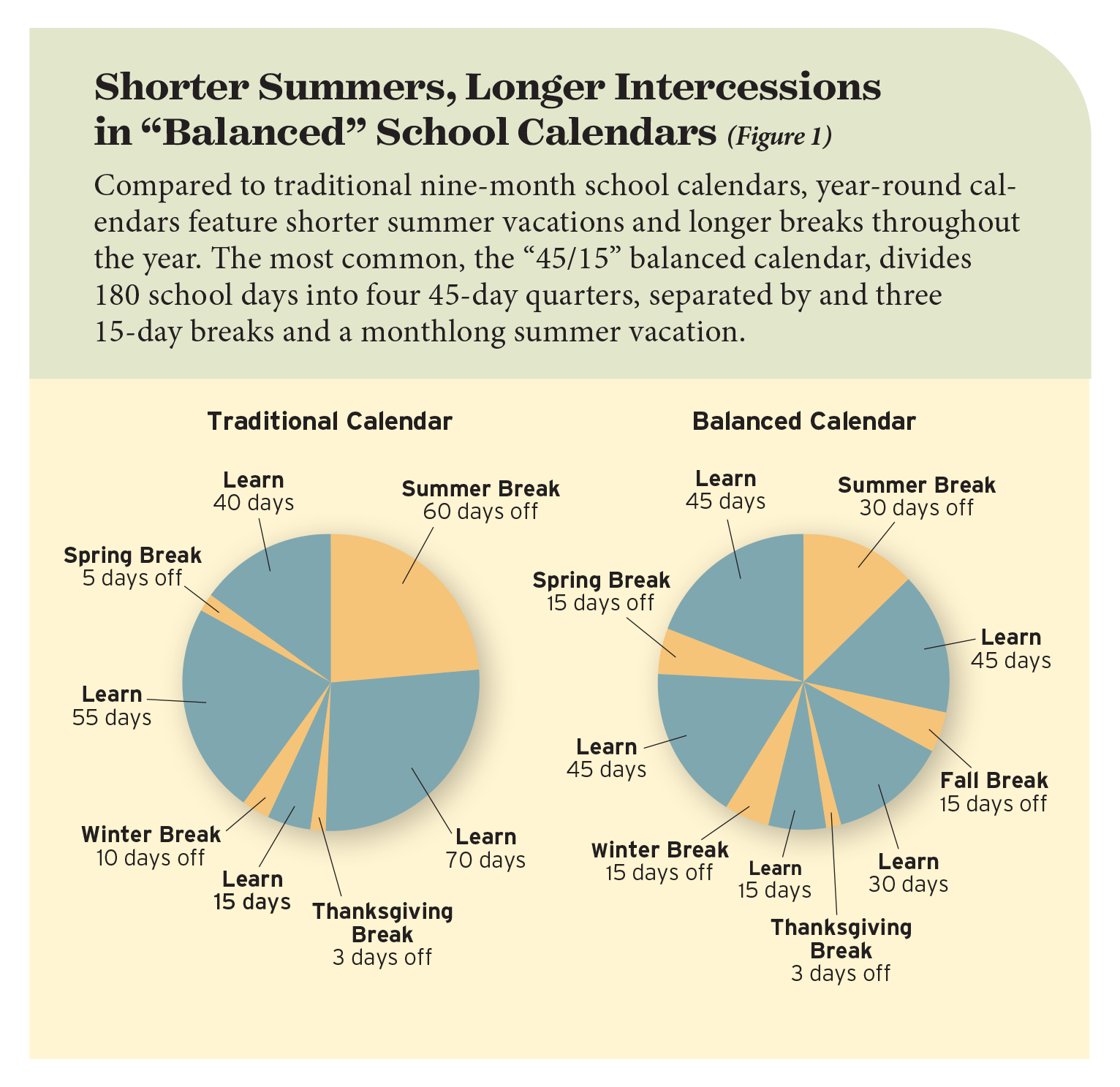
For staffing, three spans must be kept separate:
- Student instructional days: days each student is expected to attend.
- An employee’s contracted workdays: days that employee can be assigned under the applicable agreement, including any designated preparation or training days.
- Campus operating days: days on which some students attend and services must be available.
In a single-track calendar without instruction during breaks, everyone generally follows the same pattern, so the campus’s instructional days and each student’s instructional days coincide. In a multi-track calendar, the campus may need staffing on days when one group of students—and its teachers—is off track. Keeping student instruction at 180 days does not make year-round campus coverage a 180-day job.
The California Department of Education’s Year-Round Education Program Guide treats this as an implementation problem, not merely a matter of choosing dates.
Year-Round Education Program Guide - School Facilities (CA Dept of Education)
Read the California Department of Education’s implementation checklist to see which staffing decisions have to be settled before a calendar can operate.
In “Implementation Steps,” read numbered steps 5–11, from calendar selection, and steps 16–26, from operating arrangements. Notice that track assignments, bargaining, office and custodial schedules, special services, and room use are separate decisions. The guide describes one jurisdiction’s process; use it as a checklist, not as a statement of rules that apply everywhere.
A proposal that names a calendar but leaves those assignments unresolved is not yet a staffing plan.
Read the contract before counting available days
A proposed schedule must fit the actual agreements governing teachers, specialists, administrators, and other employees. Relevant terms may include annual workdays, daily hours, required breaks, duties outside teaching, assignment procedures, and provisions for changing schedules. Different employee groups need not have identical terms.
The public agreement below offers a concrete example of why “staff will work year-round” is too vague. Its figures are examples from that agreement, not universal limits.
Use this district–educator agreement as an example of the contract details a calendar planner must verify. Focus on the provisions, rather than assuming their terms govern another district.
In Article 17, “Work Year” (around printed p. 14), read subsection 17.2 and its specialist and counselor provisions, from annual workdays. In Article 18, “Hours of the Workday” (around printed pp. 15–16), read subsections 18.1.1–18.1.2, from daily hours, and subsections 18.3–18.4, from duties and lunch. Finally, find Article 27, subsection 27.6, “Multi-Track Year-Round Teaching Assignments,” and read the bargaining provision.
Under this particular agreement, returning licensed staff generally have 185 workdays, while some roles have different provisions. It also specifies daily hours and conditions for other duties. Article 27.6 says that implementing multi-track teaching assignments would reopen negotiations on specified mandatory terms. The lesson is not that every agreement requires the same response. It is that a calendar cannot silently turn an existing contract into a longer or differently assigned one.
Workload matters alongside the day count. A teaching schedule must leave room for preparation, meetings, required training, and other assigned duties. If a proposal relies on teachers routinely covering colleagues’ classes during preparation time, or on an administrator being present throughout an extended operating year without relief, it needs a contractual and operational explanation—not just a complete-looking calendar.
Test coverage across every track
Consider a simplified four-track school. Each track attends for 45 scheduled school days and then breaks for 15. Suppose the tracks’ breaks are staggered so that three tracks attend in every 15-day block:
| 15-day block | Track off | Tracks attending |
|---|---|---|
| 1 | A | B, C, D |
| 2 | B | A, C, D |
| 3 | C | A, B, D |
| 4 | D | A, B, C |
The pattern repeats four times. Across 240 campus operating days, each track attends 180 days and is off for 60. These are simplified scheduled weekdays; an actual proposal must account for holidays and other closures.
If each attending track requires one classroom teacher, the school needs three teachers teaching each operating day: classroom-teacher days. Four track-assigned teachers can supply instructional days if each teaches throughout their own track’s sessions. This covers the basic classes on paper. It leaves no spare instructional coverage for absences, training scheduled during teaching days, or a teacher whose assignment does not align with the track. Any additional contracted days for planning or training need their own workable dates.
Now consider a service needed whenever students attend: for example, a position whose qualified employee is contracted for 185 days but is expected to be staffed on all 240 operating days. Even with ideal scheduling, one such employee cannot fill at least of those days. That calculation is a minimum coverage gap, not a prescription to increase that person’s contract. The plan must specify appropriately qualified additional staff, an agreed change in workdays, or another lawful way of providing the service. The same check applies separately to administration, office support, food service, custodial work, and required instructional services; their hours and coverage needs may differ.
A useful coverage ledger records, for each role and each operating period, the number of people required, who is assigned, whether they are qualified, and whether that assignment fits their contract. It should also show who covers leave and training. Annual totals alone are insufficient: two employees can each have enough unused days yet both be unavailable on the particular day a service is needed.
Specialist coverage illustrates the difficulty. A resource specialist serving students on all tracks may be needed while a track-assigned colleague is off. The California guide discusses several possible arrangements, but each changes either the employee’s work pattern or who provides coverage.
Year-Round Education Program Guide - School Facilities (CA Dept of Education)
Return to the California Department of Education guide for concrete coverage options and the workload complications they can create.
Under “Operational Strategies for Special Services,” find “Resource Specialists.” Read the options beginning at service coverage; compare arrangements that add workdays with those that retain an individual’s days but use other staff during absences. Then, under “Pros and Cons of Year-Round Education Programs,” read the full “Cons” list, from operational trade-offs. Focus particularly on staff training, room moves, maintenance, and administrative vacation coverage. Treat the list as planning concerns, not as proof that every school will experience each one.
For example, a roving specialist or qualified substitute may cover days when the regular specialist is off. That is different from assuming an aide can perform every duty of a specialist; permitted duties and qualifications have to be checked. Likewise, sharing rooms can make a multi-track building work physically, but teachers then need time and storage to move materials. Training the whole staff becomes harder when some people are teaching and others are off track.
Reach a staffing judgment, not just a head count
A staffing feasibility assessment should end with one of three defensible conclusions:
- Feasible as specified: each period and required service has qualified coverage; assignments fit contracts and working-hour limits; and preparation, leave, training, and room transitions are accounted for.
- Conditionally feasible: the coverage model works only if named actions occur—such as bargaining over assignments, hiring relief staff, arranging qualified substitutes, or revising the training schedule.
- Not demonstrated or infeasible as proposed: required periods remain uncovered, the plan depends on work beyond agreed terms without a resolution, or the workload cannot be carried out as scheduled.
For the four-track example, “four teachers for three rooms” could establish baseline classroom coverage. It would not, by itself, establish coverage for a 240-day specialist service, teacher absences, or administrative leave. A credible recommendation names those gaps and the proposed remedy, then checks whether the remedy is permitted and staffed. Optional instruction during breaks must be evaluated separately: if offered, it creates additional teaching and support assignments rather than appearing automatically within the 180-day model.
The essential distinction is between days on a chart and people available to do the work on those days. Single-track and multi-track calendars can both redistribute instruction, but staggered tracks make continuous coverage and coordination particularly important. Next, the analysis moves beyond school employees to the childcare and scheduling consequences for families.