Hello. In the previous lesson, you tested whether a school could staff each instructional period. A family faces a parallel problem: on every day a child is not in school, someone must account for supervision, transportation, meals, and other commitments. The school may have adequate staff while a household still has no workable plan.
This lesson compares those consequences across traditional, single-track, and multi-track calendars. The central distinction is between how many days a child attends and when that child is off. We will use household scenarios to see why the same number of instructional days can produce different childcare needs.
The same 180 school days can leave different gaps
Suppose each calendar provides 180 instructional days per child. The patterns below are illustrative, not universal schedules.
| Calendar | When children attend | When families need break-time coverage |
|---|---|---|
| Traditional | Most children share a long school year. | A long summer, plus shorter breaks during the year. |
| Single-track balanced | Everyone at a school follows the same redistributed schedule. | A shorter summer and longer, shared breaks during the year. |
| Multi-track | Groups of children follow staggered schedules; some attend while others are off. | Each child has scheduled breaks, but their dates may differ from siblings’ dates or from nearby schools’ calendars. |
For a household with a younger child, childcare does not disappear merely because a school shortens summer. Some days that previously fell in summer now occur during fall, winter, or spring breaks. A family must determine whether care is available on those particular dates. Ordinary before- and after-school care is a separate need: a calendar change does not make a school day cover every caregiver’s working hours.
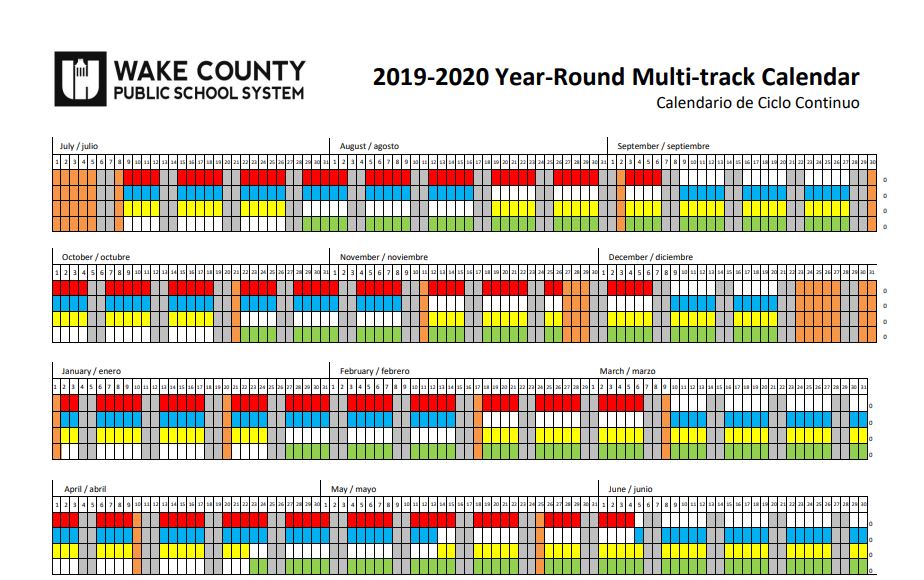
A multi-track calendar adds another distinction. A building being open is not the same as a particular child being in school. This calendar image displays separate track rows across the year. Its value here is to make the stagger visible: the household has to follow its child’s assigned row, not just the dates when the campus operates.
The Congressional Research Service’s Year-Round Schools: In Brief identifies family scheduling as a practical concern, particularly when children attend different schools or tracks. Read its concise account before considering how that concern plays out in individual households.
Year-Round Schools: In Brief - Every CRS Report
This Congressional Research Service report summarizes objections to year-round schedules. Read the relevant portion for the scheduling issues it names, rather than treating it as a measurement of how often those issues occur.
On p. 6, under “Cons,” begin with the bullet opening “The initial implementation of a year-round school program may be costly.” Continue through the bullets on staffing and family schedules, ending with the concern about extracurricular activities. Notice that the report distinguishes different-school and different-track conflicts; neither is inevitable for every family.
Household 1: A younger child needs care during working hours
Consider a household in which caregivers work weekdays and an eight-year-old needs daytime supervision whenever school is out. To isolate the calendar effect, imagine these break patterns over a comparable period:
- Traditional: 60 summer weekdays and 15 weekdays in shorter breaks.
- Single-track balanced: 30 summer weekdays and 45 weekdays across longer breaks.
- Multi-track: the child has scheduled off-track periods spread through the year; the exact dates depend on the assigned track.
The first two patterns each contain 75 break weekdays in this simplified comparison. That does not establish equal childcare cost or difficulty. A long summer may allow a family to arrange one recurring program, while three separate intersessions may require three registrations, different providers, or time away from work. Conversely, a family with reliable care during the school year but limited summer care could find the shorter summer easier. Availability, not just the day count, matters.
Price can differ as well. Suppose summer care costs 35 units per weekday and care during shorter breaks costs 55. With the illustrative patterns above, the traditional schedule costs units; the balanced schedule costs units. The difference follows from the assumed prices, not from an inherent price of balanced calendars. Different local availability or rates could reverse it. The example also excludes care before and after school, shared holidays, transport, and any days covered by caregivers.
On a multi-track calendar, an off-track child may need care while neighborhood programs are serving children who are in school—or while programs designed around a common school break are closed. An intersession class could help if it is offered to that child, on those dates, for sufficient hours, with workable transportation. “School is open” and “the child has an available full-day place” are different claims.
Household 2: Siblings’ schedules do not line up
Now consider two children who need supervision during breaks. In a single-track school, they share the school’s breaks if both attend that school. They might also share them under a traditional district calendar. Alignment is less certain if they attend different schools; single-track describes a school’s schedule, not a guarantee that every school uses it.
For a simple multi-track comparison, suppose each child has a 15-weekday break. If both are on the same track, their breaks coincide. A caregiver arranging time off work could cover both children during the same 15 weekdays. If the children are on different tracks with nonoverlapping breaks, that caregiver would need coverage across 30 separate weekdays. The children have the same combined 30 child-days out of school in either case, but the number of calendar days on which the household needs an adult available changes.
The consequences extend beyond paying for care. Siblings on different tracks may be unable to take a trip together during either break. A caregiver’s leave may cover one child’s break but not the other’s. If an older sibling attends a traditional secondary school, keeping the younger children together on one multi-track schedule still may not produce a family-wide vacation. A teen’s job, sports season, or other activities may also follow a calendar that does not align with an off-track period. None of this means every staggered break is harmful: some households value having children off at different times or can arrange individual time with each child. The point is that track assignment determines which version of the multi-track calendar a family actually experiences.
A workable comparison therefore records each household member’s dates side by side. Counting only the school’s operating days would conceal precisely the conflicts the family has to manage.
Household 3: Care is available, but only at certain times
Suppose a household can rely on a relative for several summer weeks, while the relative works during fall and spring. A shorter summer might remove weeks for which care was already available and introduce intersessions for which it is not. Another household may have the opposite arrangement: a caregiver can adjust work during the year but cannot take an extended summer break. The same single-track calendar can be harder for the first household and easier for the second.
The details of a care arrangement matter on school days too. A program that starts at 9 a.m. does not cover a caregiver’s earlier shift; a half-day intersession class does not replace full-day care. Families may need different pickup arrangements for children at different schools, and transportation to an off-site program may be the deciding constraint. Optional instruction during a break should therefore be entered into a family schedule with its eligibility, dates, daily hours, location, and transport, not simply marked “care provided.”
These scenarios show why family impacts cannot be inferred from a calendar label. They depend on the child’s age and supervision needs, the household’s work and caregiving arrangements, the availability of programs, and whether children’s dates coincide.
Turn family needs into an implementation plan
A district choosing a multi-track calendar can reduce avoidable conflicts, although it cannot make every preference compatible. The California Department of Education’s Year-Round Education Program Guide treats sibling schedules, timely track assignments, appeals, community coordination, and childcare providers as implementation matters. Its guidance is especially useful because it connects a household’s problem to decisions a district can actually make.
Year-Round Education Program Guide - School Facilities (CA Dept of Education)
Read the California Department of Education guide’s implementation and track-assignment guidance to see which family scheduling problems require explicit policies, rather than informal assurances.
Under “Implementation Steps,” read steps 9–15, from track assignment. Then read steps 29–34, from community coordination; note the explicit instruction to identify and coordinate with childcare providers. Under “Track Assignment Considerations,” in “General Axioms,” read from family priorities. Focus on why keeping relatives on compatible schedules, announcing assignments early, and offering appeals are separate safeguards.
For any proposed calendar, a family-impact assessment can now be quite concrete. It should identify:
- Each child’s actual school and track, including whether siblings’ breaks overlap and whether another school uses a different calendar.
- The uncovered hours on each date, not merely the number of break days. This includes ordinary school-day care as well as intersessions.
- Available alternatives, with confirmed places, prices, hours, transport, and eligibility. An optional school program is not guaranteed childcare.
- The household’s fixed commitments, such as work schedules, available leave, shared caregiving arrangements, and older children’s activities.
- The district’s safeguards, including early notice of assignments, a policy for keeping family schedules together where possible, and a way to appeal a difficult assignment.
A traditional calendar often makes shared summer planning easier but concentrates the need for care into a long stretch. A single-track balanced calendar preserves a common school schedule while shifting some of that need into the year. Multi-track calendars can create additional date conflicts between children—and can make childcare harder to organize even while the campus is open for other students. Which option works best depends on the household and on the support arranged around the calendar.
Conclusion
Equal instructional days do not imply equal scheduling burdens. The useful comparison is not simply “long summer versus short summer”; it is a dated, child-by-child account of who needs care, when, for how long, and what options are actually available. Single-track calendars primarily change the timing of shared breaks. Multi-track calendars also make track alignment and assignment policies consequential for families.
The next lesson will examine costs from the district’s perspective, separating recurring operating expenses from potential savings on school buildings. Family childcare costs are a distinct part of the broader tradeoff.