Hello. In the previous lesson, you separated the effect of moving school days from the effects of extra instruction and pre-existing differences between schools. Now the question is how much confidence to place in research summaries that report achievement results. By the end of this lesson, you should be able to judge claims about single-track and multi-track calendars separately—and tell a temporary seasonal advantage from an improvement sustained over a full year.
A summer advantage is not necessarily an annual advantage
A shorter summer break could help students retain what they learned. But if the calendar still contains the same number of instructional days, some of that apparent advantage might disappear while students on a traditional calendar spend more time in class. An annual achievement claim therefore needs a comparison over a sufficiently long, comparable period, not just a test immediately after summer.
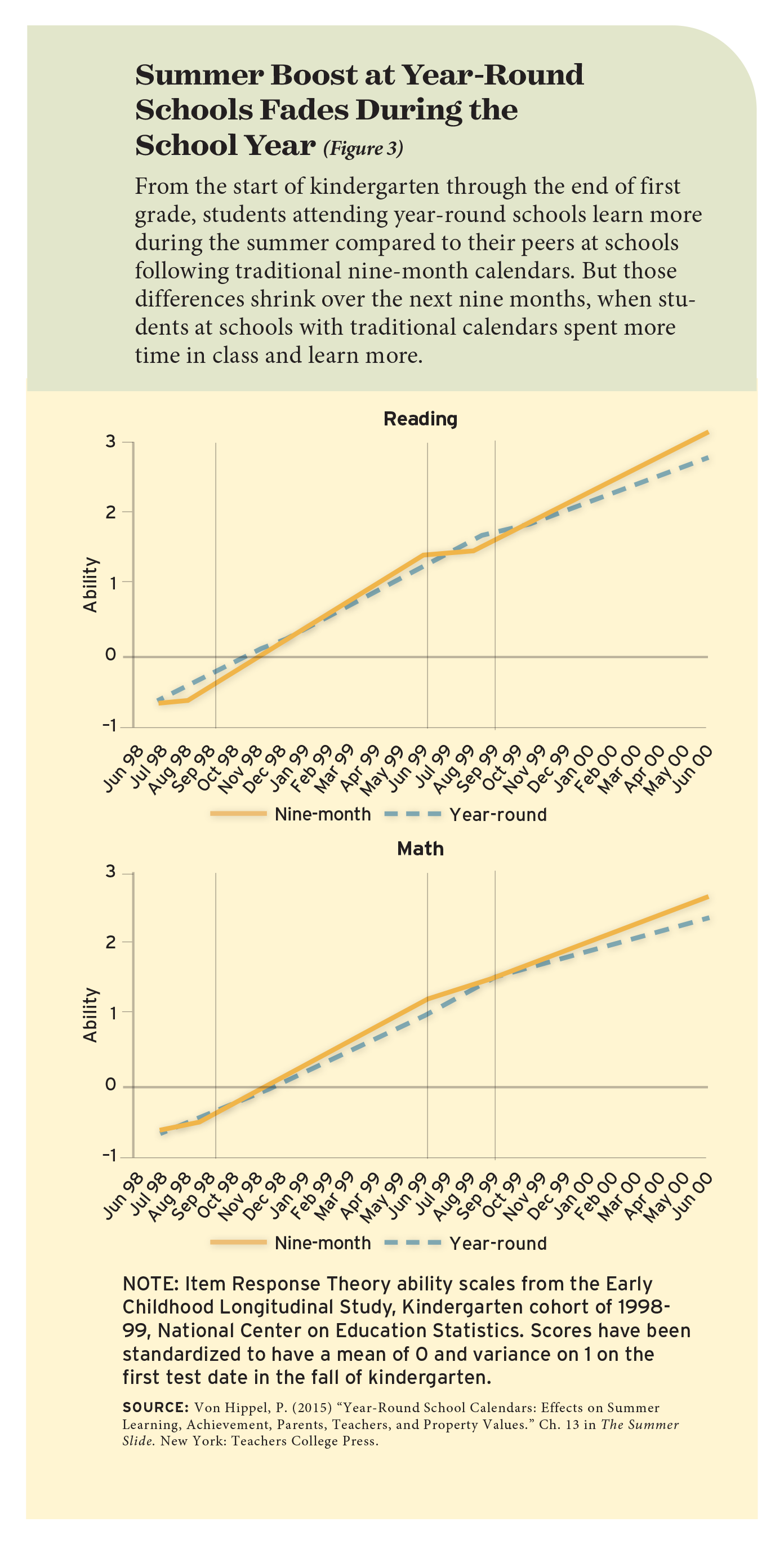
Notice that neither line represents a fixed score: students generally gain ability over time. What changes is which group is ahead and when. The figure makes an important claim testable: a summer boost should count as an overall achievement improvement only if an appropriate comparison shows that it persists at a comparable later point. It cannot settle that claim by itself; the groups may have differed for reasons besides their calendars.
A useful annual comparison would measure achievement at the same grade and similar points in the calendar cycle, account for where students started, and distinguish required days from any additional instruction. Otherwise, “higher scores” may describe a testing-date advantage rather than more learning across the year.
Read the broad review: modest averages, uncertain causes
The Community Guide systematic review brings together evidence on both types of year-round calendar. Its results are worth reading alongside its own judgment about what those results can establish.
Read the review's achievement results and its separate conclusions for single-track and multi-track calendars. Focus on the difference between a reported average and a well-supported explanation for that average.
In the results, locate the paragraph beginning “A meta-analysis by Cooper and colleagues,” after the sentence about search results. Read the earlier synthesis. Continue through the paragraphs beginning “We conducted a search of literature” and “Three studies, in five articles”; stop at the “Effects on Inequities” heading. Then go to “Discussion” → “Summary of findings.” Read the “Single-track YRSCs” and “Multi-track YRSCs” subsections, from the review's conclusions. Track which concern applies to each calendar type.
The earlier meta-analysis cited by this review found a modest average score difference for single-track schools compared with traditional-calendar schools: a standardized mean difference of , with a 95% confidence interval from to . “Standardized” means the difference is expressed relative to variation in scores, not that scores rose by 19%. The interval is above zero, so this analysis provides evidence of a positive average association among the studies it combined.
For multi-track schools, the corresponding estimate was , with a 95% confidence interval from to . That range is compatible with a small disadvantage, no difference, or a small advantage. It does not demonstrate an achievement gain. Nor does it prove that every multi-track calendar harms learning.
The review also describes later studies with mixed single-track results and mostly negative multi-track findings. Why, then, does its conclusion say the evidence is insufficient to determine whether either type improves achievement? Statistical precision answers only part of the question. A pooled estimate can be reasonably precise while the studies still leave the intervention or the comparison unclear:
- For single-track calendars, intersession instruction may be part of what produced a favorable result. The review could not reliably separate those opportunities from rescheduling the regular school days.
- For multi-track calendars, findings differed across studies, implementation details were often limited, and students on different tracks could receive different resources. “Multi-track” was not one uniform educational experience.
Thus, the single-track average is a signal worth investigating, not proof that rearranging days alone raises annual achievement. For multi-track calendars, this review offers still less support for a general achievement-improvement claim.
Narrow the question: what if the calendar changes but days do not?
A second review focuses specifically on single-track schools that redistributed the standard instructional days rather than scheduling additional days. That narrower definition gets closer to the calendar-only question from the previous lesson. Read its results with two distinctions in mind: mean test performance versus proficiency rates, and positive estimates versus a trustworthy causal estimate.
Single‐track year‐round education for improving academic ...
Fitzpatrick and Burns's single-track review narrows the intervention to rescheduling instructional days. Read how its choice of comparison schools affects the credibility of its reported gains.
Find the discussion of comparison-group strategies immediately before “5.2 | Risk of bias in included studies.” Starting at “Reviewing the studies retained for this meta-analysis,” read the design comparison; notice why geographic proximity alone may be insufficient. Then read “5.2 | Risk of bias in included studies” and “5.3 | Synthesis of results,” especially “5.3.1 | Full-sample effects.” Begin at the reported results and follow the contrast between mean scores and proficiency outcomes.
This review reports positive estimates for average test performance: approximately standardized units in reading and in math in its full sample. It does not find a corresponding clear average effect on whether students cross a proficiency threshold. These outcomes can diverge without contradiction. Students’ scores might improve slightly while few additional students cross the particular cutoff used to label them proficient. The review raises a possible explanation involving students below proficiency, but it could not directly test that explanation with these data.
Its design warning matters just as much as the estimates. Studies that selected comparison schools mainly because they were nearby tended to produce larger achievement estimates than studies using other comparison strategies. Nearby schools can still differ substantially in prior achievement and student characteristics. The review says the overall estimates may be biased, while also noting that the direction of that bias is unclear. It would go beyond the evidence to treat either the largest estimate as the true calendar effect or a smaller estimate as proof of no effect.
The two reviews are not two independent measurements of exactly the same intervention. They use different sets of studies and analytic choices; one considers both calendar types, while the other deliberately narrows its single-track sample. Read together, they support a restrained conclusion: some analyses find small positive mean-score associations for single-track calendars, but the size and cause of any annual benefit remain uncertain.
Match the claim to the evidence
A research summary becomes more useful when you translate its headline into the precise claim its evidence can bear.
| Claim in a debate | How strongly do these summaries support it? | Main boundary |
|---|---|---|
| “Single-track calendars can produce higher average test scores.” | Some support. Both reviews report positive average estimates in at least some analyses. | Study designs and, in the broad review, intersession instruction complicate attribution. |
| “Simply moving the same school days improves annual achievement.” | Limited support. The narrower review examines this more directly, but its estimates remain sensitive to comparison methods. | A positive pooled estimate is not a guarantee of a causal calendar-only effect. |
| “Single-track calendars raise proficiency rates.” | Not clearly supported by the narrower review. | Mean-score gains need not move many students past a proficiency cutoff. |
| “Multi-track calendars improve annual achievement.” | Not supported as a general conclusion by the broad review. | Its pooled estimate is near zero, and later findings are inconsistent. |
| “Multi-track calendars always reduce achievement.” | Also too strong. Some concerning findings warrant attention, but they do not establish the same effect everywhere. | Track assignments and resources differ across implementations. |
These judgments concern achievement, not whether a calendar might be worthwhile for another reason. A multi-track schedule may help a district use a crowded building more intensively even if it does not improve test scores. Conversely, a possible single-track score benefit does not by itself settle questions about staffing, childcare, or cost.
The strongest wording keeps the outcome, calendar type, and uncertainty together: “Research summaries report small positive average score differences for some single-track calendars, but do not establish that rescheduling alone reliably improves full-year achievement; they do not establish a general achievement gain for multi-track calendars.” That is more informative than either “year-round school works” or “year-round school does not work.”
Takeaways
An early advantage after summer is not the same as a sustained annual gain. The evidence reviewed here suggests possible small mean-score benefits for single-track calendars, without a clear proficiency benefit or a securely isolated calendar-only effect. It provides insufficient support for a general multi-track achievement gain. In both cases, the strength of a claim depends on what students actually received, when achievement was measured, and how credible the comparison was.
The next module turns from achievement evidence to implementation, beginning with whether staffing and contracts can support a proposed calendar.