The last lesson showed why a claim about summer learning depends on the score scale, testing dates, and students included. Even if a summer decline is measured accurately, a different question remains: Would changing the school calendar improve learning? This lesson gives you a way to read calendar studies without mistaking three possible explanations for one another: rescheduling school days, providing extra instruction during breaks, and comparing schools that differed before either calendar was adopted.
Decide what effect the study is trying to measure
A year-round calendar usually redistributes instructional days rather than increasing their number. An intersession is a break between instructional periods; it may also offer optional classes or tutoring. If students attend those programs, the intervention they experience may be more than a change of dates.
The figure makes the basic distinction visible. Both calendars show 180 learning days, arranged differently. It depicts the calendar—not any optional instruction a school might add during a break.
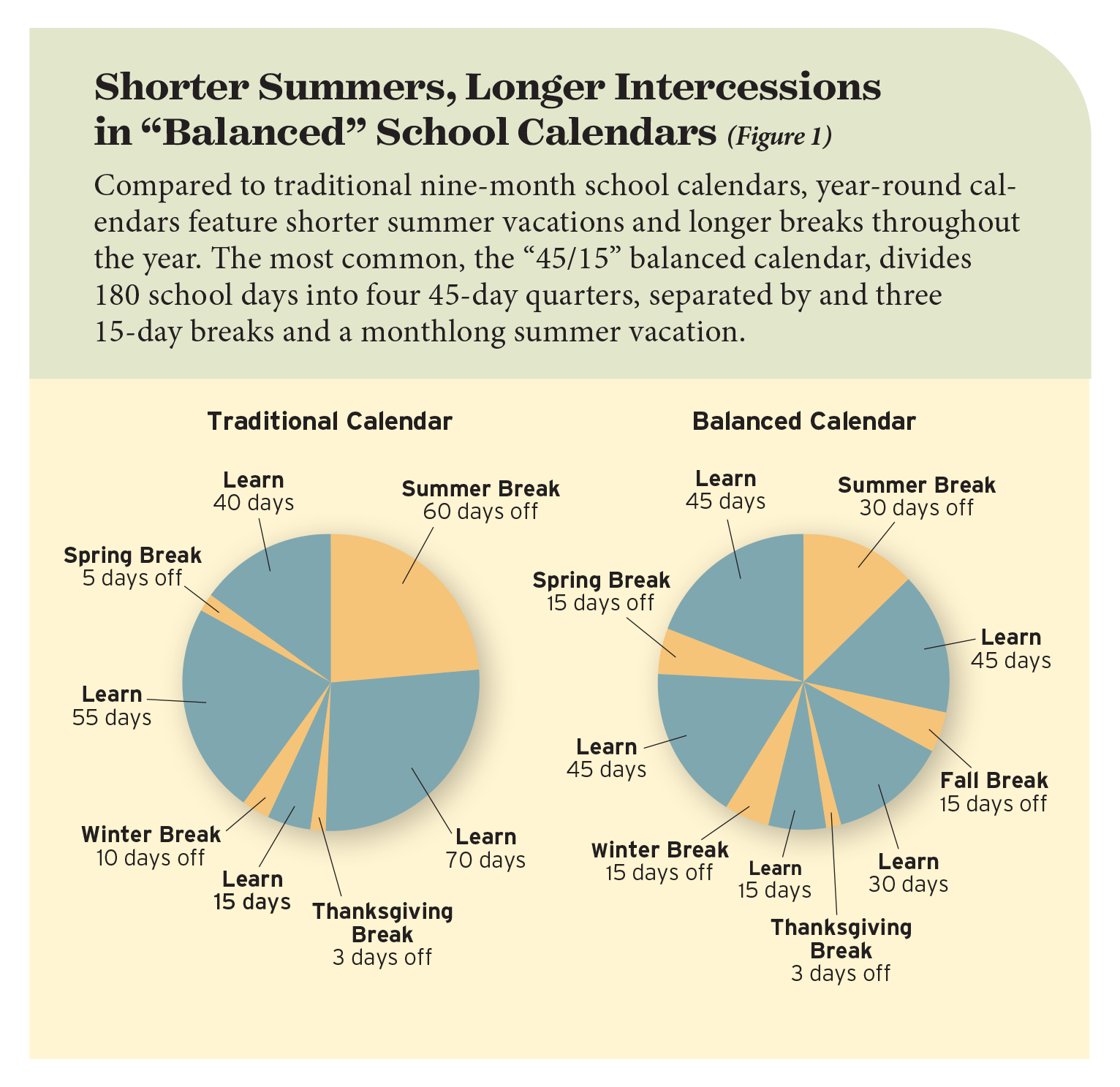
Read the definitions and the review’s explanation of why intersessions complicate an achievement claim.
This systematic review distinguishes a change in the calendar from instruction that might be offered during breaks.
In the Introduction, find the paragraph beginning “Year-round schooling alters the school calendar.” Read the calendar definitions through its explanation of why schools use single-track and multi-track calendars. Then go to Discussion → Summary of findings → Single-track YRSCs. Read the intersession discussion. Focus on what the review says researchers cannot attribute to rescheduling alone.
Two questions that sound similar demand different evidence:
- Calendar-only effect: What happens if students receive the same amount of instruction and the same other services, but their school days fall on different dates?
- Calendar-package effect: What happens if a school adopts a balanced calendar and offers its particular intersession program?
A package effect can matter to a district deciding whether to adopt that whole package. It does not, by itself, establish that moving the 180 days was the part that helped. Nor does offering an optional program mean every student received extra instruction: a study should say who was offered it, who attended, and how much they attended.
Check whether “year-round” also means “more instruction”
Suppose a balanced-calendar school has 180 required days, just like a traditional school, but offers ten additional days of tutoring during breaks. Its reported outcomes may reflect rescheduling, tutoring, or both. Counting required school days alone would miss the tutoring; calling all ten days “extra” for every student would miss differences in attendance.
A review of single-track studies made this distinction an explicit selection rule. Read its reasoning rather than treating “year-round” as a sufficiently precise description of an intervention.
Single‐track year‐round education for improving academic ...
Fitzpatrick and Burns explain why their review excludes studies that change instructional time at the same time as the calendar.
Go to Section 4.1.7, “Types of settings.” Read the selection rule from the opening sentence through the end of the subsection. Notice that the authors exclude both additional instructional days and lengthened school days: either could make an apparent calendar effect difficult to interpret.
Excluding added-time studies helps a review focus on rescheduling without a scheduled increase in instruction. It does not solve every measurement problem. A report might omit optional break programs, or students might receive different amounts of tutoring outside the required schedule. The practical test is to look beyond the calendar label for a description of instruction actually offered and received.
It also helps to distinguish a study’s conclusion from its design. “Scores rose after we adopted a balanced calendar” describes an observation. To credit the calendar, the study needs a credible account of what would likely have happened without the change.
Ask whether the comparison schools were already different
That missing “without the change” outcome is why a comparison group matters. A nearby traditional-calendar school may seem like an obvious choice, yet nearby schools can differ in prior achievement, student populations, staffing, resources, and reasons for choosing a calendar. Any of those differences could affect later scores.
This short video introduces confounding: an alternative factor associated with both the intervention and the outcome. Its example is outside education; apply the definition to a school characteristic that might influence both calendar adoption and achievement.
Randomized Control Trials and Confounding
Watch “Randomized Control Trials and Confounding” from Global Health with Greg Martin for a concise explanation of why comparison groups need to be comparable.
Watch assignment and confounding. Follow why random assignment aims to balance prior differences, then identify what plays the role of a confounder when schools choose their own calendars. The video describes groups as matching across all characteristics; in practice, random assignment balances them on average, not perfectly in every finite study.
Most calendar comparisons are not randomized. Researchers therefore try other approaches: comparing nearby schools, matching schools on measured characteristics, or tracking a school before and after a change. Each approach helps answer a different part of the problem, but each has a limit. The review below discusses those limits directly.
Single‐track year‐round education for improving academic ...
Return to Fitzpatrick and Burns to see why the choice of comparison group affects how confidently a result can be attributed to a calendar.
Near Table 1, after the page marked “9 of 28,” locate the paragraph beginning “Reviewing the studies retained for this meta-analysis.” Read the comparison discussion through its conclusion about bias. Later, after Table 2 near the page marked “11 of 28,” find the risk-of-bias discussion and read the school-selection concern. Focus on why proximity, matching, and before-and-after comparisons do not automatically make a calendar the cause of a score difference.
A simple numerical example shows what a baseline comparison can—and cannot—repair. Imagine two schools with comparable tests:
| School | Before | After |
|---|---|---|
| Adopts a balanced calendar | 70 | 75 |
| Keeps a traditional calendar | 66 | 70 |
Afterward, the balanced-calendar school scores five points higher. But it was already four points higher beforehand. Comparing the changes gives a one-point difference:
That comparison is more informative than the five-point final gap. It still is not automatically a one-point calendar effect. The schools might have been on different achievement trajectories already; one might have changed its staffing; or the balanced-calendar school might also have introduced tutoring. A before-and-after comparison helps with fixed prior differences, but it cannot rule out every difference in what happened over time.
Matching schools on prior scores and demographics similarly improves a comparison without guaranteeing that unmeasured factors—such as why a school elected to switch—are balanced. A credible study explains its comparison strategy, checks baseline levels and, where possible, earlier trends, and states what remains uncertain.
Read the result at the level the design supports
When you encounter a calendar study, separate its description into three parts:
| What to inspect | Evidence that helps | What remains ambiguous if it is missing |
|---|---|---|
| Instructional time | Required days or hours, optional programs, attendance during breaks | Whether the result reflects rescheduling or extra instruction |
| Comparison | Prior scores, school and student characteristics, earlier trends, and how comparison schools were chosen | Whether the schools would have performed differently anyway |
| Claim | A clear statement of whether the intervention is the calendar alone or a calendar-plus-program package | What a district could expect from adopting only one component |
A study that carefully holds instructional time constant but compares poorly matched schools has addressed the first ambiguity, not the second. A study with a strong comparison but a calendar change bundled with tutoring may credibly estimate a package effect, not the effect of rescheduling alone. Those are useful distinctions, not reasons to discard every imperfect study.
The most careful conclusion names both the finding and its boundary: for example, “These schools improved relative to the comparison schools after adopting a balanced calendar with intersession tutoring; the design does not isolate the calendar change.” It neither ignores the observed improvement nor assigns it to a component the study did not separately test.
Takeaways
To evaluate a calendar study, first identify what changed: dates, instructional time, or both. Then identify what serves as the comparison and whether the schools differed before the change. Excluding added instruction helps isolate rescheduling; choosing and scrutinizing comparison schools helps address pre-existing differences. Neither safeguard substitutes for the other.
The next lesson uses these distinctions to assess how strongly research summaries support claims about achievement under single-track and multi-track calendars over a full year.