Introduction
Welcome back! In our last lesson, you learned the incredibly useful phrase おすすめ は 何 ですか? (Osusume wa nan desu ka?) to ask for a recommendation. This is a fantastic way to navigate a menu when you're unsure what to order.
Today, we'll build on that by empowering you to read and understand parts of the menu yourself. Your goal is to be able to read signs and menus in Japan, and this lesson is a major step in that direction. We will focus on decoding some of the most common and essential food-related kanji. Recognizing these characters will help you identify what a restaurant serves, understand key deals, and figure out the main ingredients in a dish.
By the end of this lesson, you will be able to recognize essential kanji on a Japanese menu, including the terms for "food" (食べ物), "drinks" (飲み物), and special offers like "all-you-can-eat" (食べ放題).
The Building Blocks: Food and Drink
Let's start with the two most fundamental kanji you'll see on any menu. Almost every menu is divided into food and drinks, and recognizing these two words is your first big win.
- 食 (shoku/ta) means "to eat".
- 飲 (in/no) means "to drink".
You will rarely see these alone. Instead, they form the basis for the words you'll actually see on the menu.
| Kanji | Romaji | English Meaning | Breakdown |
|---|---|---|---|
| 食べ物 | tabemono | Food (lit. "things to eat") | 食 (eat) + 物 (thing) |
| 飲み物 | nomimono | Drinks (lit. "things to drink") | 飲 (drink) + 物 (thing) |
These two words are often used as headings for menu sections. Spotting 飲み物 is your cue to look for beer, soft drinks, and tea.
Super Deals: All-You-Can-Eat and All-You-Can-Drink
Japan has many restaurants that offer 放題 (hōdai) plans, which mean "all you can...". These are extremely popular and offer great value. Combining this with the kanji you just learned gives you two of the most important phrases for a hungry traveler.
| Kanji | Romaji | English Meaning |
|---|---|---|
| 食べ放題 | tabehōdai | All-you-can-eat |
| 飲み放題 | nomihōdai | All-you-can-drink |
Recognizing 食べ放題 on a sign outside a restaurant can tell you immediately what kind of dining experience to expect.
To see these terms in context, let's look at a resource that breaks them down.
Learn These Japanese Kanji and You'll Be Fine! (Restaurant Edition)
The article 'Learn These Japanese Kanji and You'll Be Fine! (Restaurant Edition)' provides a great overview of these terms and more. Let's read the section that covers them.
Please read the section titled '8. Kanji for Things You Do at a Restaurant'. Focus on the entries for 食べ物 (Tabemono) / 飲み物 (Nomimono), and the explanation of 食べ放題 (tabehodai) and 飲み放題 (nomihodai).
Decoding the Menu: Key Descriptors
Now that you can find the food and drink sections, let's learn some kanji that describe the dishes themselves. Recognizing these will help you understand portion sizes, dish types, and ingredients.
Portion Sizes & Refills
These are crucial for ordering the right amount of food.
| Kanji | Romaji | English Meaning |
|---|---|---|
| 大 / 大盛り | dai / ōmori | Large / Large portion |
| 中 | chū | Medium |
| 小 | shō | Small |
| 並 | nami | Normal / Regular size |
| おかわり自由 | okawari jiyū | Free refills (often for rice, soup) |
You'll often see 大, 中, and 小 next to prices to indicate sizes for drinks or side dishes. 大盛り is very common in ramen shops and for rice bowls.
Types of Dishes and Specials
These words give you context about the menu item.
| Kanji | Romaji | English Meaning |
|---|---|---|
| 定食 | teishoku | Set meal (main dish + rice + soup + side) |
| 名物 | meibutsu | Famous specialty (of the region or restaurant) |
| お薦め | osusume | Recommendation |
| 限定 | gentei | Limited (e.g., for a limited time) |
| 季節 | kisetsu | Seasonal |
Finding 定食 is great for getting a full, balanced meal. And as you know from our last lesson, お薦め points you to what the restaurant is proud of.
Main Ingredients & Cooking Style
These kanji are your best clues for what a dish actually is.
| Kanji | Romaji | English Meaning | Category |
|---|---|---|---|
| 肉 | niku | Meat | Ingredient |
| 魚 | sakana | Fish | Ingredient |
| 鶏肉 | toriniku | Chicken | Ingredient |
| 豚肉 | butaniku | Pork | Ingredient |
| 牛肉 | gyūniku | Beef | Ingredient |
| 焼き | yaki | Grilled / pan-fried | Cooking Style |
| 揚げ | age | Deep-fried | Cooking Style |
| 生 | nama | Raw (e.g., nama bīru - draft beer) |
Cooking Style |
If you see a dish called 豚肉の生姜焼き (butaniku no shōga-yaki), you can now decode it: 豚肉 (pork) + 焼き (grilled) = Grilled Pork. This pattern-recognition is exactly the practical skill you need.
To solidify this knowledge, spend some time reviewing these terms in the following resource.
Japanese Restaurant Menus: Reading the Kanji - Unseen Japan
The 'Unseen Japan' article provides an excellent breakdown of kanji for ingredients and cooking methods. Seeing them in context will help you remember them.
Please read the sections titled 'Common Food Kanji on Japanese Restaurant Menus', 'Ready, Steady, Cook', and 'Seafood and Meat Food Kanji'. Focus on the tables listing different meats and the descriptions of cooking styles like 焼く (yaku - to grill) and 生 (nama - raw).
Practical Application: Reading a Sign
Let's put your new skills to the test with a real-world example. Look at this sign for a donburi (rice bowl) restaurant.
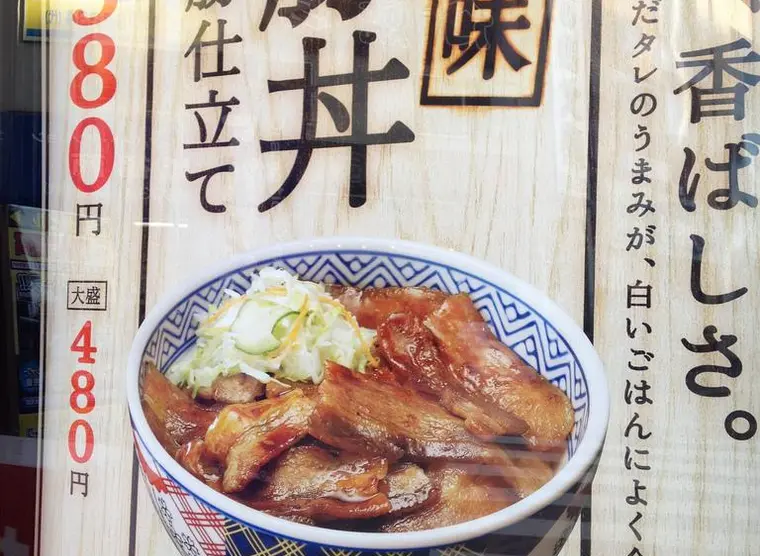
Can you spot any kanji you've learned?
You should be able to identify:
- 大盛 (ōmori): This tells you a "large portion" is available.
- 丼 (don): This is a new but very important kanji for food. It means
donburi, or rice bowl. You'll see it at the end of many dish names, like牛丼(gyūdon - beef bowl).
This sign is a perfect example of what you'll encounter. By recognizing just one or two key kanji, you can get a good idea of what's being offered.
Conclusion
Excellent work today! You've taken a significant step toward one of your primary goals: reading environmental text in Japan. While learning kanji can seem daunting, focusing on a small, high-impact set for specific situations like dining makes it much more manageable.
Key Takeaways:
- Start by looking for the main categories: 食べ物 (food) and 飲み物 (drinks).
- Keep an eye out for great deals like 食べ放題 (all-you-can-eat) and 飲み放題 (all-you-can-drink).
- Recognize portion sizes like 大 (large) and 大盛り (large portion) to order correctly.
- Identify key ingredients like 肉 (meat), 魚 (fish), 豚 (pork), and 牛 (beef) to understand a dish.
- Cooking styles like 焼き (grilled) and 揚げ (fried) provide further clues.
Preview of the next lesson:
You've now learned how to get a table, order an item, ask for a recommendation, and read parts of the menu. The final step in your dining journey is paying. In our next lesson, we will cover the essential phrase for asking for the bill: お会計をお願いします (O-kaikei o onegaishimasu).