Introduction
Welcome back! In our last lesson, you mastered the essential phrase for ordering items directly from a menu: ... を ください (... o kudasai). This gave you a reliable way to get exactly what you want, especially when using menus with pictures.
But what happens when you're faced with a menu full of unfamiliar items and you're feeling adventurous? This lesson will equip you with another "magic phrase" for your travels. We will focus on how to ask for a recommendation, a fantastic way to discover local favorites and interact positively with restaurant staff.
By the end of this lesson, you will be able to confidently ask, "What do you recommend?" using the phrase おすすめ は 何 ですか? (Osusume wa nan desu ka?), understand common responses, and accept the suggestion.
The "Magic Question": Asking for a Recommendation
When you want to ask for a recommendation, the go-to phrase is polite, simple, and universally understood in Japan.
First, you get the staff's attention with すみません (Sumimasen), which you'll remember means "Excuse me." Then, you ask the main question:
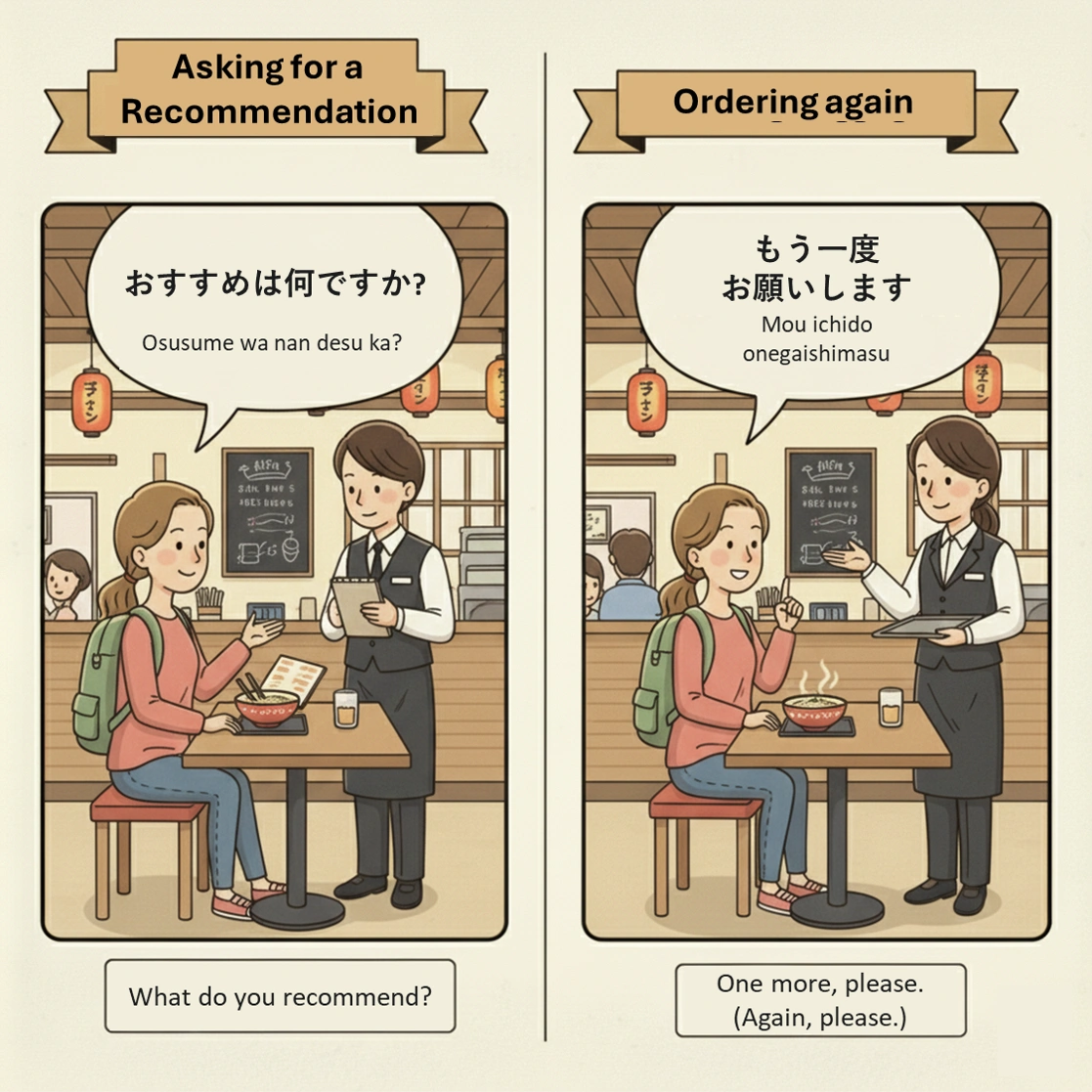
おすすめ は 何 ですか?
(Osusume wa nan desu ka?)
"What is your recommendation?"
Let's break that down:
- おすすめ (osusume): recommendation
- は (wa): the topic marker particle
- 何 (nan): what
- ですか (desu ka): "is it?" (the question form)
To learn a bit more about why this phrase is so effective, please read the first part of the following article.
The Magic Question "Osusume wa Nan Desu ka?" to Enjoy ...
The article 'The Magic Question "Osusume wa Nan Desu ka?"' from Speakable Japanese explains the power of this single phrase and provides a clear breakdown.
Please read from the beginning of the article down to the end of the section titled '1. The Magic Question'. Focus on the breakdown of the full phrase: Sumimasen, osusume wa nan desu ka?
Understanding the Answer
After you ask for a recommendation, the staff will likely point to something on the menu and give a short explanation. While you might not understand every word, you can listen for a few key positive terms that signal why the dish is recommended.
Here are some of the most common words you'll hear:
| Japanese | Romaji | English Meaning |
|---|---|---|
| 人気です | ninki desu | It's popular. |
| 新鮮です | shinsen desu | It's fresh. |
| 美味しいですよ | oishii desu yo | It's delicious! |
| 季節限定です | kisetsu gentei desu | It's a seasonal special. |
If you hear one of these, it's a very good sign! You can usually trust the staff's recommendation.
How to Respond
Once the staff member has given their recommendation, you have two simple ways to proceed.
1. Accepting the Recommendation
Even if you don't fully understand what the dish is, you can confidently accept it with this simple and polite phrase:
じゃあ、それで おねがいします。
(Jaa, sore de onegaishimasu.)
"Okay then, I'll have that, please."
Here, それ (sore) means "that," making this a versatile response. This phrase connects to the ... o onegaishimasu pattern you learned in Module 4 for making polite requests.
2. Ordering the Item Directly
If the staff member points to the item on the menu, and you feel confident, you can also use the ordering pattern from our last lesson:
じゃあ、[Item Name] を ください。
(Jaa, [Item Name] o kudasai.)
"Okay then, [Item Name], please."
Both responses are excellent. The first is a great catch-all, while the second shows you're combining different skills you've learned.
Cultural Etiquette: When and How to Ask
Asking for recommendations is very common, but being mindful of politeness and timing will make the interaction smoother. There are also polite ways to decline a suggestion if it doesn't seem right for you.
Essential Phrases to Ask for Restaurant Recommendations in Japan
To ensure a smooth and polite interaction, it's helpful to know the right time to ask and how to respond if you don't want the recommendation. The article 'Essential Phrases to Ask for Restaurant Recommendations in Japan' provides excellent cultural tips.
Please read the sections titled 'Japanese Dining Etiquette: Polite Ways to Ask for Recommendations' and 'Polite Japanese Phrases for Refusing Recommendations'. Focus on the advice about timing and the phrases for politely declining.
As you just read, a key phrase for politely declining is:
もう すこし かんがえます。
(Mō sukoshi kangaemasu.)
"I'll think about it a little more."
This is a soft and respectful way to handle the situation, leaving you free to choose something else from the menu.
Let's Practice: A Restaurant Scenario
Let's put all the pieces together in a short role-play.
-
You get the waiter's attention.
You:
すみません。 (Sumimasen.) -
You ask for the recommendation.
You:
おすすめ は 何 ですか? (Osusume wa nan desu ka?) -
The waiter recommends the ramen, saying it's popular.
Waiter:
ラーメン が 人気です。 (Rāmen ga ninki desu.) -
You accept the recommendation.
You:
じゃあ、それで おねがいします。 (Jaa, sore de onegaishimasu.)
This simple four-line exchange is a complete, successful interaction that you can use in countless restaurants across Japan.
Conclusion
Great job! You've now added another incredibly versatile tool to your Japanese toolkit for travel. Asking for a recommendation is not just practical; it's a great way to engage with local culture and try dishes you might have otherwise missed.
Key Takeaways:
- The primary phrase to ask for a recommendation is
おすすめ は 何 ですか? (Osusume wa nan desu ka?). - Always start by politely getting attention with
すみません (Sumimasen). - Listen for keywords in the response, such as
人気 (ninki)(popular) or新鮮 (shinsen)(fresh). - Accept a recommendation with
じゃあ、それで おねがいします (Jaa, sore de onegaishimasu). - Politely decline with
もう すこし かんがえます (Mō sukoshi kangaemasu).
Preview of the next lesson:
Now that you can get a table, order a specific item, and ask for a recommendation, what's next? To become even more independent, you'll need to decipher the menu itself. In our next lesson, we will start learning to read essential food-related kanji you're likely to see on menus, such as 食べ放題 (all-you-can-eat) and 飲み物 (drinks).