Introduction
Welcome back! In our previous lesson, we successfully navigated the first step of dining in Japan: getting a table by stating your party size, for example, ふたりです (futari desu) for two people.
Now that you're seated, it's time to order. This lesson will teach you one of the most powerful and practical phrases for your trip: how to order an item from a menu. You'll learn the simple, "plug-and-play" pattern ... を ください (... o kudasai), which you can use in restaurants, cafes, and even shops.
By the end of this lesson, you will be able to confidently order food and drinks, a core skill for enjoying the culinary side of your travels in Japan.
The Essential Ordering Phrase: ... をください (... o kudasai)
The most direct way to order something in Japanese is by using the pattern:
[Item] + を (o) + ください (kudasai)
Let's break this down:
- [Item]: This is the name of the food or drink you want.
- を (o): This is a grammar particle. Its job is to mark the object of the sentence—in this case, the item you are ordering. Even though it's written with the hiragana for "wo" (
を), it is always pronounced "o". - ください (kudasai): This means "please give me" or "I'll have...". It's a polite and standard way to make a request.
So, if you want to order water (おみず - o-mizu), you would say:
おみず を ください。 (O-mizu o kudasai.) - "Water, please."
To see this pattern in action with more examples, please read the following material.
Essential Japanese Phrases and Cultural Tips for Dining in Japan
The article 'Essential Japanese Phrases for Dining in Japan' from Japan Living Guide provides a clear table of common ordering phrases. It will introduce you to the core pattern and some useful vocabulary.
Please read the section titled 'Ordering Food and Drinks'. Pay close attention to the phrases using '... o kudasai', such as the examples for getting a menu, water, and beer.
The "Point-and-Order" Shortcut
As you just read, many Japanese menus have pictures. This is incredibly helpful when you can't read the dish names. In this situation, you have a universal key:
これ を ください。 (Kore o kudasai.) - "I'll have this, please."
これ (kore) means "this." You can simply point to the item on the menu and use this phrase. It's a foolproof way to order exactly what you want without needing to know the specific name of the dish.
Let's Practice with a Menu
Now, let's combine this new phrase pattern with the Katakana reading skills you developed in Module 2. This is exactly the kind of practical application that will be useful on your trip.
Here is a menu from a Japanese cafe. Many cafes and fast-food restaurants use a lot of Katakana for their menu items, which are often loanwords from English.
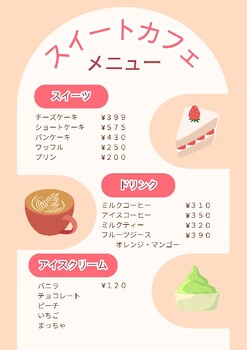
Take a moment to read the items under the ドリンク (Drinks) and スイーツ (Sweets) categories. Now, let's practice ordering. How would you say the following?
- "Iced coffee, please."
- "Cheesecake, please."
- "Chocolate ice cream, please."
Take a moment to formulate your answers before looking at the solutions below.
Solutions:
- Iced coffee is
アイスコーヒー (aisu kōhī). So, you would say:
アイスコーヒー を ください。 (Aisu kōhī o kudasai.) - Cheesecake is
チーズケーキ (chīzukēki). So, you would say:
チーズケーキ を ください。 (Chīzukēki o kudasai.) - Chocolate ice cream is
チョコレート (chokorēto). So, you would say:
チョコレート を ください。 (Chokorēto o kudasai.)
This exercise shows how you can directly apply your reading skills to a real-world task.
A Note on Quantity and Politeness
You might see or hear variations of the ordering phrase. Let's look at one common example.

In this image, the phrase is ビール 二つ ください (biiru futatsu kudasai).
ビール (biiru)is the Katakana for "beer."二つ (futatsu)is a counter word that means "two things."
While you can add numbers like this, it's not necessary, especially when you're starting out. Simply saying ビール を ください (Biiru o kudasai) and holding up two fingers is perfectly understood. Sticking to the basic pattern is the most efficient way to communicate your needs.
You may also remember the phrase ... を おねがいします (... o onegaishimasu) from Module 4 for making polite requests. You can also use this for ordering. Both kudasai and onegaishimasu are polite and appropriate. kudasai is very common and direct for ordering, while onegaishimasu can feel slightly more formal. You can confidently use kudasai in any restaurant.
Conclusion
Excellent work! You now have the essential phrase for ordering anything from a menu in Japan. This is a huge step toward being self-sufficient during your trip.
Key Takeaways:
- The fundamental pattern for ordering is
[Item] を ください ([Item] o kudasai). - The particle
をis pronounced "o". - For menus with pictures, the phrase
これ を ください (Kore o kudasai)("This, please") is your most valuable tool. - You can use your Katakana reading skills to order items directly from many menus.
Preview of the next lesson:
You know how to order what you want, but what if you're not sure what's good? In the next lesson, we'll learn another key dining phrase: おすすめ は 何 ですか? (Osusume wa nan desu ka?), which means "What do you recommend?"