Introduction
Welcome back! In our last lesson, you mastered the pattern [Place] は どこ です か? ([Place] wa doko desu ka?) to ask where things are. You learned how to combine the topic marker は (wa) with the question word どこ (doko) to navigate your surroundings.
Today, we'll learn an equally powerful phrase that uses a very similar structure: [Item] は あります か? ([Item] wa arimasu ka?). This is how you ask "Do you have...?" or "Is there...?". This single pattern is your key to countless situations in Japan, from asking for an English menu in a restaurant to checking if a store has an item in your size. By the end of this lesson, you'll be able to confidently inquire about the availability of almost anything.
The Core Pattern: [Item] は あります か?
Just like the phrase for asking "where," this pattern is a "plug-and-play" structure. You simply put the item you're asking about at the beginning.
Let's break it down:
- [Item]: The thing you want to ask about (e.g., a map, an English menu).
- は (wa): The topic particle, just like in our previous lessons. It tells the listener what you're talking about.
- あります (arimasu): This is a verb that means "to exist" or "to have" for inanimate objects.
- か (ka): The question particle that turns the statement into a question.
So, the structure is: [The thing you want] wa arimasu ka?
This simple visual breaks it down perfectly.
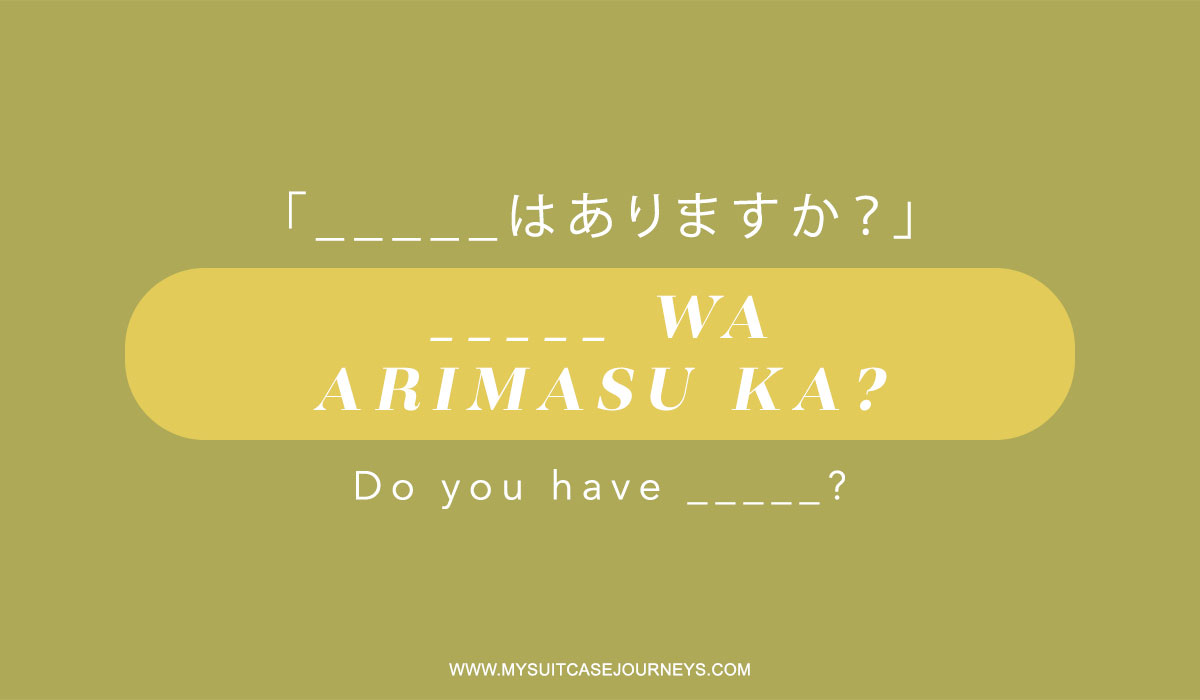
To learn more about how this phrase works and what to expect as an answer, please read the following article.
Shopping in Japan: Essential Words & Phrases
The blog Nihongo Master provides a fantastic breakdown of this essential phrase. It explains the structure and the simple 'yes' or 'no' answers you can expect.
Please read the section titled '~ wa arimasu ka? (〜はありますか?)'. Focus on understanding the structure of the phrase and the two possible replies: 'hai' (yes) and 'iie' (no).
As the article explains, this is a yes/no question. The most common answers you will hear are:
- はい、あります (Hai, arimasu) - "Yes, we have it."
- いいえ、ありません (Iie, arimasen) - "No, we don't have it."
Building Your "Item" Vocabulary
Now that you have the pattern, you need some words to plug into the [Item] slot. The same article provides useful vocabulary lists for shopping, which are perfect for this pattern.
Here is a curated list of essential words, including items, colors, and sizes. Notice that many of these are written in Katakana, which you've already studied. This is great practice for reading menus and signs.
Common Items:
| English | Japanese (Katakana/Hiragana) | Romaji |
|---|---|---|
| Map | ちず (地図) | chizu |
| English Menu | えいごのメニュー | eigo no menyū |
| Shirt | シャツ | shatsu |
| Shoes | くつ (靴) | kutsu |
| Jacket | ジャケット | jaketto |
| Pamphlet | パンフレット | panfuretto |
Common Colors & Sizes:
| English | Japanese (Katakana/Hiragana) | Romaji |
|---|---|---|
| Red | あか (赤) | aka |
| Blue | あお (青) | ao |
| Black | くろ (黒) | kuro |
| S Size | Sサイズ (エスサイズ) | esu saizu |
| L Size | Lサイズ (エルサイズ) | eru saizu |
Note: The words in parentheses are the kanji characters. We will cover some essential kanji in later lessons.
Putting It All Together in Realistic Scenarios
This one phrase is incredibly versatile. You can use it at your hotel, in restaurants, at tourist sites, and while shopping. Let's see some real-world examples.
Essential Japanese Phrases for Travel
The travel site Live Japan has an article packed with useful phrases. It demonstrates how '[Item] wa arimasu ka?' is used in many different travel situations.
Skim through the article and find the following four phrases that use our pattern. Notice the context for each one: In the 'Checking In' section, find phrase #18 about asking for a map. In the 'Ordering Food' section, find the phrase for asking for an English menu (under #22). In the 'Asking for Information' section, find phrase #42 about brochures. In the 'Shopping' section, look at phrase #49 which explicitly explains the pattern.
As you saw in the article, this single pattern works everywhere. Let's practice forming some complete questions. Remember to start with すみません (sumimasen) to get someone's attention politely.
-
At a restaurant: You want to know if they have an English menu.
すみません。えいごのメニューはありますか?
(Sumimasen. Eigo no menyū wa arimasu ka?) -
At your hotel front desk: You need a map of the area.
すみません。ちずはありますか?
(Sumimasen. Chizu wa arimasu ka?) -
In a clothing store: You see a shirt you like and want to know if they have it in black.
すみません。くろはありますか?
(Sumimasen. Kuro wa arimasu ka?)
In this context, pointing at the shirt and asking "kuro wa arimasu ka?" is enough to mean "Do you have this in black?".
Conclusion
Excellent work today! You have now added another essential "plug-and-play" phrase to your travel toolkit. By combining [Item] は あります か? ([Item] wa arimasu ka?) with a handful of key nouns, you can now inquire about almost any item you might need during your trip to Japan.
Key Takeaways:
- The pattern to ask "Do you have...?" or "Is there...?" is [Item] は あります か? ([Item] wa arimasu ka?).
- あります (arimasu) is the verb for existence or possession of inanimate objects.
- This pattern is versatile and can be used in hotels, restaurants, shops, and tourist information centers.
- You can expect a simple はい (hai) or いいえ (iie) in response.
Preview of the next lesson:
Now that you can ask if an item is available, the next logical step is to ask for it. In our next lesson, you will learn how to make a simple, polite request using the pattern [Item] を ください ([Item] o kudasai). This will allow you to complete the interaction and get what you need.