Introduction
Welcome back! In our last lesson, you learned how to ask if an item is available using the phrase [Item] は あります か? ([Item] wa arimasu ka?). This is the perfect way to check if a store has a certain size or if a restaurant has an English menu.
Today, we'll learn the natural follow-up: how to ask for the item once you know it's there. You'll master the simple and powerful pattern [Item] を ください ([Item] o kudasai), which means "I would like [Item], please." This is one of the most fundamental phrases for any traveler, and you'll use it constantly when ordering food, buying train tickets, or shopping for souvenirs.
By the end of this lesson, you'll be able to confidently ask for exactly what you want in a variety of situations.
The Core Pattern: [Item] を ください
Making a request for a specific item in Japanese is straightforward. You just need this one "plug-and-play" pattern.
[Item] を ください ([Item] o kudasai)
Let's break it down:
- [Item]: The noun for the thing you want (e.g., water, coffee).
- を (o): This is a particle that marks the direct object of a verb. In simple terms, it points to the item that you are requesting. It's pronounced like the English letter "o".
- ください (kudasai): This is the key verb that means "please give me" or "I would like".
The image below, set in a restaurant context, perfectly illustrates this "fill-in-the-blank" structure.

To get a better sense of how and when to use this phrase, let's look at a short explanation.
20 Essential Japanese Phrases for Travelers to Japan
The travel site Boutique Japan provides a concise explanation of this essential phrase. It highlights its versatility for use in both restaurants and stores.
Please read section 4, titled ' __ o Kudasai (__をください) – I would like __, please'. Focus on how this single phrase can be applied in many different travel situations.
The Most Useful Word: これ (kore) - "This"
As a traveler, you won't know the Japanese word for everything you see. This is where the word これ (kore), meaning "this," becomes your best friend. By pointing at an item on a menu, a product on a shelf, or a food item in a display case, you can simply say:
これ を ください (Kore o kudasai) - "This one, please."
This single phrase is incredibly effective and universally understood in shops and restaurants. The following resource explains this practical trick and provides some other useful vocabulary.
Essential Japanese Travel Phrases for Your Japan Trip
The Migaku blog offers practical advice tailored for travelers. It emphasizes the power of combining 'kore' with 'kudasai' and gives examples of other common items you might order.
First, read point #1 in the section 'Japanese phrases for food and drinks'. Pay close attention to the tip about pointing at menu items and using 'Kore o kudasai'. \nThen, skim point #1 in the 'Useful phrases for shopping' section, which reinforces how to use 'kore' (this), 'sore' (that), and 'are' (that over there) with 'kudasai'.
Practice with Common Vocabulary
Now that you have the pattern, let's practice with a few essential words. Many of these are loanwords written in Katakana, which you've already studied.
The image below gives a clear example with みず (mizu), or water.
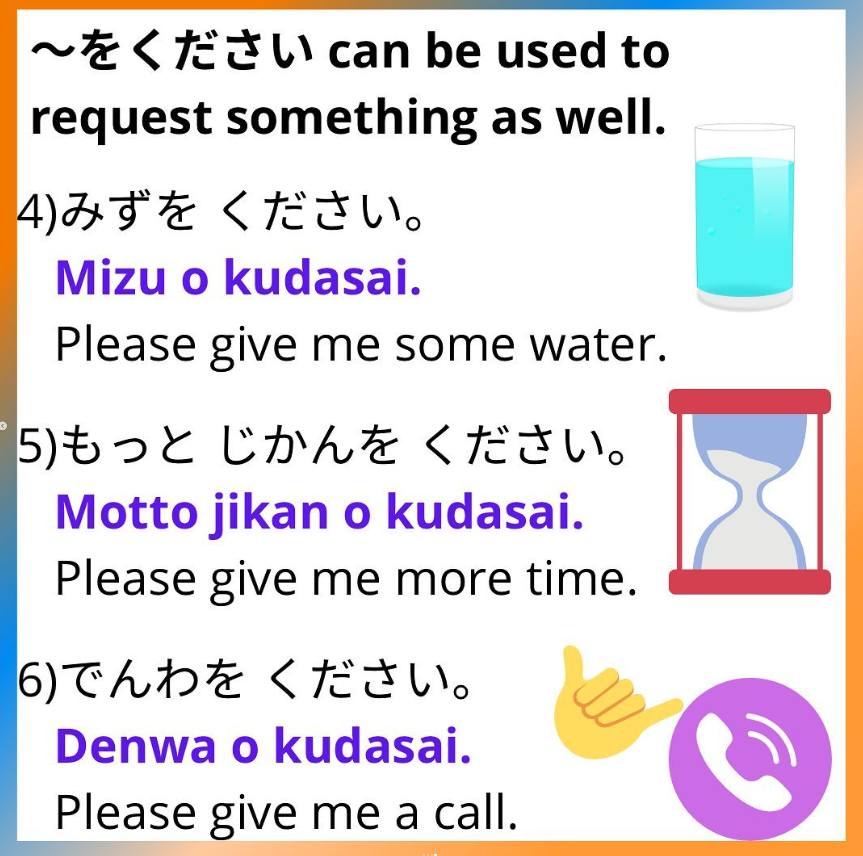
Here is a small vocabulary list you can use to practice the ...o kudasai pattern.
| English | Japanese (Hiragana/Katakana) | Romaji | Example Phrase |
|---|---|---|---|
| This | これ | kore | Kore o kudasai. |
| Water | みず (水) | mizu | Mizu o kudasai. |
| Beer | ビール | bīru | Bīru o kudasai. |
| Coffee | コーヒー | kōhī | Kōhī o kudasai. |
| Receipt | レシート | reshīto | Reshīto o kudasai. |
Putting It All Together: A Realistic Scenario
Let's walk through a typical interaction at a café. Remember from our first module how to use すみません (sumimasen) to politely get someone's attention.
-
Get the staff's attention:
You: すみません。 (Sumimasen.)
"Excuse me." -
Point at the item on the menu and make your request:
You: これ を ください。 (Kore o kudasai.)
"This one, please."
It's that simple! You have successfully ordered. This combination of sumimasen and kore o kudasai will cover a vast number of your ordering and shopping needs.
Conclusion
Great job today! You've learned one of the most practical and frequently used phrases in the Japanese language. By mastering [Item] を ください ([Item] o kudasai), you've unlocked the ability to order food, buy items, and handle simple transactions with confidence.
Key Takeaways:
- The pattern to request a specific item is [Item] を ください ([Item] o kudasai).
- The particle を (o) is used to mark the item you are asking for.
- When you don't know the name of an item, you can point and use これ を ください (Kore o kudasai) for "This one, please."
- This phrase is essential for daily interactions in restaurants, convenience stores, and shops.
Preview of the next lesson:
While kudasai is perfect for requesting specific, tangible items, there's another polite request phrase, ...を おねがいします (...o onegaishimasu), which is often used for services or more general requests. In the next lesson, we will explore onegaishimasu and learn when to use it instead of kudasai.