Introduction
Welcome back! In our last lesson, you learned the fundamental sentence pattern A は B です (A wa B desu) to make polite statements like Kore wa menyū desu (This is a menu). This structure is the foundation for much of what you'll say in Japan.
Today, we'll build directly on that knowledge to ask one of the most important questions for any traveler: "Where is...?" You will learn how to transform the statement pattern into a question by using the question word for "where" and a question-marking particle. By the end of this lesson, you'll be able to ask for directions to the station, a hotel, or the restroom with confidence.
From Statement to Question
Remember the pattern A wa B desu? To ask a "where" question, we just need to make two simple changes:
- Replace the description/location (B) with the question word for "where," which is どこ (doko).
- Add the question-marking particle か (ka) to the very end of the sentence.
Let's see how that works:
- Statement: あれ は えき です。 (Are wa eki desu.) - That over there is the station.
- Question: えき は どこ です か? (Eki wa doko desu ka?) - Where is the station?
Notice how the topic, えき (eki), now comes first. The structure is clean and predictable: [The Place You're Asking About] wa doko desu ka?
This simple graphic clearly lays out the pattern for you.

The Core Pattern: [Place] は どこ です か?
This "plug-and-play" phrase is your key to navigating Japan. Before you use it, remember the politeness phrase you learned in the first module: すみません (sumimasen), which means "excuse me" or "sorry." It's the standard way to get someone's attention before asking a question.
Let's look at a resource that puts this all together in a travel context.
Essential Japanese Travel Phrases for Your Japan Trip
The travel blog Migaku has a great list of essential phrases. We'll focus on the two that are most relevant for asking for directions.
Under the heading 'Japanese words and phrases for getting around & asking for directions', please read points #2 and #7. Pay attention to the structure of (Place name) wa doko desu ka? and the practical example provided.
As the article shows, the pattern is straightforward:
すみません。 [Place] は どこ です か?
Sumimasen. [Place] wa doko desu ka?
(Excuse me. Where is [Place]?)
A very useful related phrase mentioned in the article is ここ は どこ ですか? (Koko wa doko desu ka?), which means "Where am I?" or "Where is this place?". Koko means "here". This is incredibly helpful if you get disoriented.
Building Your "Place" Vocabulary
To make this pattern useful, you need some words to plug into the [Place] slot. Let's gather some essential vocabulary for common places you'll look for during your trip.
Giving and Asking for Directions: 'Right' in Japanese & More
The following article from JapanesePod101 contains excellent vocabulary lists for navigating cities and buildings. These are the words you'll plug into our question pattern.
Please review the vocabulary tables under the headings 'In the City: Basic Vocabulary' and 'In a Structure/Building: Basic Vocabulary'. You don't need to memorize them all, but focus on recognizing key words like eki, hoteru, and toire.
Here is a summary of the most critical words from that resource for you to focus on. These are high-frequency words you'll definitely need.
| English | Japanese | Reading |
|---|---|---|
| station | えき (駅) | eki |
| hotel | ホテル | hoteru |
| restroom | トイレ | toire |
| airport | くうこう (空港) | kūkō |
| bank | ぎんこう (銀行) | ginkō |
| entrance | いりぐち (入口) | iriguchi |
| exit | でぐち (出口) | deguchi |
Note: The words in parentheses are the kanji characters for that word. You'll learn to recognize some of these in later lessons, but for now, focus on the spoken phrase and the hiragana/katakana.
Putting It All Together: Practice
Now you have the pattern and the vocabulary. Let's combine them into complete, polite questions.
-
To ask for the station:
すみません。えき は どこ です か?
(Sumimasen. Eki wa doko desu ka?) -
To ask for the restroom:
すみません。トイレ は どこ です か?
(Sumimasen. Toire wa doko desu ka?) -
To ask for your hotel (e.g., the 'Sakura Hotel'):
すみません。さくらホテル は どこ です か?
(Sumimasen. Sakura Hoteru wa doko desu ka?)
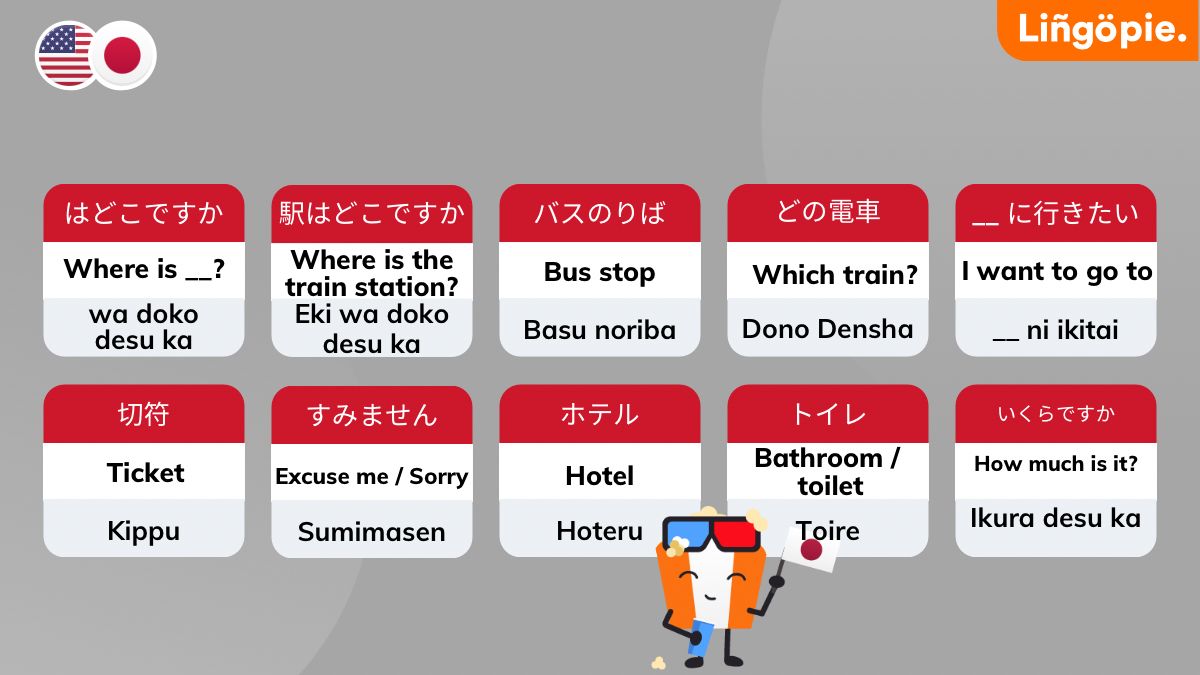
This image provides a great visual recap of these practical phrases.
Conclusion
Fantastic work! You have now learned one of the most powerful and practical phrases for your trip. By combining a simple, repeatable pattern with a handful of key nouns, you can now ask for directions to almost any major location you might need.
Key Takeaways:
- The pattern to ask "Where is...?" is [Place] は どこ です か? ([Place] wa doko desu ka?).
- どこ (doko) is the Japanese word for "where".
- か (ka) is the particle placed at the end of a sentence to mark it as a question.
- Always begin with すみません (sumimasen) to politely get someone's attention.
Preview of the next lesson:
Now that you can ask where something is, what about asking if something is available? In the next lesson, we'll learn another crucial question pattern: [Item] は あります か? ([Item] wa arimasu ka?), which you'll use constantly for shopping and ordering.