Introduction
Welcome to the first lesson of our "Navigation and Transportation" module! In the previous module, you mastered the language needed for shopping, culminating in handling the final questions at checkout. You're now ready to step outside the store and navigate the streets of Japan.
Today, we'll learn one of the most crucial phrases for any traveler: asking "Where is...?". This will be your key to finding train stations, restrooms, hotels, and more. The great news is that this lesson builds on a sentence structure you've already seen, the A wa B desu pattern, making it a powerful and easy-to-learn tool. Our goal is to confidently apply the [Place] wa doko desu ka? pattern to ask for directions.
Remember from our earlier lessons, a great way to start any interaction with a stranger is by saying Sumimasen (Excuse me) to politely get their attention. We'll be using that today.
1. The Core Pattern: "Where is...?"
The basic structure for asking for a location is simple and follows a "plug-and-play" format, which should suit your learning style well.
The key components are:
[Place]: The location you are looking for (e.g.,eki- station).wa(は): The topic marker particle you've seen before.doko(どこ): The question word for "where".desu ka(ですか): The polite ending that turns the statement into a question.
Putting it all together, you get: [Place] wa doko desu ka?
To see this in action and understand its importance, let's turn to a short reading.
Where Is in Japanese: Master the Essential Phrase for Travelers
The article 'Where Is in Japanese' from Kizuna Training clearly breaks down this essential phrase. It explains the components and provides immediate, practical examples.
Please read the sections titled 'The Basics of Saying 'Where Is' in Japanese' and 'Polite vs. Casual Ways to Say 'Where Is''. Focus on the structure of the question and the examples provided, like 'Eki wa doko desu ka?'. Note the tip about 'desu ka' adding politeness, which is essential for you as a traveler.
As the resource highlights, this pattern is your go-to for politely asking for directions. Let's look at the key examples:
駅はどこですか?(Eki wa doko desu ka?) - Where is the train station?トイレはどこですか?(Toire wa doko desu ka?) - Where is the restroom?ホテルはどこですか?(Hoteru wa doko desu ka?) - Where is the hotel?
2. Expanding Your Vocabulary: Finding Different Places
The ... wa doko desu ka? pattern is incredibly versatile. You just need to swap out the [Place] with the location you're looking for. Since you are focused on practical reading skills for signs, learning the kanji for these places will be very helpful.
Below is a list of common places you might need to find.
| English | Kanji / Kana | Rōmaji |
|---|---|---|
| Train Station | 駅 | eki |
| Bus Stop | バス停 | basu tei |
| Restroom / Toilet | トイレ | toire |
| Convenience Store | コンビニ | konbini |
| Hotel | ホテル | hoteru |
| Hospital | 病院 | byōin |
| Bank | 銀行 | ginkō |
| Post Office | 郵便局 | yūbinkyoku |
| Police Box | 交番 | kōban |
| Entrance | 入口 | iriguchi |
| Exit | 出口 | deguchi |
(This vocabulary is adapted from the "Navigating Japan by Speaking the Language" resource and other materials.)
Practice:
Try forming a few questions yourself. For example, how would you ask "Where is the convenience store?"
(Answer: Konbini wa doko desu ka?)
The infographic below shows another practical example for transportation.

3. A Useful Upgrade: "Where is the closest...?"
Sometimes, you don't just want to find a station, you want to find the nearest one. For this, you can add one simple word: moyori (最寄り), which means "closest" or "nearest".
The pattern becomes: Moyori no [Place] wa doko desu ka?
Let's consult a resource that lays this out in a simple template.
Navigating Japan by Speaking the Language
The article 'Navigating Japan by Speaking the Language' includes a handy table of phrase templates. We'll use it to see how to ask for the 'closest' location.
In the article, find the table under the heading 'Easy Templates for Key Phrases and Directions in Japanese'. Locate the row for 'Where is (the closest) [location]?' to see how 'Moyori no...' is used.
This simple addition makes your question much more specific and useful. For example:
最寄りの駅はどこですか?(Moyori no eki wa doko desu ka?) - Where is the closest train station?最寄りのコンビニはどこですか?(Moyori no konbini wa doko desu ka?) - Where is the closest convenience store?
This is a fantastic phrase to have ready when you're in an unfamiliar area.
4. Putting It All Together
Now you have all the pieces to ask for directions confidently and politely. A complete interaction would look like this:
- Get their attention:
すみません。(Sumimasen.) - Excuse me. - Ask your question:
駅はどこですか?(Eki wa doko desu ka?) - Where is the station?
Conclusion
Excellent work! You've now added a fundamental navigation tool to your Japanese phrasebook. With this single pattern, you can find dozens of important locations throughout Japan.
Key Takeaways:
- To ask "Where is...?", use the pattern:
[Place] wa doko desu ka? - To be more specific, ask for the nearest location with:
Moyori no [Place] wa doko desu ka? - Always start with a polite
Sumimasento get someone's attention before asking. - You now have a list of essential location vocabulary, including their kanji, which will help you read signs.
Preview of the next lesson:
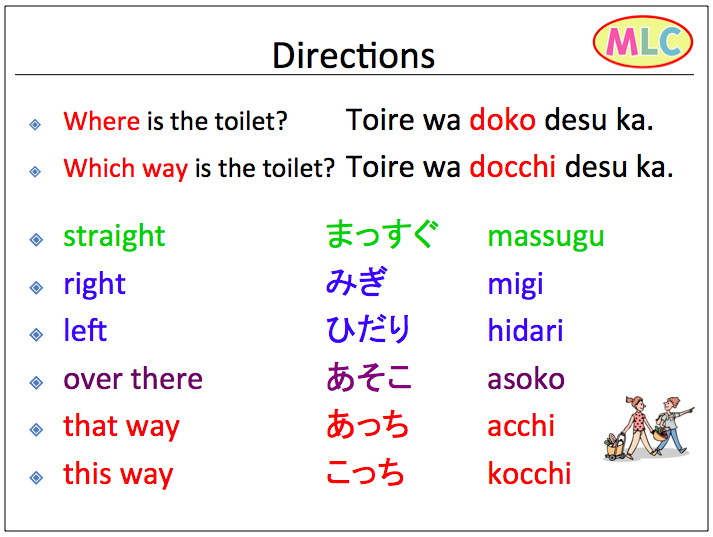
Asking the question is the first step. In our next lesson, we will focus on understanding the answer. We'll learn the essential words for basic directions: migi (right), hidari (left), and massugu (straight), so you can follow the help you receive.